

60 Second Texts That Book 73%: Estimate Scheduling for Contractors
The fastest way contractors win estimates is an instant, text-first response that qualifies leads and offers real-time booking, ideally within 60 seconds. This approach, sometimes called contractor estimate scheduling, pairs automated qualification with calendar access so prospects book without waiting on a callback. Some platforms build this exact workflow, and the setup is practical enough for a small crew to launch in a week with measurable results soon after.
TL;DR:
Responding to leads within 60 seconds via automated text significantly increases booking rates, averaging around 73 percent.
Using a multi-step workflow with instant acknowledgment, qualification questions, and real-time booking reduces no-shows and streamlines scheduling.
Strict compliance requires capturing explicit consent and providing clear opt-out instructions to avoid legal risks with automated outreach.
Piloting the system on high-volume lead sources for at least 30 days provides trustworthy data before full implementation.
Automation tools like Astreaux simplify setup by offering pre-built templates, calendar integration, and AI handling, saving time and increasing efficiency.
Astreauxcalendly.comBook More Contractor EstimatesAstreaux helps contractors respond instantly, qualify new leads, and streamline estimate scheduling through conversational AI.Book a call
Why speed and channel choice decide whether a lead becomes a booked estimate
Homeowners rarely wait for one contractor to call back. They submit requests to several companies at once and book with whoever answers first, which means the value of a lead decays by the minute.
Contractors who respond within 5 minutes are about 21 times more likely to qualify a lead than those who wait 30 minutes, yet many contractors average 4 to 8 hours before reaching out. That gap is where estimates get lost to faster competitors.
Text responses under 60 seconds produce roughly a 73% appointment booking rate among leads who respond, a sharp lift over slower channels. Channel matters as much as speed:
A text-first sequence, followed by a call and an email confirmation, produces the highest conversion rates recorded in contractor lead-handling studies.
Texting also protects against no-shows, since a confirmed, reminded appointment is far less likely to fall through than a verbal callback promise.
Homeowners increasingly expect this kind of instant, self-service booking rather than a phone tag negotiation.
The pattern holds across trades: whoever engages first, in the channel the customer already prefers, tends to win the job before a slower competitor even dials the number.
What an automated estimate-scheduling workflow actually looks like
A working system follows a predictable sequence, and once it’s mapped out, configuring it in software becomes straightforward.
Acknowledge instantly. The moment a lead submits a form or misses a call, an automated text confirms receipt within seconds, something like “Thanks for reaching out about your roof repair. What’s the best day this week for a free estimate?”
Qualify with one to three questions. Keep it tight: property type, urgency, and rough project scope are usually enough to route the lead correctly.
Offer two or three real-time slots in a single message rather than asking the customer to check availability elsewhere.
Book directly to the calendar once the customer replies with a preferred time, removing the back-and-forth entirely.
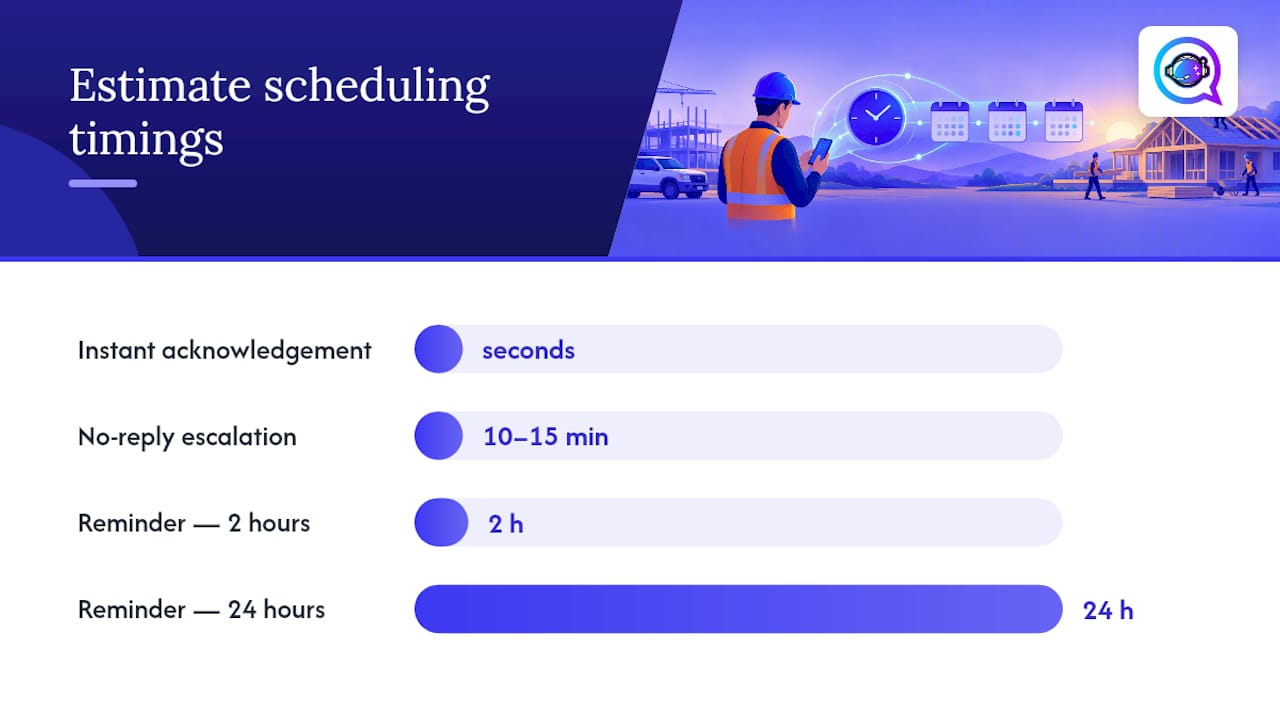
Escalate if there’s no reply. If a lead doesn’t respond within a set window, typically 10 to 15 minutes, trigger a phone call as backup.
Confirm and remind. Send a confirmation immediately after booking, then a reminder 24 hours and 2 hours before the appointment.
Pro Tip: Keep the first text under 160 characters. Short messages get read and answered faster than long ones packed with company details.
This sequence works whether a solo contractor runs it manually from a phone or an AI agent handles it around the clock, but the logic stays the same either way.
Compliance essentials for texting and calling leads
Automating outreach means following federal rules on consent, and the requirements tightened significantly with the FCC’s recent action.
The FCC’s Second Report and Order adopted one-to-one prior express written consent for robocalls and robotexts, meaning a lead’s consent applies only to the specific business that obtained it, not to every marketer a lead-generation site might sell that contact to. This makes leads purchased from comparison sites or aggregators riskier for automated follow-up unless that direct, single-seller consent was captured at the point of submission. The order also extended Do Not Call protections to text messages and introduced mandatory call and text blocking after notice, along with new recordkeeping obligations.
For contractors, the practical steps are straightforward:
Capture explicit, topic-specific consent language on every lead form, not a buried generic checkbox.
Keep dated records of consent for each contact, since blocking and recordkeeping rules make this a liability issue.
Include a clear opt-out instruction in every automated text, and honor it immediately.
Avoid running outreach on purchased or third-party leads unless direct consent for your business is documented.
Step-by-step implementation checklist for contractors
Getting from zero to automated estimate scheduling doesn’t require a big software budget, just the right pieces connected in order.
Build the minimum viable stack. Connect your web form or lead capture tool to an SMS webhook or AI agent, link that to your calendar (Google or Outlook), and route confirmed bookings into your CRM.
Set up 24/7 handling. Configure the AI agent to manage after-hours and weekend leads automatically, while routing high-value or urgent jobs to a human during business hours.
Write your templates. You’ll need two acknowledgment messages, two qualifying questions, a booking confirmation, a reminder, and a no-show follow-up. Astreaux’s contractor template library covers each of these out of the box.
Test before you launch. Run a mystery-shop check: submit a lead yourself at different times of day and confirm the response time, the qualifying flow, and the booking link all work as expected.
Pilot on one lead source first. Turn on instant texting and calendar booking for your website form alone, run it for 30 days, and compare booked-estimate rates against the prior 30 days before rolling it out everywhere.
Pro Tip: Run your pilot on the lead source with the highest volume, not the newest one. A bigger sample gives you a clearer read on whether the booking rate actually moved.
Integration tools like Zapier or a direct API connection make calendar syncing simple even for contractors without in-house developers. The goal of the pilot isn’t perfection, it’s a clean before-and-after comparison you can trust before committing to a full rollout.
How to measure success: KPIs and realistic targets
Once the workflow is live, a handful of numbers tell you whether it’s actually working.
KPI | What it tracks | Target range |
|---|---|---|
First response time | Time from lead submission to first contact | Under 60 seconds |
Text-to-booking rate | Percentage of texted leads who book a slot | 73% |
No-show rate | Booked estimates that don’t show up | Reduced with automated reminders |
Lead-to-job conversion | Booked estimates that become signed jobs | Tracked monthly against pipeline goals |
Contractors who hit a first-text response under 60 seconds see booking rates near 73%, making response time the single number worth watching most closely. A simple dashboard pulling these figures weekly, paired with an occasional A/B test on message wording or slot count, is usually enough to keep improving booking rates over time.
How Astreaux maps to this checklist
Building this workflow from scratch takes time most contracting crews don’t have between jobsite visits and paperwork. Astreaux is built specifically to run the sequence above without requiring you to stitch together separate tools.
The platform’s conversational AI learns your business’s voice, so replies sound like you rather than a generic bot, and it plugs into calendars, CRMs, and over 7,000 apps for the scheduling and record-keeping pieces of the checklist. Specific to this workflow:
Astreaux includes a library of contractor-specific text templates for acknowledgments, qualifying questions, and confirmations, so you’re not writing scripts from scratch.
An off-hours AI agent can handle nights and weekends automatically, then hand qualified leads to your team during business hours.
Calendar sync can let prospects book directly from a text, closing the exact gap between interest and a confirmed slot.
Automated reminders and streamlined scheduling have been shown to reduce no-shows by up to 50% in similar service businesses.
If you’re ready to see this running on your own lead flow, Astreaux’s contractor page walks through a demo, and a single-source pilot is the fastest way to see the numbers move.
Where automation should stop and a person should step in
Speed wins estimates, but it shouldn’t replace judgment on the calls that matter most. A burst pipe or an electrical hazard needs a live person on the line immediately, not a chatbot working through a qualifying script, and older customers often still prefer that option too. Train whoever monitors your AI handoffs to watch for those moments and step in without hesitation. Check your response-time and booking numbers weekly during rollout, not monthly. Small corrections early save a lot of lost leads later.
— Jamaal
Primary sources behind this guide
These are the sources cited above, kept here for reference.
FCC Second Report and Order on one-to-one consent and text blocking rules.
Contractor Lead Response Time Study on qualification rates by response speed.
The Lead Response Time Study You Need to See on multi-channel conversion performance.
Service area signage workflow guide for moving from estimate approval to job scheduling.
Sources
FAQ
How fast should a contractor respond to a new lead?
Aim for under 60 seconds with an automated text acknowledgment, since responses in that window drive booking rates near 73%. Anything beyond 5 minutes sharply reduces your odds of qualifying the lead at all.
Is it legal to text leads automatically without calling first?
Yes, as long as you have documented, one-to-one consent from that specific contact for your business, per the FCC’s current rules. Leads bought from aggregators or comparison sites carry more legal risk unless that direct consent was captured at submission.
What’s the difference between texting and calling leads first?
A text-first approach, followed by a call if there’s no reply and an email confirmation, produces the highest conversion rates in contractor lead studies. Texts also get read faster and let customers book without needing to talk on the phone right away.
How much can automated reminders reduce no-shows?
Automated confirmations and reminders have reduced no-show rates by up to 50% in comparable service businesses. The reduction comes from confirming the appointment immediately and reminding the customer again closer to the scheduled time.
Does Astreaux work for contractors specifically?
Yes, Astreaux’s contractor solution includes text templates, calendar booking, and off-hours AI handling built around the estimate-scheduling workflow described here. It integrates with over 7,000 apps, including common CRMs and calendar tools contractors already use.