
No Reply Leads: A Follow-Up Playbook That Gets Replies
When a lead goes quiet, send a short, value-adding follow-up within 2 to 4 business days, and use a fresh angle instead of repeating your first message, and plan for a polite breakup email by touch five or six. Reps who send at least one follow-up lift their reply rate from 16% to 27%, and a second follow-up can push reply odds toward 25% on its own. Many deals only close after multiple touches, so quitting after one silent email can leave revenue opportunities unpursued.
Here’s your copy-paste action plan for right now:
Day 2 to 4: Send a short follow-up with one new value point and a single, low-friction ask.
Day 7 to 10: Reframe with a fresh angle (case study, mini-audit, or trigger event).
Day 14 to 18: Send the breakup email, and set a 90-day tickler regardless of outcome.
Quick stat check: Wait too long and interest cools. Wait too short and you look desperate. Two to four business days is the sweet spot for most cold outreach.
Key Takeaways
A signal-driven cadence of five to six touches, paired with fresh value on every message and a polite breakup email, converts far more no-reply leads than repeated generic check-ins.
Point | Details |
|---|---|
Follow up at least once | Sending one follow-up lifts reply rates from 16% to 27%, and a second follow-up pushes odds higher still. |
Time the first touch right | Wait two to four business days before your first follow-up to avoid looking desperate or getting ignored. |
Vary the message, not just the channel | Add a new value point, asset, or trigger to every touch instead of resending the same email. |
Use the breakup email | A polite, low-pressure breakup message often prompts a reply from overloaded prospects around touch five or six. |
Automate the timing with Astreaux | Astreaux sends instant, voice-matched replies and manages multi-channel follow-up sequences so leads don’t go cold. |
How Often Should You Follow Up With No Reply Leads?
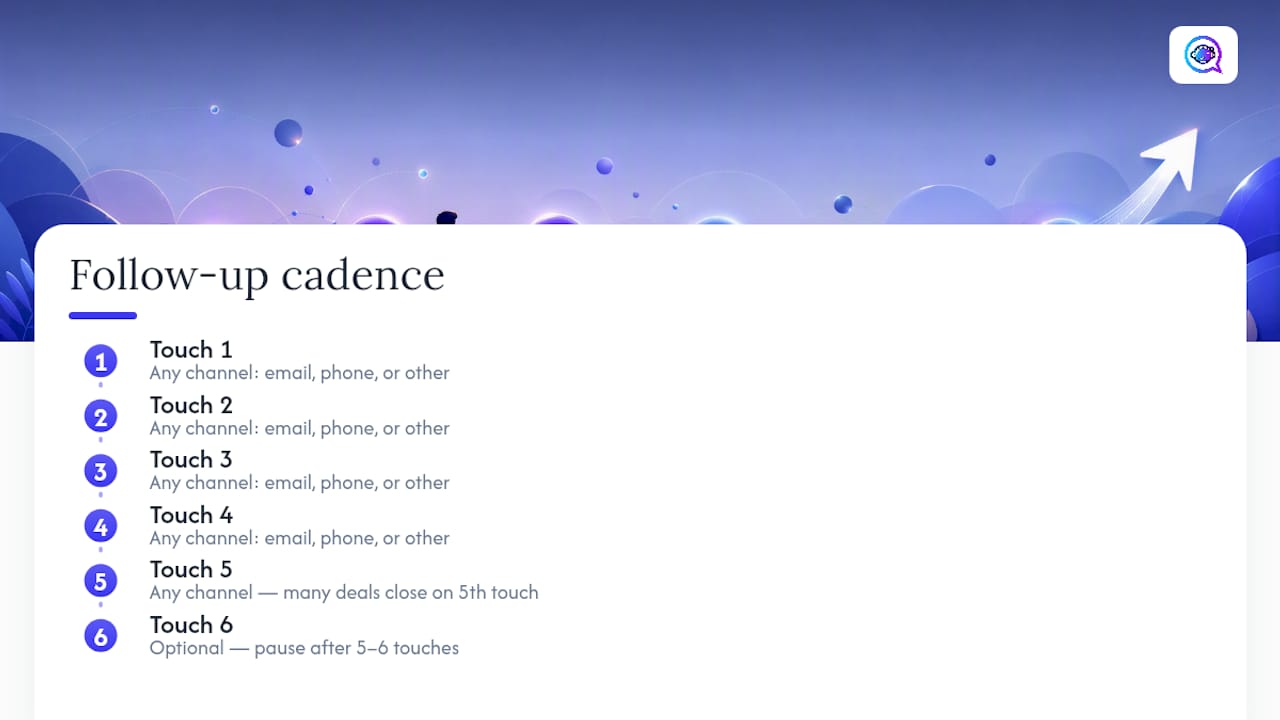
There’s no universal answer, but A sequence of several touches over time can cover most B2B sales cycles effectively without wearing out your welcome. The logic behind each touch matters more than the exact day count, since a lead who just saw a funding announcement needs different timing than one who ghosted after a demo.
Touch 1 (Day 0): Initial outreach or the meeting/demo itself.
Touch 2 (Day 2 to 4): Short follow-up, one new value point, one question.
Touch 3 (Day 7 to 9): Different channel (phone or LinkedIn) with a fresh angle.
Touch 4 (Day 12 to 14): Buyer-enablement assets such as case studies can help prospects build internal buy-in.
Touch 5 (Day 18 to 21): The breakup email.
Touch 6 (Day 90+): Long-term tickler tied to a new trigger, not a calendar reminder.
Early touches are usually by email, but later touches may include calls or short SMS messages. If the account has other stakeholders, this is also the point to multi-thread rather than keep hammering one inbox.
Pro Tip: Signal-based timing beats a rigid calendar. Acting on account triggers like funding news, new job postings, or a repeat pricing-page visit outperforms blind, fixed-interval cadences, because you’re reaching out when the lead actually has a reason to care again.
What Should You Say In A Follow-Up Email?
The best follow-up copy does three things in under 90 words: reminds them who you are, adds something new, and asks one easy question. Here are templates built around that structure.
1. First follow-up (Day 2 to 4)
Subject: Quick follow-up, [First Name]
Hi {{firstName}}, wanted to make sure my note on [topic] didn’t get buried. Since we last spoke, [one new value point, e.g., a relevant stat or feature]. Is this still something worth a 15-minute conversation this month?
2. Second follow-up with a fresh angle (Day 7 to 9)
Subject: One idea for [Company Name]
Hi {{firstName}}, I put together a quick breakdown of how teams like yours handle [pain point] and thought it might save you some digging. Happy to send it over, or walk through it live if that’s easier.
3. Buyer-enablement follow-up (Day 12 to 14)
Attach or link a short case study or ROI snippet here. Enablement assets like these often outperform another meeting request because they help your contact make the case internally without you in the room.
4. Breakup email (Day 18 to 21)
Subject: Closing the loop
Hi {{firstName}}, I don’t want to keep filling your inbox if the timing isn’t right. I’ll close this out on my end for now, but if priorities shift, just reply and I’ll pick it back up. Wishing you the best either way.
A personalized breakup email frequently gets a reply precisely because it removes pressure.
Subject-line swipes by intent:
Reminder: “Quick follow-up, [Name]” / “Still on your radar?”
New value: “One idea for [Company]” / “Thought of you when I saw this”
Breakup: “Closing the loop” / “Should I close this out?”
Post-demo: “Recap + next step from our call” / “Notes from [Date]'s demo”
Personalization micro-copy:
Reference a trigger: “Saw the news about [funding round/hire].”
Reference the last touchpoint: “Following up on our chat about [specific detail].”
Close with low friction: “Is this still a priority for [quarter]?”
What Mistakes Kill Your Reply Rate?
Most low reply rates trace back to a handful of habits, and every one of them has an easy fix.
Following up too fast. Sending a second message within hours reads as pushy. Fix: wait the full two to four business days before touch two.
Resending the identical message. It signals you have nothing new to say. Fix: add one fresh detail, asset, or angle every time.
Stacking multiple CTAs. Asking for a call, a document review, and a referral in one email creates decision paralysis. Fix: one ask per email.
Adding no new value. A bare “just checking in” wastes the touch. Fix: pair every follow-up with a stat, asset, or trigger.
Ignoring deliverability. Blasting the same subject line to hundreds of dormant leads at once can trigger spam filters and hurt your sender reputation. Fix: stagger sends and vary subject lines across batches.
Buyers notice generic outreach faster than you’d think. A Gartner-backed statistic cited by Apollo found that 73% of B2B buyers actively avoid suppliers who send irrelevant messages, which makes relevance a deliverability issue as much as a courtesy one.
Pro Tip: Change your message before you change your channel. Switching from email to a cold call with the same tired pitch just moves the problem. Fix the copy first, then diversify the channel.
How Do You Make A Stalled Lead Interesting Again?
Reframing beats repeating. A lead who ignored your third generic check-in will often respond to a message built around something specific happening in their world right now.
Company news or funding: “Congrats on the Series B, curious how that shifts your priorities for [problem].”
New hires: “Saw you brought on a new [role], happy to loop them into this conversation.”
Content engagement: If they opened your last three emails but never replied, reference the topic they clicked on.
Pricing-page visits: A recent site visit is a strong signal to send a short, direct nudge about next steps.
Match the trigger to the channel:
A short video note works well after a demo no-show.
A mini-audit of their current process works well for prospects who value proof over promises. Offering a no-obligation audit builds trust while demonstrating expertise.
A competitive insight (“here’s what we’re seeing in [industry]”) works when the lead has gone cold post-proposal.
Pro Tip: Multi-thread carefully. Add a second contact only after two or three unanswered touches, and always loop your original champion in (“Hi Alex, cc’ing [Name] since I know decisions like this often involve the wider team”). Never go around someone silently.
When Should You Stop Chasing A Lead?
Persistence has a ceiling. These stop rules protect your time and your domain’s sending reputation.
No reply after five to six meaningful touches across at least two channels: pause and move to long-term nurture.
A spam complaint or unsubscribe: stop immediately and suppress the contact.
A clear negative reply (“not interested,” “wrong time”): respect it, log it, and set a 90-day tickler instead of pushing further.
A role change or departure: stop outreach to that contact and search for a replacement stakeholder.
CRM note template:
Status: Paused after 6 touches, no response. Last contact: [date]. Trigger for re-engagement: [funding round / new hire / renewal cycle]. Next action: revisit in 90 days or sooner if trigger fires.
From here, add the lead to a nurture track, request a warmer contact from an existing customer, or surface a case study through internal enablement. Fixing lead routing and qualification upstream also reduces how many leads end up in this stalled bucket in the first place.
What Metrics Prove Your Follow-Up Strategy Is Working?
Track reply rate by touch number, conversion rate by touch, domain complaint rate, and engagement by channel (email opens versus SMS replies versus call connects). If touch two consistently outperforms touch four, that tells you where to concentrate effort.
Automation best practices:
Trigger follow-ups off account signals (funding, hiring, site visits), not just calendar days.
Cap re-engagement batch sizes so you’re not blasting hundreds of dormant contacts from one domain at once.
Use a separate sending subdomain for higher-risk, high-volume re-engagement campaigns.
A/B test one variable at a time: subject line, CTA phrasing, or send timing.
Pause a sequence automatically once reply or open rates drop below your baseline for two consecutive touches.
Quick stat check: Speed compounds. Companies that respond to inbound inquiries within the first hour are nearly seven times more likely to qualify the lead than those that wait longer, which is exactly the kind of gap automation is built to close.
A Lesson From The Deals That Almost Didn’t Happen
One of my biggest closed deals came from a sixth touch, not a first one. The prospect had gone silent for weeks after a strong demo, and every instinct said to move on. A short note referencing a recent product launch on their end got a reply within the hour. taught me that timing and relevance beat volume every time. The lesson: don’t judge a sequence by touch one or two. Judge it by whether each message earns the right to be read.
Let Astreaux Handle The Follow-Up Timing For You
Everything in this playbook works, but running six touches across email, SMS, and calls for every lead in your pipeline takes time most reps don’t have. Astreaux acts as your always-on follow-up layer: it learns your business’s voice, then sends instant, personalized replies to new leads and keeps nurturing the ones who go quiet, without sounding like a robot wrote it.
What that looks like in practice:
Instant replies to new leads, so fewer of them go cold in the first place.
Persona voice training that matches your actual tone across every follow-up.
Multi-channel reach across SMS, email, and more from one sequence.
CRM and ad platform integrations across over 7,000 apps so lead data and follow-up status stay in sync.
If you’re a contractor chasing estimate requests or a real estate agent nursing a long buyer cycle, the industry-specific setup for real estate agents or the contractor lead-response tools show exactly how the cadence above runs on autopilot. Start a trial or book a demo at Astreaux and see how many of your stalled leads are still worth a reply.
Sources
Test these principles against your own pipeline data rather than assuming they’ll perform identically. Your industry, deal size, and buyer type all shift the exact numbers.
FAQ
How Long Should You Wait Before Following Up?
Wait two to four business days after your first outreach before sending a follow-up, giving the lead time to respond without letting the conversation go cold.
How Many Follow-Ups Should You Send Before Giving Up?
Plan for five to six touches across email, phone, and at least one other channel before pausing outreach, since many deals don’t close until the fifth touch.
What Is A Breakup Email?
A breakup email is a polite, final follow-up that tells the lead you’ll stop reaching out unless they respond, and it often prompts a reply from prospects who were simply overloaded.
Can Automation Help With Following Up On Unresponsive Leads?
Yes. Tools like Astreaux send instant, voice-matched replies and manage timed multi-channel sequences, which keeps follow-ups personalized without requiring manual tracking for every lead.

Should You Change The Channel Or The Message First?
Change the message first. Switching channels with the same generic copy rarely improves reply rates, while a fresh angle or new value point often does.