AI Lead Scoring for Revenue Teams: A Practical Playbook
AI lead scoring uses machine learning trained on your closed-won and closed-lost history to assign each prospect a numeric probability of converting, so reps call the right leads first instead of working a list top to bottom. The model learns which firmographic, behavioral, and intent signals actually predicted revenue in your own pipeline, then scores every new lead against that pattern the moment it hits your CRM.
The immediate payoff is triage speed. Instead of an SDR manually reviewing a lead’s company size, job title, and website activity, the system does it in real time and hands over a ranked queue. Paired with fast routing, that alone tends to lift conversion because the leads most likely to close get a callback while they are still warm.
Here’s what that looks like in practice:
A model scores each new lead from 0 to 100 based on historical patterns.
High scores route straight to a rep’s queue or trigger an instant automated reply.
Low scores drop into a nurture sequence instead of consuming rep time.
Every closed deal, won or lost, feeds back into the model to sharpen the next batch of scores.
Don’t roll this out cold. Run a small pilot with a holdout group first, measure the conversion lift in your top-scored cohort, and only then expand it across your full funnel.
Key Takeaways
AI lead scoring works because it trains on your own closed-won and closed-lost outcomes, then pairs that ranking with fast, consistent follow-up to convert the leads most likely to close.
Point | Details |
|---|---|
Start with a data audit | Confirm you have clean, labeled closed-won and closed-lost records before building any model. |
Pilot before scaling | Run a holdout or A/B test on a small segment to measure real conversion lift first. |
Match model to data volume | Use a hybrid rules-plus-predictive approach until you have enough labeled deals for full AI scoring. |
Watch for drift | Track AUC and conversion metrics on a schedule and set clear retraining triggers. |
Pair scoring with instant follow-up | Astreaux routes high-tier scored leads into automated, personalized conversation to book appointments before leads go cold. |
What Is AI Lead Scoring and How Does It Differ From Rule-Based Scoring?
AI lead scoring, sometimes called predictive lead scoring, is a machine learning system that ranks leads by their statistical likelihood to convert, using patterns learned from your own historical deals rather than a fixed point system someone built in a spreadsheet. The term “predictive lead scoring” is the more precise industry phrase; “AI lead scoring” is the way most buyers search for the same capability, and this article uses both.
The distinction matters because rule-based scoring assigns fixed point values (“job title = VP: +10 points, downloaded whitepaper: +5 points”) that someone has to guess at and then manually update every quarter. AI lead scoring instead trains on firmographic, behavioral, technographic, and intent signals pulled from your actual closed-won and closed-lost records, and it updates the weighting on its own as new outcomes roll in.
Ask three questions before you commit to a build:
Do you have enough historical deal data, ideally hundreds of closed-won and closed-lost records, to train a model without overfitting?
Is your CRM data clean enough that a model would learn real signal instead of noise?
Does your sales motion involve enough lead volume that manual scoring is actually a bottleneck?
If the answer to any of those is a firm no, a hybrid model, rules for the basics with a predictive layer on top, is often the practical middle ground while you build up labeled data.
How AI Lead Scoring Works, Phase by Phase
A production scoring system moves through five phases, and understanding each one helps you know exactly where to plug in your own CRM, ad platforms, and analytics tools.
Data ingestion. The model pulls from your CRM, website analytics, email engagement, and third-party enrichment tools. The richer the feed, the better the signal, but even a clean CRM export plus basic web tracking is enough to start.
Cleaning and labeling. Every historical lead needs a clear outcome tag, closed-won or closed-lost, along with the date it happened. Aim for a defined event window (say, the last 12 to 24 months) and enough volume in both categories that the model isn’t learning from a handful of anecdotes.
Modeling. Most production systems for tabular CRM data lean on gradient-boosting methods like XGBoost, LightGBM, or CatBoost because they balance accuracy with clear feature-importance output. Logistic regression remains a solid choice when your team needs to explain exactly why a score moved.
Scoring. Once trained, the model assigns a live probability score to every new lead, usually on a 0 to 100 scale, and that score maps directly to an action: instant call, SDR queue, or nurture track.
Continuous learning. As leads close, won or lost, those outcomes flow back into the training set. The model recalibrates on a set cadence rather than running on year-old assumptions.
Pro Tip: Don’t wait for a “perfect” dataset before you start. A model trained on 300 clean closed-won and closed-lost records will outperform a rules-based system built on guesswork, and it gets sharper with every deal you close after launch.
Traditional Scoring vs. AI-Driven Scoring: Which Fits Your Team?
Rule-based scoring assigns fixed points to attributes a person picked, and it carries two chronic problems: it decays fast because nobody remembers to update it after the market shifts, and it bakes in whatever bias the original point-assigner had about what a good lead looks like.
AI-driven scoring handles far more variables at once, weighing dozens of firmographic, behavioral, and intent signals simultaneously, and it recalculates those weights automatically as new closed deals come in. That’s the core reason predictive models tend to outperform static rules once there’s enough data to train on.
Choose rule-based scoring if: you’re pre-revenue or have fewer than a few hundred closed deals to learn from.
Choose AI-driven scoring if: you have solid historical CRM data and lead volume high enough that manual triage is genuinely a bottleneck.
Choose a hybrid if: you have decent volume but shaky data hygiene. Rules can catch obvious disqualifiers while a lighter predictive layer ranks the rest.
A hybrid approach is often the practical path: keep simple rules for hard disqualifiers (wrong geography, no budget signal) and let the model handle the nuanced ranking work rules were never built to do.
What Business Results Should You Expect From AI Lead Scoring?
The clearest, fastest-to-measure benefit is speed-to-lead. Automated scoring and routing can compress the research and triage work that used to take a rep 15 to 30 minutes down to under 60 seconds, which matters enormously in categories where the first vendor to respond tends to win the deal.
Beyond speed, teams typically see three connected gains:
SDR productivity. Reps stop manually researching every inbound lead and spend that time on outreach instead.
Conversion lift on top-tier leads. Once a model retrains against real outcomes, the highest-scored cohort should convert at a materially higher rate than your unscored baseline, and running an A/B or holdout test is the standard way to prove that lift before you scale it.
Marketing efficiency. Marketing can see which channels and campaigns actually feed high-scoring leads instead of just raw volume, and shift spend accordingly.
The benefit scales with volume and channel complexity. A team running high inbound volume, multiple paid channels, and account-based marketing gets the most out of predictive scoring, because that’s exactly the environment where predictive scoring shines and rule-based systems buckle under the number of variables. A five-person outbound team closing a handful of enterprise deals a quarter has less to gain, and might be better served by a hybrid approach weighted toward firmographic fit.
None of this works without clean inputs. A model trained on duplicate records, missing close dates, or inconsistent stage definitions will produce scores that look precise and are quietly wrong. Data governance isn’t a separate initiative from lead scoring, it’s the foundation the whole system sits on.
Which Data Signals Actually Improve Model Accuracy?
Not every field in your CRM deserves equal weight. Central inputs for predictive scoring fall into four categories, and firmographic, technographic, behavioral, and intent data each earn their place for different reasons.
Firmographic and contact attributes (company size, industry, title, seniority) matter most if your motion is outbound, since fit is often the strongest early predictor before behavior even enters the picture.
Behavioral signals like demo requests, pricing page visits, and email replies tend to be the strongest predictors for inbound motions, because they show active buying intent rather than static fit.
Technographic and product-usage signals (what tools a prospect already runs, or how they’re using a free trial) carry outsized weight for product-led motions, where usage depth often predicts upgrade likelihood better than any demographic field.
Third-party intent data (topic research, competitor site visits) adds real value but varies in reliability by vendor, so validate a new intent feed against your own closed-deal history before trusting it fully.
Scores update in real time as these behaviors change, which means a lead who was a 40 last week can jump to an 85 after requesting a demo, and your routing rules need to react to that shift immediately rather than on a nightly batch.
Pro Tip: Before adding a new data source, run a quick correlation check against your last quarter’s closed-won deals. If the new signal doesn’t actually separate winners from losers in your own historical data, it’s adding noise to your model, not accuracy.
Data hygiene isn’t optional overhead here. Canonicalize company names, dedupe contact records, and set a regular enrichment cadence, monthly at minimum, so the model isn’t learning from stale or duplicated inputs.
How Do You Implement AI Lead Scoring, Step by Step?
Going from idea to a production scoring model follows a fairly consistent sequence, whether you build it inside your CRM or bring in a dedicated tool.
Audit your data. Pull your last 12 to 24 months of closed-won and closed-lost records. Confirm you have a clean outcome label on each and at least a few hundred examples in both buckets, thin data is the single most common reason pilots stall.
Choose your build path. Many CRMs, including HubSpot’s native AI scoring feature, offer built-in predictive scoring you can configure without a data science team. Vendor ML models and fully custom models sit above that in complexity and control, and are worth it once your data volume and revenue justify the investment.
Prepare labels and features. Define your event window, tag every historical record with its outcome, and decide which firmographic, behavioral, and intent fields will feed the model.
Train and validate. Run the model against a holdout set of historical deals it hasn’t seen, and check that it correctly separates past winners from past losers before trusting it on live leads.
Set score bands and routing rules. Map score ranges to concrete actions rather than leaving them abstract.
Pilot with a holdout test. Run the model live against a portion of your pipeline while a comparable slice continues with your old process, then compare conversion rates.
Roll out and integrate. Push scores into CRM fields and workflows so reps see them where they already work, not in a separate dashboard nobody opens.
A practical score-band structure looks like this:
80 to 100 (high tier): route for a call within 60 minutes or trigger an instant automated response.
50 to 79 (medium tier): route to SDR nurture with a defined follow-up cadence.
Below 50 (low tier): enter automated nurture until behavior or new activity raises the score.
Batch scoring, updating scores on a schedule, works fine for lower-velocity B2B sales. Real-time scoring, where the score updates the instant a lead takes a new action, matters far more for high-velocity or inbound-heavy motions where minutes decide whether you reach a lead first. Document these SLA mappings and check adherence weekly, not just at launch. For teams still working out the routing logic itself, a structured lead routing framework is worth reviewing before you finalize your score bands.
If you’d rather not build the scoring and routing logic from scratch, partners like BabyLoveReach AI publish practical implementation patterns worth reviewing before you commit engineering time to a custom build.
How Do You Keep Lead Scores Accurate Over Time?
A model that worked well at launch will quietly get worse if nobody watches it. Buyer behavior shifts, your ICP evolves, and campaigns change what “high intent” even looks like, all of which erode a model’s accuracy without any obvious warning sign.
Track two categories of metrics on a fixed cadence: model performance (AUC, precision on your top-scored tier) and business outcomes (conversion lift, speed-to-contact on high-tier leads). Watch for feature distribution shifts, is your model suddenly seeing a lead mix it wasn’t trained on, and set explicit retraining triggers rather than retraining on a whim.
Metric type | What to track | Retrain trigger |
|---|---|---|
Model performance | AUC / precision on top-tier leads | Sustained AUC drop over several weeks |
Business outcome | Conversion lift, speed-to-contact | KPI decay beyond your baseline for 4+ weeks |
Data health | Feature distribution shifts in new leads | New lead mix diverges from training data |
Model drift is a documented, ongoing risk, not a one-time setup problem, and teams that treat monitoring as optional tend to discover the drift only after conversion rates have already slipped. Assign clear ownership: someone owns the data pipeline, someone owns the model itself, and sales needs a direct feedback channel to flag when scores feel wrong in practice, that ground-level pushback often catches drift before your dashboards do.
Pro Tip: Version every model you deploy and log exactly when your label definitions shift, like a change in what counts as “closed-won.” Without that history, you can’t tell whether a performance drop came from drift or from a change your own team made upstream.
How Astreaux Applies Scoring to Real Service Businesses
Scoring only pays off if the highest-tier leads actually get contacted fast. That’s the gap Astreaux was built to close for service professionals. Once a lead crosses into your high-tier band, instant conversational follow-up matters as much as the score itself, a real estate agent, contractor, or mortgage broker loses the advantage of a good score if nobody replies for three hours.
Astreaux’s conversational AI learns the voice of your business and responds to new leads immediately, so a high-scoring prospect gets a personalized reply while their intent is still fresh rather than sitting in a queue.
A lead comes in and gets scored by your existing pipeline logic.
High-tier leads trigger an instant, personalized Astreaux response instead of waiting on manual outreach.
The conversation nurtures the prospect toward a booked appointment automatically.
Outcomes, booked, no-showed, closed, feed back into your scoring model to sharpen future tiers.
The value of a score decays the moment a lead goes cold. Pairing predictive scoring with instant conversational follow-up is how you actually capture the lift the model promises, instead of losing it in the gap between a high score and a human callback.
A reasonable pilot SLA: high-tier leads get an Astreaux-driven response and a booking attempt within minutes of the score crossing your threshold, then compare booking and no-show rates against your prior manual process. Real estate agents and contractors running this loop tend to see the clearest gains, since both fields live and die on speed-to-response.
Where AI Lead Scoring Breaks Down
No scoring model is immune to bad inputs, and the most common failure mode is training on too little data, or worse, data with unlabeled or inconsistent outcomes. A model trained on 80 closed deals with murky “closed” definitions will produce confident-looking scores that mean almost nothing.
Bias is a subtler risk. If your historical closed-won records overrepresent one segment, say, enterprise deals from a single vertical, the model learns to favor that pattern and quietly deprioritizes leads that don’t look like your past wins, even when they’d convert well. Regularly audit which lead types your model scores highest and check that against actual outcomes, not just assumptions.
Interpretability is a real trade-off too. Gradient-boosting models tend to outperform simpler methods on raw accuracy, but they’re harder to explain to a rep who wants to know exactly why a lead scored 72 instead of 90. Logistic regression sacrifices some accuracy for a model whose weights are easy to state in plain language, worth considering if your team needs to defend scores in weekly pipeline reviews.
Integration friction is the least glamorous problem and the most common one in practice. A model that scores leads perfectly but never makes it into the CRM field a rep actually looks at is functionally useless. Budget real implementation time for the plumbing, not just the modeling, before you call a pilot complete.
How Should You Handle Data Privacy and Compliance?
Lead scoring models run on personal and business contact data, which puts them squarely inside privacy regulations like GDPR and CCPA depending on where your leads live. Build compliance into the pipeline from day one rather than retrofitting it after a pilot succeeds.
Start with data minimization: collect and feed into the model only the fields that demonstrably improve scoring accuracy, not every attribute you can technically capture. Document a clear retention policy for lead data, especially for leads who never convert, and make sure your enrichment vendors are contractually bound to the same standards you hold your own systems to.
Give leads a real opt-out path for data processing, and keep an audit trail of consent where required. If your model or a downstream sales action treats any protected attribute as a proxy, zip code correlating with a protected class, for instance, review that feature for disparate impact before it goes live, not after a customer complaint. Transparency with sales and marketing teams about what the model uses and why also reduces internal risk: a rep who can explain a score in plain terms is far less likely to make a compliance misstep in a follow-up conversation.
What Does AI Lead Scoring Look Like Across Industries?
The mechanics stay the same, ingest, score, route, retrain, but the signals that matter shift meaningfully by vertical.
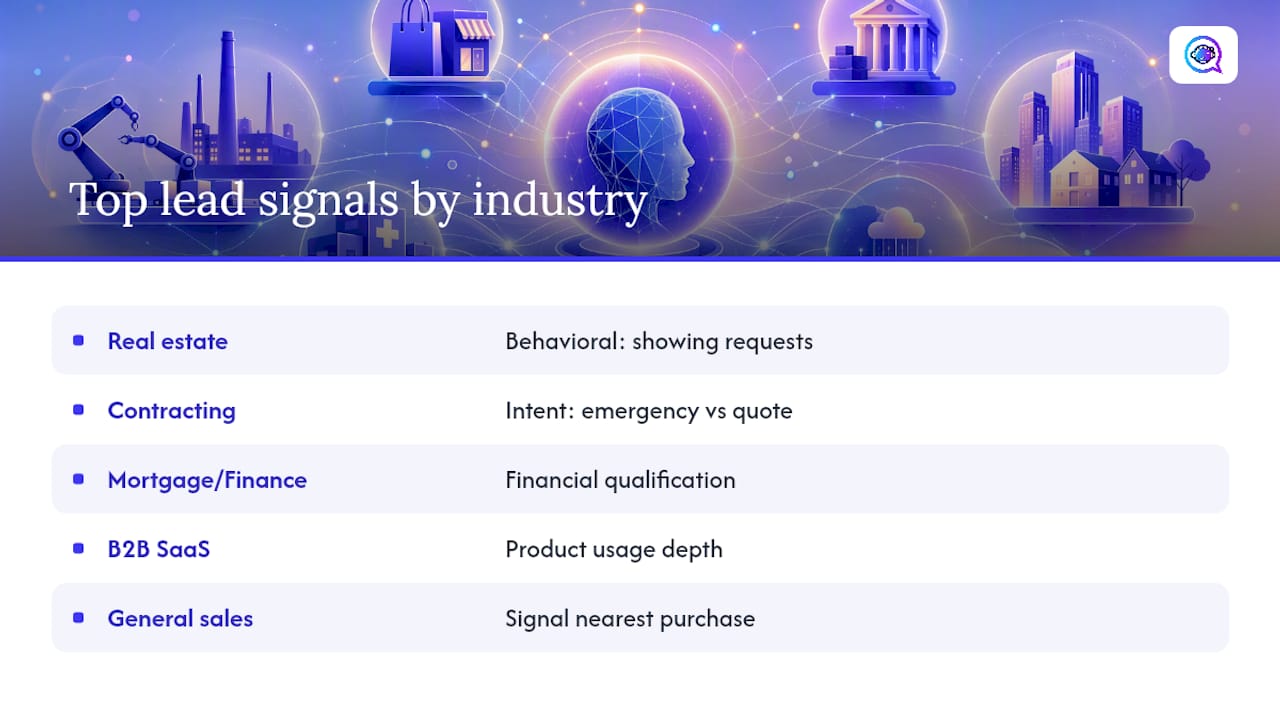
Real estate: Behavioral signals like saved-listing activity, showing requests, and mortgage pre-approval mentions in intake forms often outweigh firmographic data entirely, since the “company” here is the buyer’s own household. Instant follow-up after a showing request tends to be the single highest-leverage moment in the funnel.

Contracting and home services: Intent signals (an emergency repair request versus a routine quote inquiry) and geographic proximity carry more weight than almost anything else, since urgency and service radius often decide the deal before price does.

Mortgage and financial services: Firmographic and financial qualification data (income range, credit tier where legally collectible, loan type) combine with behavioral signals like calculator tool usage to predict which leads are close to a decision versus early-stage browsers.
B2B SaaS: Technographic and product-usage data, trial engagement depth, feature adoption, team seat growth, typically outpredicts firmographic fit alone, especially in product-led motions where usage is the clearest intent signal available.
Across every vertical, the pattern holds: the highest-value signal is the one closest to an actual buying decision, not the one easiest to collect.
How Do You Explain a Lead Score to Sales and Marketing?
A score means nothing to a rep who doesn’t trust it, and trust comes from being able to explain, in plain language, why a lead landed where it did. Frame every score around its top contributing factors rather than the raw number alone: “This lead scored 88 mainly because they requested a demo and match our best-fit company size,” lands far better than “this lead is an 88.”
For marketing, translate scores into channel and campaign performance: which sources are consistently producing high-tier leads, and which are generating volume that never converts. That reframes the score from a sales-only tool into a shared diagnostic both teams can act on.
Build a simple, shared reference sheet mapping score bands to plain-language descriptions (“80 to 100: actively evaluating, contact within the hour”) so nobody has to interpret raw numbers cold. When the model’s weighting shifts after a retrain, communicate that change before scores move, a sudden shift in what “qualified” means erodes trust fast if nobody flagged it coming.
A Practical Playbook, Not a Perfect Model
The biggest mistake I see revenue teams make with AI lead scoring is treating it like a one-time software purchase instead of an ongoing operational discipline. The model isn’t the finish line. The retraining cadence, the drift monitoring, the routing SLAs, that’s where the actual value gets protected or lost.
Conventional advice oversells the modeling step and undersells the plumbing. Plenty of guides walk through gradient boosting versus logistic regression in detail and then wave vaguely at “integrate with your CRM” as if that’s a footnote. In practice, a mediocre model with tight routing SLAs and fast conversational follow-up will outperform a brilliant model that dumps scores into a CRM field nobody checks.
If you’re just starting, resist the urge to build the most sophisticated model possible. Start with a hybrid approach, clean your closed-won and closed-lost labels obsessively, and pilot on a holdout group before you touch your full pipeline. The teams that get real lift aren’t the ones with the fanciest algorithm. They’re the ones who close the loop between a high score and an actual human, or AI-driven, response within the hour.
— Jamaal
Turn High Scores Into Booked Appointments Automatically
A model can hand you a perfectly ranked lead list, but the conversion lift only shows up when someone, or something, reaches that lead before it goes cold. Astreaux closes exactly that gap: it learns your business’s voice and responds to high-tier leads instantly, turning a score into a real conversation and a booked appointment without a rep having to drop what they’re doing.
For real estate agents, contractors, mortgage brokers, and other service professionals running lead scoring on top of a busy pipeline, Astreaux plugs into your existing CRM and integrates with over 7,000 apps, so scored leads flow straight into automated, personalized follow-up. Try a pilot: pick your high-tier score band, connect it to Astreaux’s lead outreach automation, and measure booking rate and no-show rate against your current process over a few weeks. If you run a contracting business specifically, the contractor-focused workflow is built around estimate requests and fast scheduling from day one.
Sources
What Is Predictive Lead Scoring? What It Does and How It Works
AI Lead Qualification: How It Works in 2026 - The GTM with Clay Blog
How model drift kills AI accuracy and what optimisation can do about it
FAQ
What Is AI Lead Scoring?
AI lead scoring is a machine learning system that assigns each prospect a probability of converting, trained on your historical closed-won and closed-lost deals rather than fixed manual point rules.
How Is AI Lead Scoring Different From Traditional Lead Scoring?
Traditional scoring uses static point values a person assigns and rarely updates; AI-driven scoring learns from real outcomes and recalibrates automatically as new deals close.
How Much Data Do You Need to Start AI Lead Scoring?
You need enough labeled closed-won and closed-lost records, typically several hundred, spanning a defined time window, to train a model that isn’t just guessing.
How Often Should a Lead Scoring Model Be Retrained?
Retrain whenever you see sustained AUC decay or a shift in your incoming lead mix, rather than on a fixed calendar alone, since drift can happen faster than a quarterly schedule accounts for.
Can Small Teams Use AI Lead Scoring Without a Data Science Team?
Yes. Many CRMs offer built-in predictive scoring features, and tools like Astreaux add instant conversational follow-up on top of scored leads without requiring custom model-building.