
Business Texting Etiquette: 5 Dos, 5 Don’ts, and Automation
Professional business texting follows four rules: identify yourself and your organization, keep messages short and clear, respect reasonable hours while responding promptly, and get documented consent for marketing with an opt-out in every message. Skip any one of these and you risk confusion, compliance headaches, or a customer who blocks your number. Get them right and texting becomes your fastest channel for conversions.
TL;DR:
The FCC’s one to one consent rule took effect January 27, 2025, requiring documented written consent for each seller before marketing texts.
Include an opt out instruction in every marketing text, keep consent records, and honor requests to stop immediately, as required.
Reply to new leads within an hour when possible, answer routine questions the same business day, and flag unanswered texts after two hours.
Send routine texts during agreed business hours, account for the recipient’s time zone, and move sensitive, legal, or complicated discussions to a call or email.
A missed call text sent within 60 seconds can recover a lead, while CRM linked templates reduce errors in names, dates, and service details.
Astreauxcalendly.comRespond to Leads in Your VoiceRespond to new leads in your business's voice with conversational AI that engages prospects and helps streamline scheduling and follow-up.Book a call
1. Essential dos for every business text
Every text you send represents your business, so the first few words matter more than the rest of the message combined. A recipient who does not immediately recognize who sent a text and why is already suspicious, and suspicion kills response rates.
Start with your name and company in the opening sentence, state your purpose, and give the reader one clear action to take. Resist the urge to pack two or three requests into a single message. One idea per text keeps your reader from skimming past the part that actually needs a response.
Open with your name and company before anything else (“Hi, this is Maria with Lakeview Realty”).
Stick to one idea per message and close with a short call to action like “Reply Y to confirm” or “Tap the link to book.”
Personalize with the recipient’s name and a specific time or place when relevant, which our guide to safe personalization tactics covers in more detail.
Document every marketing opt-in and include a brief opt-out line, such as “Reply STOP to unsubscribe.”
Use standard grammar and punctuation. A text riddled with typos reads as careless, even when the sender is not.
Pro Tip: Write your opening line first, then build the rest of the message around it. If the first sentence does not answer “who is this and why,” rewrite it before sending.
2. Essential don’ts that undermine professionalism
Texting feels casual, which is exactly why it is easy to slip into habits that damage trust. The same shorthand you use with friends reads as sloppy or confusing to a client or coworker who does not share your context.
Avoid slang, heavy emoji use, and shorthand like “u” or “asap” that can read as unprofessional or ambiguous.
Do not deliver complex, confidential, or emotionally sensitive news by text. Pick up the phone instead.
Do not text outside agreed contact hours unless the matter is genuinely urgent.
Never assume consent for marketing messages. Require a documented opt-in before sending promotional texts.
Avoid stringing together five or six messages when the conversation has outgrown texting. Move to a call or email once the topic gets complicated.
3. Timing and responsiveness that reduce friction
Texting earns its reputation as a fast channel only when response times actually stay fast. A new lead who texts your business and waits three hours for a reply has usually moved on to a competitor by the time you respond.
Send texts during business hours and factor in the recipient’s time zone before you hit send.
Reply to new leads within an hour whenever possible, since speed is often the difference between a booked appointment and a cold lead.
Answer non-urgent customer questions within the same business day.
Escalate to a phone call or email when the topic involves sensitive details, legal language, or anything that benefits from tone and context a text cannot carry.
Use autoresponders and missed-call texts to acknowledge contact immediately, then follow up personally once a team member is available.
Pro Tip: Set a house rule that any text left unanswered for more than two hours during business hours gets flagged for follow-up. Small delays compound into lost leads faster than most teams realize.
4. Tone, language, and formatting that read as professional
A text message has to do in two lines what an email does in a paragraph, so tone matters even more when space is tight. Professional does not mean stiff. It means direct, friendly, and easy to act on.
Keep punctuation standard, skip the all caps (which reads as shouting even when that is not the intent), and limit emojis to low-risk, audience-appropriate contexts like a thumbs up confirming an appointment. A financial advisor texting a client about a document deadline should sound different from a contractor confirming a job site address, but both should sound like a person, not a script.
Weak: “hey u still coming today??” Strong: “Hi Alex, this is Sam with Ridge Roofing. Still good for our 2 PM visit today?”
Weak: “CALL ME ASAP ITS IMPORTANT” Strong: “Hi Dana, please give us a call when you get a chance. A quick update on your estimate.”
Weak: “confirmed!! see u soon!!!” Strong: “Confirmed for Thursday at 10 AM. See you then.”
Prompt replies and prepared response scripts are two of the most consistently cited etiquette practices across business texting guides, according to a business texting etiquette checklist. Teams that standardize their scripts in advance tend to sound more consistent across every conversation, as explained in this Event Marketing email playbook.
5. Legal and compliance essentials for business texting
Texting for business carries real legal weight, and the rules shifted meaningfully in the last two years. The FCC’s one-to-one consent rule requires that a consumer give prior express written consent to each individual seller before receiving marketing texts or robocalls, closing the loophole where one broad consent used to cover multiple unrelated businesses. The rule took effect January 27, 2025.
Separately, the FCC codified that National Do-Not-Call Registry protections extend to text messages and adopted mandatory blocking procedures for illegal texts sent to consumers on the registry. Revocation requests, meaning a customer who replies STOP or asks to be removed, must be honored immediately.
Practical compliance steps for any team sending marketing texts:
Document how and when each contact gave consent, including the exact language they agreed to.
Include a short opt-out instruction, such as “Reply STOP to opt out,” in every marketing message.
Keep consent and opt-out logs for your records in case a complaint or audit arises.
Consult legal or compliance counsel for program-specific questions, since consent requirements vary by message type and audience.
Teams should be prepared to document consent clearly and respond to revocation requests promptly, since recordkeeping is central to demonstrating compliance with current rules.
For a deeper walkthrough of these requirements, our guide to TCPA compliance for SMS programs breaks down the consent documentation process step by step, and our double opt-in guide covers how to build a defensible consent trail from the first message.
6. Ready-to-use templates for common business texts
Copy-ready language saves time and keeps your team consistent. Adapt these for your own voice, but keep the structure: identify, state purpose, give a clear action.
Appointment confirmation: “Hi {{firstName}}, this is {{agentName}} with {{companyName}}. Confirming your appointment for {{date}} at {{time}}. Reply Y to confirm or call us to reschedule.”
Missed-call follow-up: “Hi, sorry we missed your call! This is {{companyName}}. Want to grab a time to talk? Tap here to book: {{link}}.”
Lead qualification (first message): “Hi {{firstName}}, thanks for reaching out to {{companyName}}. What’s the best time this week for a quick call?”
Compliant marketing opt-in line: “By replying YES, you agree to receive texts from {{companyName}} about {{topic}}. Msg & data rates may apply. Reply STOP to opt out.”
For longer qualification flows and more scenario-specific scripts, our lead follow-up templates and SMS qualification flows cover sequences beyond a single message.
7. Workplace scenarios: adjusting etiquette by audience
Who you are texting changes which rules matter most. Internal messages to coworkers can stay brief and contextual, but they should still respect off-hours boundaries rather than assuming instant availability. Managers benefit from setting explicit expectations upfront: which hours are fair game for texts, and which topics belong in a meeting instead.
Customer-facing texts call for higher formality and sharper privacy awareness, especially when any personal or health information is involved. Practices handling patient reminders should review our notes on HIPAA considerations for text reminders before sending anything that touches protected health information.
Internal: keep it brief, stay in context, and avoid expecting replies outside work hours.
Managers: state response-time expectations clearly so boundaries do not get tested by accident.
Customer-facing: use a more formal tone, protect private details, and keep opt-ins documented.
Group threads: use segmented lists or announcement channels rather than one long group thread where replies land in everyone’s inbox.
8. Automating etiquette without losing the personal touch
Consistency is where most texting programs break down, not intent. A team member who writes a thoughtful message on Monday might send something rushed and generic on Friday, and that inconsistency is what customers notice. Automated instant replies help meet response-time expectations without sacrificing brevity, and a missed-call text sent within 60 seconds of a dropped call can recapture a lead who would otherwise call the next available competitor.
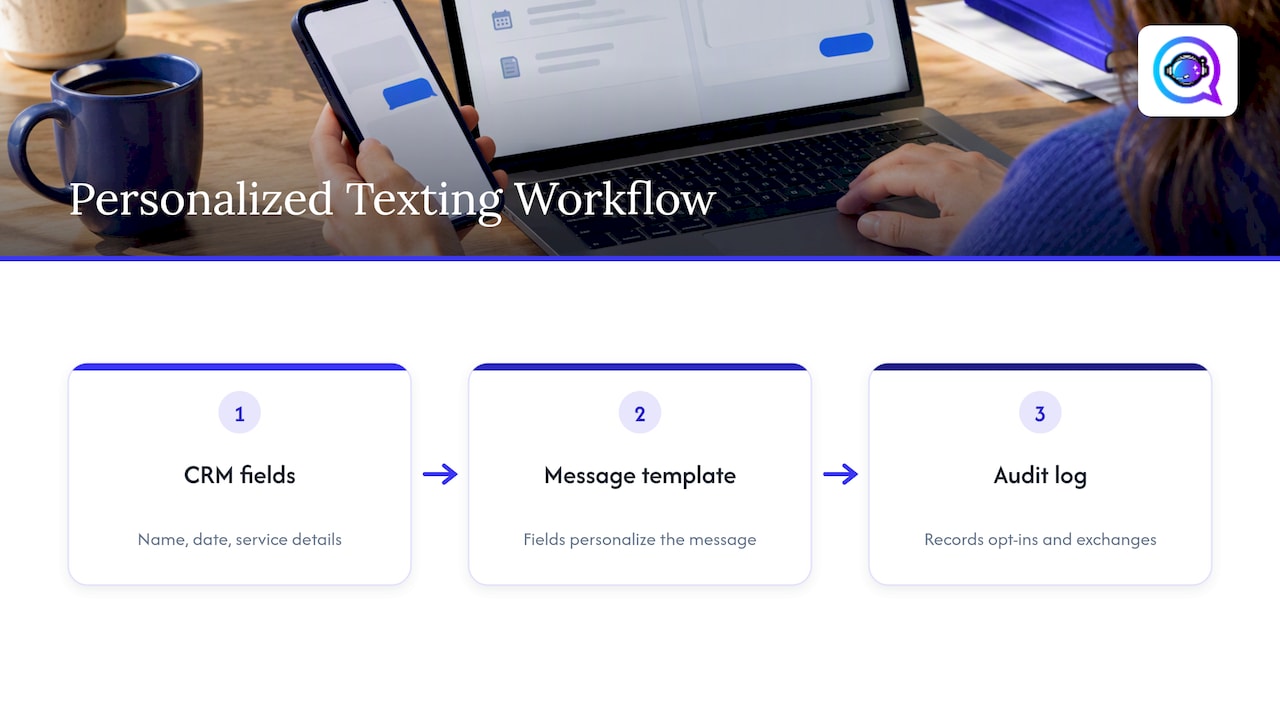
Tying message templates to CRM fields keeps personalization accurate, since the system pulls the right name, date, and service details instead of a team member guessing from memory. Keeping an audit log of every opt-in and message exchange also supports the recordkeeping compliance requires, so the etiquette and the paperwork happen in the same step.
9. Why texting etiquette shapes trust and conversions
Polite, timely texts do more than avoid annoyance. They build the kind of trust that turns a one-time inquiry into a repeat customer. Teams that standardize templates and response windows see fewer dropped conversations simply because consistency removes the guesswork for everyone involved.
— Jamaal
10. Astreaux as a way to operationalize good etiquette at scale
Writing a great texting policy is one thing. Keeping every team member consistent with it, every single day, is the harder part. Our AI platform learns the voice of your business and responds to new leads instantly, which means the identify-yourself-and-reply-fast rule happens automatically rather than depending on whoever is free at the moment.

The platform automates missed-call texting, ties message templates to CRM fields for accurate personalization, and connects with numerous apps so your scheduling, nurturing, and follow-up stay in sync across tools. Various service professionals use these flows to reduce no-shows and keep pipeline moving without rewriting the same message by hand. Visit Astreaux AI to see how automated engagement fits your team, or explore our contractor-specific lead response tools if missed-call recovery is your biggest gap.
FAQ
What are some professional etiquette rules for texting?
Identify yourself and your organization in the first sentence, keep each message focused on one idea, and use standard grammar instead of slang or all caps. Respond within a reasonable window and always include an opt-out option on marketing messages.
What is the 3 text rule?
There is no single official “3 text rule” in business texting standards, though many teams use a practical guideline of limiting a single conversation thread to about three messages before moving complex topics to a call or email. The idea is to prevent long, fragmented text chains from replacing conversations that need more context.
What is a red flag in texting?
A red flag in business texting includes messages sent without identifying the sender, marketing texts sent without documented consent, or requests for sensitive information like payment details over text. Unusually late-night messages or pressure to respond immediately are also signs a message does not follow standard etiquette.
What are the 7 P’s of business phone etiquette?
Definitions of the “7 P’s” vary across sources and are not tied to a single authoritative standard, though common versions include preparation, promptness, politeness, professionalism, personalization, patience, and precision. These principles overlap closely with text etiquette, particularly promptness and precision.