

3 Message SMS Qualification That Books Calls for Service Teams
The fastest way to qualify a new lead is an immediate, consented SMS that asks one short routing question, then either books the appointment or hands the lead to a rep. Aim to send that first text promptly after the lead raises their hand, ask only a few concise questions, and automate the sequence so no lead sits untouched. Everything below shows you how to build, wire, and measure that exact flow.
TL;DR:
Sending the initial qualification SMS within 60 to 90 seconds of lead action significantly increases the chance of converting that lead before they disengage.
Collecting consent through opt-in checkboxes or click-to-text buttons ensures compliance and improves the quality of contacts for SMS outreach.
Limiting flows to one short question per message and routing leads based on quick responses maintains high engagement and effective qualification rates.
Integrating SMS workflows with CRM systems and automation tools ensures all responses are properly recorded, enabling targeted follow-ups and better lead segmentation.
Measuring key metrics such as response time and bot containment rate helps optimize qualification flows and improve overall conversion effectiveness.
Astreauxcalendly.comRespond to Leads Without DelayAstreaux uses conversational AI to engage new leads instantly, personalize responses, and streamline scheduling for service professionals.Book a call
Why SMS Beats Email and Phone for Fast Qualification
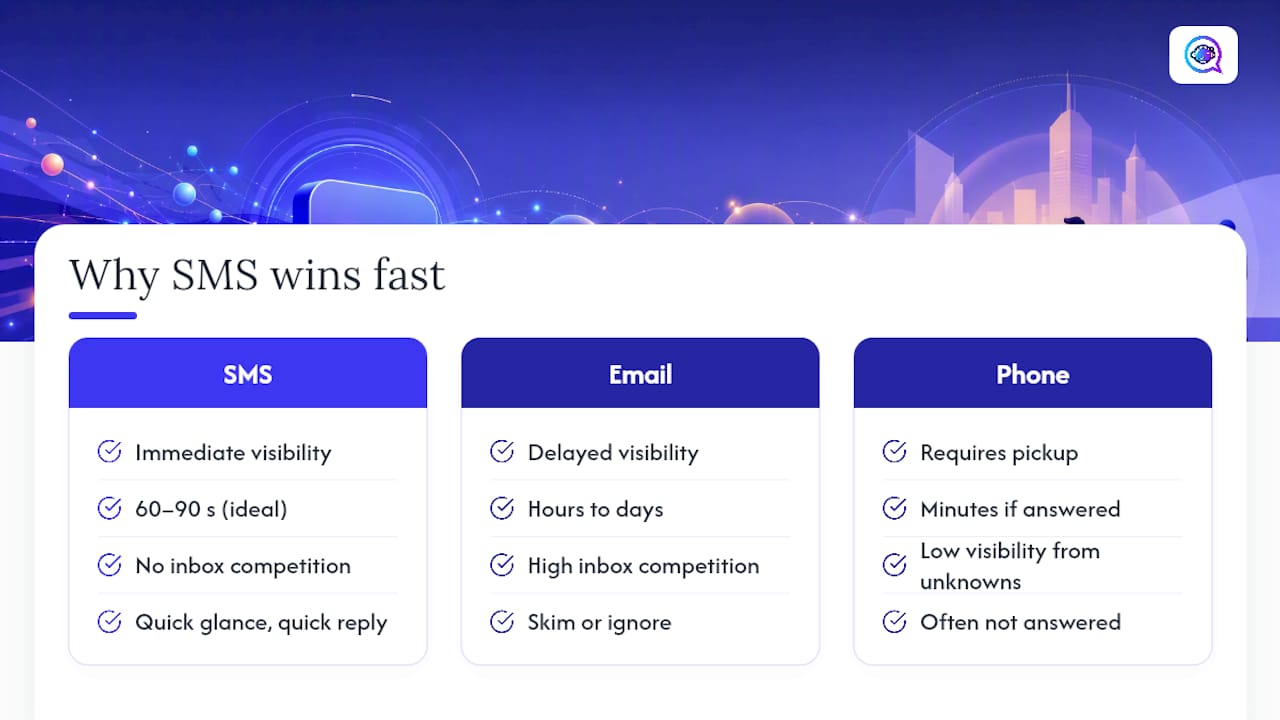
Speed decides more deals than script quality ever will. HubSpot’s compiled research on sales statistics shows how quickly sales cycles stall once a lead goes untouched, and every hour you wait after a form fill compounds that risk. SMS solves this because people read texts almost as soon as they arrive. Email sits in an inbox competing with newsletters and internal memos. A phone call requires the lead to pick up, which fewer and fewer people do for unknown numbers.
Text messages skip that competition entirely. Mailchimp’s guidance on SMS lead generation recommends short messages with a clear call to action precisely because that format matches how people actually behave on a phone: quick glance, quick reply, done.
Speed-to-lead benchmark: The strongest SMS qualification programs send the first message within 60 to 90 seconds of a lead’s action, whether that’s a form submission, a missed call, or a demo request.
That window matters because it’s the moment the lead is still thinking about you. A missed call from a contractor’s office, a demo request on a SaaS landing page, a referral text from a happy client. These sources convert best with SMS because the lead already expects a fast response and has a phone in hand.
Paid ad forms benefit the most from this approach since cost per lead makes speed a direct return on investment. Miss the window on a $40 paid lead and you’ve effectively burned that spend before a human ever gets to make a case. Demo requests behave the same way: a prospect filling out a form on your pricing page is in a decision mindset for a very short stretch, and a text lands inside that stretch far more reliably than an email does.
How to Capture SMS Opt-Ins and Incoming Numbers
Getting a phone number is only half the job. You need a number the lead actually consents to receive texts on, captured in a way that holds up if anyone ever asks how you got it.
Build your capture points around a few proven patterns:
Add an unchecked opt-in checkbox on every lead form, with language like “I agree to receive SMS updates from [Business Name] about my inquiry. Message frequency varies. Reply STOP to opt out,” linked to your terms of service and privacy policy.
Use click-to-text buttons on mobile landing pages so a tap opens a pre-filled text instead of a phone call, which lowers friction for leads who don’t want to talk yet.
Place QR codes on yard signs, truck wraps, and print ads that open a pre-filled SMS to your business number, turning offline touchpoints into instant conversations.
Validate phone numbers at the point of entry rather than after submission, catching typos before a lead disappears into a dead number.
Make phone number a required field only when SMS is your primary follow-up channel; make it optional when email is the fallback, so you don’t lose leads who simply prefer not to share a mobile number.
Landing pages built specifically for a single ad campaign convert opt-ins better than general contact pages, mostly because the form has one job and the visitor already expects a fast reply. If you’re testing this on a Webflow site, a form-enhancement extension can help enforce phone formatting at the field level before submission.
SMS Qualification Flows and Paste-Ready Templates
A qualification flow only works if it respects one rule: one question per message, never a paragraph of questions crammed into a single text. Salesmsg’s breakdown of AI lead qualification over SMS confirms this pattern across working deployments: short exchanges, checked confidence, then a route or a booked meeting.
Here are four flows you can paste into your SMS platform today:
Inbound demo lead: “Hi {{firstName}}, thanks for requesting a demo of [Product]! Quick question: are you exploring this for yourself or your whole team?” → routes to self-serve trial link or a rep booking link based on the answer.
Service inquiry (contractor/home services): “Hi {{firstName}}, this is [Business Name]. What’s the main issue you’re looking to fix: repair, replacement, or a new install?” → routes to an estimate scheduler.
High-ticket pre-qualification: “Hi {{firstName}}, thanks for your interest in [Service]. What’s your target timeline: this month, next quarter, or just researching?” → “just researching” nurtures into a drip sequence; the other two route straight to a rep.
After-hours lead: “Hi {{firstName}}, thanks for reaching out to [Business Name] after hours. We’ll have a real person reply first thing, but can you tell us what you’re looking for so we can prioritize your reply?” → tags the lead urgent or standard based on the response.
Pro Tip: Write your first message to acknowledge, not interrogate. “Thanks for reaching out” before any question keeps the exchange feeling human instead of like a form with a pulse.
Each flow ends the same way: a booking link, a routed handoff, or a clear “here’s what happens next” message. Never let a flow just stop.
Automation and CRM Integration: What to Wire Before Launch
None of this works without the right plumbing behind it. Before you write a single message, confirm five pieces are in place: a registered business phone number under the 10DLC framework for compliant business texting, an SMS sending platform, your CRM, a booking calendar, and webhooks connecting all of them.
The Search & Systems breakdown of an AI SMS bot workflow lays out the architecture clearly: a form fill triggers the bot, the bot acknowledges in under 60 seconds, asks its routing questions, and writes results straight back to the CRM record.
That write-back step is where most manual processes quietly fail:
Map each qualifying answer to a specific CRM field, not a free-text notes box, so reps can filter and sort leads by response later, following best practices for integrate deck analytics with CRM.
Set a tag or pipeline stage automatically once a lead answers all qualifying questions, so nothing sits in “new” longer than it should.
Build routing rules around the answers themselves: budget above a threshold routes to a senior rep, “just researching” routes to a nurture sequence.
Set an AI confidence threshold for ambiguous replies, escalating anything the bot can’t classify to a human within minutes rather than guessing.
An AI agent handling this well should function as an extension of your CRM rather than a separate tool bolted alongside it, so replies land on the actual contact record and existing workflows fire without extra setup. Astreaux’s approach to this exact integration problem is worth understanding in more detail through its lead automation platform, and teams wiring their own stack from scratch can walk through a CRM integration setup guide for the field-mapping specifics.
Compliance and Sending Best Practices
Getting the legal basics right protects both your deliverability and your business. Every opt-in needs three elements: clear consent language, a way to opt out, and a link to your terms.
Use opt-in copy like: “By submitting this form, you agree to receive SMS messages from [Business Name]. Message and data rates may apply. Reply STOP to unsubscribe, HELP for help.”
Keep every message under 160 characters where possible. Mailchimp’s guide to SMS character limits explains that going over that count splits your text into multiple segments, raising cost and sometimes hurting deliverability.
Ask one question per message, never stack two questions in a single text.
Respect sending windows (generally 8 a.m. to 9 p.m. local time) and log every message and reply for an audit trail.
Honoring STOP and HELP automatically, not manually, keeps your program compliant even during busy weeks when nobody’s watching the inbox closely.
What to Measure and Sample Benchmarks to Prove Impact
A pilot without measurement is just a guess with better formatting. Track five numbers from day one: response rate, booking conversion, bot containment rate, time-to-first-SMS, and no-show rate on booked appointments.
Metric | What it tells you | Healthy early benchmark |
|---|---|---|
Time-to-first-SMS | How fast leads get acknowledged | Under 90 seconds |
Questions per flow | Whether you’re over-asking | A small number of questions |
Bot containment rate | Share of leads fully qualified without a human | 30% to 60% |
Booking conversion | Whether qualification actually leads to a meeting | Track weekly, compare to prior channel |
That containment range comes from real deployment data on AI SMS bot workflows: bots resolving initial qualification for 30% to 60% of leads while passing the rest to a human quickly is considered healthy for an early-stage program. Set a two-week baseline before you tweak anything, then attribute changes in booking rate directly back to the specific flow or source you adjusted.
Implementation Checklist: A Lean Pilot You Can Run in 2 to 4 Weeks
Don’t try to automate every lead source at once. Pick one, prove it, then expand.
Choose a single lead source (paid form or demo request works best for volume).
Write three messages: an acknowledgment, one qualifying question, and a routing/booking message.
Set your routing rule: what answer sends a lead to a rep versus a nurture sequence.
Define your SLA (first SMS under 90 seconds, human follow-up on hot leads within 15 minutes).
Assign an owner responsible for watching the pilot and handling escalations.
Run it for two to four weeks, logging every message for your audit trail.
Set stop criteria (response rate below a workable floor, high opt-out rate) and scale criteria (booking conversion beats your prior channel) before you begin, not after.
Designing the pilot around one high-intent source first, rather than spreading thin across five lead types, is what makes the two-week data actually mean something.
Publisher Expertise: How Astreaux Implements Automated SMS Qualification
Astreaux was built around the exact workflow described above: instant SMS replies, a short qualification exchange, and a routed booking, all running without a rep touching the first message.
Conversational AI replies within moments of a new lead coming in, trained on each business’s own voice rather than a generic script.
CRM and calendar integrations write qualification answers straight to the contact record and trigger booking links automatically.
Integration with over 7,000 apps means most existing lead sources, from ad platforms to web forms, connect without custom development.
Real estate agents, contractors, and therapists tend to see the clearest early wins because their leads are time-sensitive and their booking calendars benefit directly from faster qualification. For flow ideas beyond what’s covered here, the paste-ready SMS templates on the Astreaux blog cover several more use cases, and the SMS deliverability guide walks through the character-limit and sending-window details in more depth.
Best Practices for Crafting Effective Qualifying Questions
The questions you ask determine whether your SMS flow filters leads or just annoys them. Every question needs a purpose tied directly to a routing decision, not general curiosity about the lead.
Start with the single most decision-relevant fact you need: timeline, budget range, or type of need. If the answer to a question wouldn’t change what happens next, cut the question. This is why effective flows stay at two to four questions rather than climbing toward a full intake form over text.
Phrase each question so a short answer works. “Are you looking to buy in the next 30 days, 90 days, or just browsing?” gives you three clean buckets to route against. An open-ended “Tell me about your timeline” invites a paragraph reply that a bot can’t reliably parse and a rep has to manually read later.
Avoid stacking assumptions into a question. “Since you’re ready to move forward, what’s your budget?” presumes readiness the lead hasn’t confirmed yet, which reads as pushy rather than helpful.
Order matters too. Ask the easiest, lowest-friction question first to build reply momentum, then move to any question that might feel more personal, like budget. Leads who answer one question are far more likely to answer a second than leads who see a budget question land first and simply stop replying.
Test question phrasing the same way you’d test an email subject line. A small wording change, like swapping “What’s your budget?” for “What range are you working with?”, often changes response rate more than any technical fix to your flow.
Strategies for Segmenting and Prioritizing Leads Based on SMS Responses
Every qualifying answer should feed a segment, not just sit in a CRM field unused. Build your segments around the two axes that actually predict close rate: intent strength and fit.

A lead who answers “ready this month” and fits your ideal customer profile on budget or property type belongs in a hot segment with a same-day human follow-up SLA. A lead who answers “just researching” belongs in a nurture segment that gets scheduled content over weeks, not an immediate call that will likely go unanswered.
Use tags rather than free-text notes so your team can filter and report on segments at scale. “Timeline: 30 days” and “Timeline: researching” as distinct tag values let a sales manager pull a live list of hot leads in seconds rather than scrolling through call notes.
Prioritize follow-up speed by segment, not by lead source. A hot lead from a referral and a hot lead from a paid ad deserve the same fast response, even though their acquisition cost is wildly different. Reserve slower, templated follow-up for segments that show low intent regardless of where they came from.
Revisit segment definitions every few months. A budget range that qualified as “hot” a year ago may now sit in the middle tier if your average deal size has shifted, and stale segment logic quietly misroutes leads without anyone noticing until the booking rate drops.
Common Pitfalls and Troubleshooting Tips for SMS Qualification Workflows
The most common mistake is asking too many questions before offering any value back. A flow that interrogates a lead for five messages before mentioning a next step will see reply rates fall sharply after the second text. Cap it at four questions and always end with a booking link or a clear human handoff.
A second frequent problem is silent failure on phone number validation. If your form accepts malformed numbers, your entire flow never fires and no one notices until someone audits the lead list weeks later. Validate at the point of entry, not after the fact.
Watch for high opt-out rates clustered around a specific message. If leads consistently drop off after question two, the issue is usually that question’s phrasing or its perceived intrusiveness, not your overall strategy. Fix the single message before scrapping the whole flow.
Bot containment rates far outside the 30% to 60% healthy range signal a design problem, not necessarily a bad tool. A containment rate near zero often means your questions are too complex for a bot to classify confidently; a containment rate near 100% might mean you’re never escalating hot leads to a human fast enough, which quietly costs you bookings.
Finally, check your sending windows against real time zones, not your office’s default. A well-designed flow that texts a lead in another time zone at 6 a.m. their time will generate complaints regardless of how good the qualifying questions are.
Ways to Personalize SMS Conversations to Increase Engagement
Personalization in SMS isn’t about long, tailored paragraphs. It’s about small, specific details that make the message feel like it came from a person who read the lead’s original inquiry.
Start with the name field. “Hi {{firstName}}” outperforms a generic “Hi there” simply because it confirms a human, or something trained to sound like one, is actually engaging with this specific inquiry.
Reference the lead’s original action directly. “Thanks for requesting a quote on the kitchen remodel” reads very differently than “Thanks for reaching out,” because it proves the message isn’t a blanket auto-reply.
Match tone to industry. A therapist’s intake flow should read warmer and slower than a contractor’s estimate flow, which can be brisk and practical without feeling cold. This is where training a response system on a business’s actual voice, rather than a single generic script across every client, makes a measurable difference in reply rates.
Use the lead’s own prior answers inside later messages. If a lead already said “timeline: 30 days,” the next message referencing “since you’re looking to move fast” feels responsive rather than repetitive. Bots that ignore earlier answers and re-ask similar questions are one of the fastest ways to lose a lead’s patience mid-flow.
Author Perspective: Three Rules for Any SMS Qualification Flow
Run one pilot at a time. Keep every message to a single question. And measure how fast a hot lead reaches a human, not just how fast the bot replies. Get those three right before you touch anything else.
— Jamaal
Try Astreaux for Automated SMS Qualification
There are platforms that offer an alternative to hiring another rep just to handle first replies by learning a business’s own voice and sending instant, personalized SMS qualification the moment a lead comes in, then routing hot prospects straight to a calendar.
A strong first pilot for most service businesses is a single paid-ad or website-form source, since the volume is high enough to show results within two to four weeks without overwhelming your team’s capacity to review the data. Some contractors have used this setup to cut down on missed estimate requests, and the contractor-focused lead response page walks through that specific use case if that’s your world. Real estate agents and insurance agents facing similar speed-to-lead pressure can review the real estate outreach page or the insurance agent automation page for vertical-specific setups. Whichever path fits, the next step is the same: request a demo through the Astreaux platform and see your first automated flow running against a real lead source within days.
Sources
FAQ
Is SMS Marketing Illegal?
SMS marketing is legal when it follows consent rules like the Telephone Consumer Protection Act in the United States, which requires clear opt-in language, an easy way to opt out, and honest sender identification. It becomes a legal problem only when businesses text without documented consent or ignore STOP requests.
Is SMS Getting Phased Out?
No, SMS remains one of the highest-engagement channels available, with response habits that continue to outperform email for time-sensitive follow-up according to Mailchimp’s SMS research. Newer channels like app notifications supplement SMS but haven’t replaced it for lead follow-up.
How Do You Qualify Your Leads?
The fastest method combines an immediate SMS acknowledgment with two to four short qualifying questions, one per message, that determine budget, timeline, or fit before routing the lead to a booking link or a human rep. Platforms like Astreaux automate this entire sequence, including the CRM write-back, so no manual follow-up step gets missed.
Which CRM Has Built-In SMS?
Many modern CRMs offer native or add-on SMS features, but capability varies widely in how well they support automated qualification flows versus simple one-off texting. Astreaux connects with CRM systems through integrations with over 7,000 apps, so most existing CRMs can receive qualification data without a custom build.