
Paste Ready SMS Lead Follow Up Templates for Service Teams
Send a reply within five minutes of a new lead arriving, then run a short automated sequence for the next seven days. SMS lead follow up works because it’s fast and it gets read, but only when the timing is disciplined and the lead has consented to text messages. This playbook is built around that exact principle: speed plus structure beats volume every time.
TL;DR:
Sending an acknowledgment within five minutes of lead capture is crucial, as delays beyond this greatly reduce response rates and conversion chances.
Using personalized, short SMS messages referencing the specific lead action or inquiry improves reply rates and engagement.
A disciplined cadence that includes a follow-up four hours later and a final check-in after seven days maximizes response without overwhelming the lead.
Automating the sequence with proper timing, stop rules, and time zone considerations ensures consistent follow-up and avoids spam complaints.
Compliance requires immediate opt-out handling and careful data security practices, especially when integrating with multiple platforms and channels.
AstreauxRespond Faster to New LeadsAstreaux uses conversational AI to engage new leads instantly, personalize responses, and support streamlined scheduling for service professionals.Explore Astreaux
Why SMS Follow-Up Beats Other Channels for Fresh Leads
SMS earns a 98% open rate, compared to the much lower open rates typical of cold email, and most of those opens happen within minutes rather than hours. That gap matters because speed-to-lead is arguably the single metric sales teams underweight the most.
SMS lead follow up performs best in a handful of clear scenarios:
Form submissions from a landing page or ad campaign
Missed calls where the lead didn’t leave a voicemail
Post-demo check-ins when interest is still fresh
Abandoned quote or cart flows before urgency fades
Appointment confirmations and reminders ahead of a scheduled call
Each of these shares one trait: the lead has already shown intent, and a fast, personal text capitalizes on that moment before a competitor does.
Timing, Cadence, and Frequency Rules That Actually Work
Real estate speed to lead studies and general sales follow-up cadence data point to the same conclusion: the first text matters more than any message that follows it. A lead who fills out a form and hears nothing for thirty minutes has usually moved on mentally, even if they haven’t said so.
A cadence that consistently performs well looks like this:
0 to 5 minutes: Send an automated acknowledgment confirming receipt and setting expectations for a callback or next step.
4 hours later: If there’s no reply, send a short follow-up that adds a specific detail or question rather than repeating the first message.
Next morning: A brief check-in, timed for a normal waking hour in the lead’s local time zone, not yours.
Day 3: An objection-handling message that addresses a likely hesitation (price, timing, fit).
Day 7: A final, low-pressure check-in that gives the lead an easy way to say “not now” without ending the relationship.
This sequence lines up closely with the automated cadence pattern that consistently produces replies without triggering fatigue.
Time zone handling isn’t optional. A message that lands at 6 a.m. because a lead is three zones west of your office does more damage to trust than a slow response would. Cap outbound frequency at one message per day at most during an active sequence, and build in a stop rule: any reply, positive or negative, should pull the lead out of the automated cadence immediately. Sending a sixth message to someone who already said “not interested” is the fastest way to generate a spam complaint. If a lead goes fully silent after day 7, shift them into a slower, monthly nurture track instead of continuing daily texts.
High-Converting SMS Templates by Pipeline Stage
Every template below stays under 160 characters, includes a clear call to action, and follows the five-part structure recommended in sales follow-up template guidance: reference, action, context, timing, and opt-out.
1. Capture stage (immediate confirmation)
“Hi {{firstName}}, thanks for reaching out about {{service}}. I’ll call you within the hour. Reply STOP to opt out.”
“Got your request, {{firstName}}! We help with {{service}} across your area. Free 10 min to chat today? Reply STOP to opt out.”
These work because they confirm receipt instantly, which stops the lead from filling out three more competitor forms while waiting.
2. Connect stage (post-demo check-in)
“Hi {{firstName}}, how did the demo feel yesterday? Happy to answer any lingering questions. Reply STOP to opt out.”
“Following up on {{product}}, {{firstName}}. What’s the biggest question on your mind right now? Reply STOP to opt out.”
Post-demo texts perform best when they ask a direct question instead of restating features the lead already saw.
3. Convert stage (quote follow-up and urgency)
“Your {{service}} quote is ready, {{firstName}}. Rate is locked through Friday. Want me to send the link? Reply STOP to opt out.”
“Quick one, {{firstName}}: still deciding on {{service}}? I can hold your slot until tomorrow. Reply STOP to opt out.”
Urgency only works when it’s true. A fake deadline gets noticed and erodes trust fast.
4. Care stage (reminders and renewal nudges)
“Reminder: your appointment with {{businessName}} is tomorrow at {{time}}. Reply YES to confirm or STOP to opt out.”
“Hi {{firstName}}, your {{service}} plan renews next month. Want to review options first? Reply STOP to opt out.”
Care-stage texts protect revenue you’ve already earned by cutting no-shows and lapses before they happen.
Automation and Workflow Checklist for Reliable Follow-Up
Templates and cadence only work if the automation behind them fires correctly every time. A dependable SMS lead follow up workflow needs a few non-negotiable components:
An event trigger tied to the exact moment a lead is created (form fill, missed call, calendar booking)
An immediate acknowledgment step that fires within minutes, not hours
Conditional branching based on reply content (interested, objection, opt-out)
A remove-on-reply rule so anyone who responds exits the automated sequence instantly
Time-zone-aware send windows that respect the lead’s local hours, not the sender’s
Real-time suppression for opt-outs, plus a synced do-not-contact list across every channel
10DLC registration and throughput planning if you’re sending from a U.S. long code at volume
On the integration side, capture the lead’s source, timestamp, and consent status at intake, then log every sent message and reply back to the CRM for a clean audit trail. Test the full sequence with a dummy lead before launching it live, checking that time zone logic and stop rules actually behave as designed.
Pro Tip: Run a test lead through your entire sequence from a phone with a different area code set to a different time zone. It’s the fastest way to catch a timing bug before a real prospect does.
Compliance Essentials Before You Hit Send
Not every text needs the same level of consent. Transactional messages, like appointment confirmations tied to a service someone already requested, generally carry lower consent requirements than marketing messages promoting a new offer or upsell. Treat the two categories differently in your automation logic rather than lumping every outbound text under one policy.
Opt-out handling has to be immediate and universal. When someone replies STOP, that opt-out needs to suppress every future message across every campaign, not just the one sequence they were in. Build in the standard STOP language on every marketing text, and make sure your platform processes it in real time rather than on a batch delay.
At minimum, your platform for TCPA compliance should offer:
Consent logs tied to each lead record, timestamped at capture
Time-window suppression that blocks sends outside acceptable local hours
Litigation-suppression list checks before any bulk send
Cross-channel opt-out sync so a text opt-out also flags email and call lists
None of this replaces legal counsel for your specific program, but it covers the baseline most teams miss.
Measuring What Works: KPIs and A/B Tests
Four numbers tell you whether your sequence is healthy: reply rate, conversion rate, opt-out rate, and time-to-first-response. Time-to-first-response is the leading indicator. If it creeps past five minutes, everything downstream suffers, since speed-to-lead research consistently ties delayed first contact to lower close rates.
Run A/B tests on one variable at a time: send timing (immediate versus 15-minute delay), CTA phrasing (“reply YES” versus “call me back”), and message length. Give each test a couple of weeks and enough volume to see a clear pattern before declaring a winner.
Watch for warning signs that your sequence has scale problems: a rising opt-out rate usually means messages feel repetitive or poorly timed, and a sudden deliverability drop often signals carrier filtering from unregistered 10DLC traffic or spam-trigger language.
Why This Playbook Matters: Author Expertise and Platform Capability
This framework reflects how Jamaal at Astreaux approaches lead response for service businesses: templates that are specific enough to paste into a workflow today, paired with automation logic that actually holds up in production.
These principles can be applied through instant AI-driven engagement that responds to new leads the moment they arrive, personalized to match each business’s voice rather than sounding like a generic bot. Such platforms often connect to thousands of apps, enabling cadence and templates to plug directly into existing booking and CRM tools instead of living in a separate silo. Professionals such as real estate agents, contractors, and therapists can use this approach to automate scheduling and nurture sequences without manually tracking every lead by hand.
Personalization Strategies for SMS Follow-Up
Generic blasts get ignored. The templates above use merge fields like {{firstName}} and {{service}} for a reason: personalized texts read like a real person wrote them, and that changes reply behavior.
Go beyond first names when you can. Reference the specific service or product the lead inquired about, the exact time they submitted a form, or a detail from a call they had with your team. “Thanks for asking about the kitchen remodel quote” reads completely differently than “Thanks for reaching out.”
Behavioral personalization matters just as much as demographic details. A lead who opened a quote link but didn’t reply needs a different message than one who never opened it at all. Segment your follow-up content based on what the lead has actually done, not just who they are on paper.
Tone personalization matters too. A financial advisor’s follow-up should sound measured and professional, while a contractor’s can be more casual and direct. Match the voice of the text to the voice your business actually uses on a phone call, because a mismatch between your texting tone and your calling tone creates a subtle sense that something’s off, even if the lead can’t name why.
The goal isn’t complexity. It’s specificity. One well-placed detail that proves you’re paying attention outperforms five generic merge fields stacked into a single message.
Segmentation and Targeting for Lead Follow-Up
Not every lead deserves the same cadence. Segmenting by source, intent signal, and pipeline stage lets you match urgency to actual likelihood of conversion instead of treating every inbound contact identically.
Source-based segmentation is the simplest starting point. A lead from a paid ad campaign with high purchase intent often warrants the aggressive five-minute response cadence, while a lead who downloaded a low-commitment guide might fit better into a slower, weekly nurture track.
Behavioral segmentation adds a second layer. Leads who’ve engaged with multiple touchpoints, opening emails, visiting a pricing page, replying to a prior text, are further along than someone who submitted a single form and went quiet. Route the engaged group into your faster, more direct sequence and the cooler group into longer-form nurture content.
Demographic and firmographic segmentation matters most in B2B contexts. A lead matching your ideal customer profile deserves a faster, higher-touch sequence than one who’s clearly outside your target market, even if both filled out the same form.
The practical move: build two or three segments, not fifteen. Overcomplicating segmentation slows down setup and rarely improves results proportionally. Start with source and intent, then refine once you have enough reply data to see what’s actually working.
Making SMS Work Inside a Multi-Channel Strategy
SMS lead follow up rarely works well as a standalone channel. It performs best as one piece of a coordinated sequence that includes email, phone calls, and sometimes ads.
A common pattern: text arrives first because it gets read fastest, a phone call follows within the hour for leads who show strong intent, and email carries the longer-form content, like case studies or pricing breakdowns, that doesn’t fit in 160 characters. Each channel plays to its strength instead of duplicating the same message three ways.
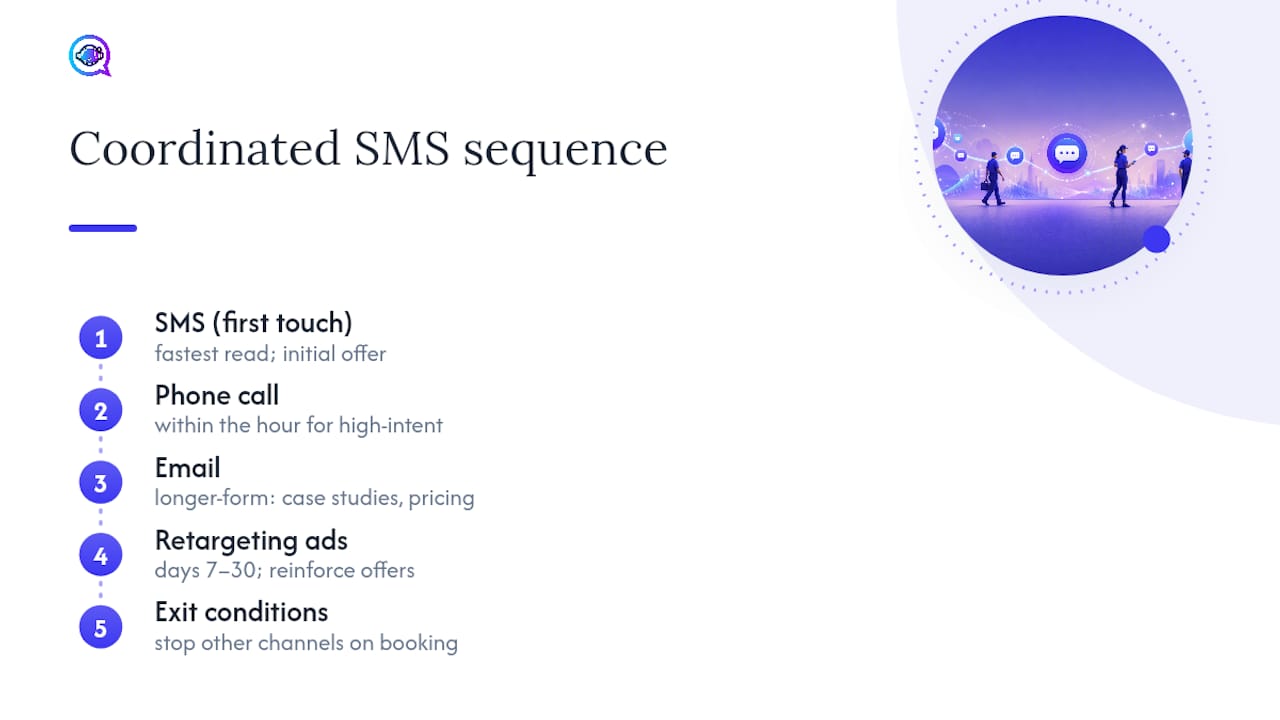
Retargeting ads can reinforce texted offers for leads who haven’t converted yet, keeping your brand visible without adding another direct message to their phone. This works particularly well for the day 7 to day 30 window, once your active SMS cadence has ended but the lead hasn’t fully gone cold.
The coordination detail most teams miss: exit conditions need to sync across channels. If a lead books a call through a text reply, your email nurture sequence should stop sending generic “still interested?” messages the same afternoon. Disconnected channels create the exact kind of contradictory messaging that makes a business look disorganized, even when each individual channel is performing well on its own.
Common Problems and How to Fix Them
Low reply rates usually trace back to one of three causes: messages arrive too generic, timing is off, or the CTA is unclear. Test one variable before assuming the whole approach failed.
High opt-out rates almost always signal frequency fatigue or a mismatch between what the lead expects and what they’re receiving. If someone submitted a form for a single quote and you’re texting them weekly for a month, that’s a consent mismatch, not just an annoyance.
Deliverability problems, messages simply not arriving, often stem from unregistered 10DLC throughput or language that trips carrier spam filters (excessive links, all caps, certain flagged words). Registering your sending number properly and keeping template language conversational solves most of this.
Another frequent issue: teams treat every inbound reply the same way. A lead who texts back “not now” needs a different downstream path than one who texts “yes, call me.” Build branching logic that actually reads reply intent, even at a basic keyword level, rather than routing every response into the same generic “thanks, someone will follow up” holding pattern.
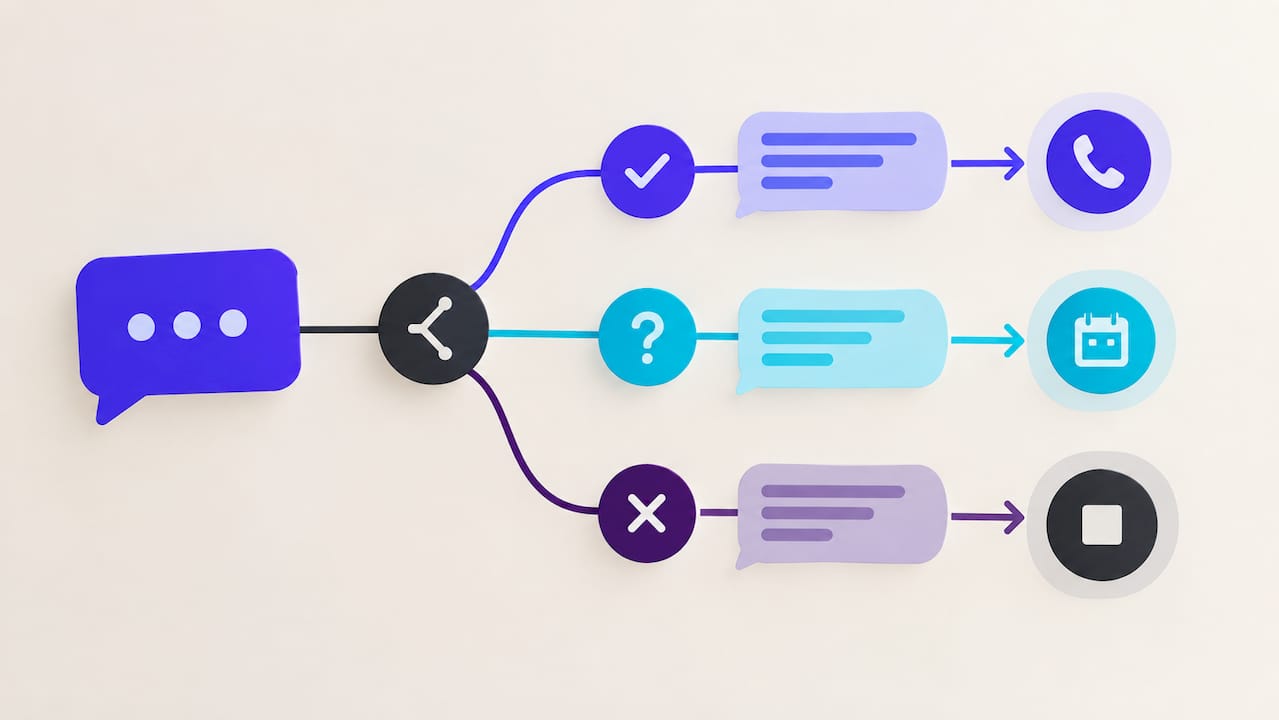
Finally, watch for the trap of over-automating the middle of a conversation. Automated triggers and templates handle the first touch beautifully. But once a lead replies with a real question, a human needs to take over quickly. A bot stuck answering follow-up questions with canned responses undoes the trust the fast initial reply built.
Privacy and Data Security Beyond Basic Compliance
Compliance covers the legal minimum. Protecting lead data well means going further than opt-out language and consent logs.
Store phone numbers and message content with the same access controls you’d apply to any sensitive customer data, limiting who on your team can view full conversation histories. Not every team member needs visibility into every lead’s texted phone number and message thread.
Encrypt data both in transit and at rest if your platform allows it, and confirm any third-party integration you connect (calendar tools, payment processors, marketing platforms) meets a similar security bar before you pipe lead data into it. A workflow that connects to 7,000-plus apps is powerful, but each connection is also a potential exposure point if the receiving app has weak security practices.
Retention policy matters more than most teams realize. Old lead data sitting in a system indefinitely is a liability with no upside once a lead has gone cold for months. Set a reasonable retention window and purge stale records rather than keeping every phone number forever “just in case.”
Finally, be transparent with leads about how their number will be used. A lead who consented to appointment reminders and then starts receiving unrelated marketing texts from a data-sharing arrangement they never agreed to is a trust problem long before it’s a legal one.
The Real Lesson Behind Every Successful SMS Sequence
Most advice on this topic treats templates as the hard part. They’re not. The message wording matters less than most guides suggest, and the timing and exit logic matter more than almost anyone gives them credit for.
The conventional wisdom says “personalize everything” and “test constantly.” Both are true but incomplete. What actually separates a sequence that converts from one that gets ignored is discipline around the boring parts: honoring stop rules instantly, respecting time zones without exception, and pulling a lead out of automation the second they reply. Teams obsess over clever copy and skip the workflow architecture that makes the copy land at the right moment.
If you take one thing from this playbook, prioritize the five-minute first response and the remove-on-reply rule before you spend another hour tweaking template phrasing. Get those two mechanics right, and mediocre copy will still outperform brilliant copy running on a broken cadence.
— Jamaal
Put This Playbook on Autopilot With Astreaux
Astreaux is built for exactly the workflow this article describes: instant AI-driven replies, personalized to your business’s voice, that fire the moment a lead comes in, then follow the kind of cadence and templates outlined above without you managing each message by hand.
Professionals juggling leads across multiple sources can use platforms that connect to existing CRM and thousands of other apps to handle acknowledgment, follow-up sequences, and booking steps in one system. Voice training features allow responses to sound personalized rather than like generic scripts, which matters more than most automation tools admit. For contractors specifically, estimate follow-up and booking automation can cut down on missed leads and no-shows without adding headcount.
Start a trial or book a demo at Astreaux to see how the templates and cadence in this playbook run inside your own pipeline.
Sources
Automated Text Message Follow-Up: Templates, Timing, and Tools - Cynthia Concierge
Sales follow up templates: 25 SMS templates that get replies in 2026
FAQ
What is an SMS follow-up?
An SMS follow-up is a text message sent after a lead takes an action, like submitting a form or missing a call, designed to re-engage them quickly while their interest is still fresh.
What is a good follow-up text message?
A good follow-up text is short, references the lead’s specific action or interest, includes a clear next step, and stays under 160 characters with an opt-out option included on marketing messages.
Is SMS becoming obsolete?
No. SMS still earns a 98% open rate, far higher than most other channels, which makes it one of the most reliable ways to reach a lead within minutes of first contact.
What is a good customer follow-up message?
An effective follow-up message acknowledges the specific interaction, asks a direct question or offers a clear next step, and matches the tone your business uses elsewhere, whether that’s professional or conversational.
How fast should a business respond to a new SMS lead?
Aim to send an automated acknowledgment within five minutes of the lead arriving, since speed-to-lead research consistently links faster first contact to higher conversion rates.