
3 Message Pilot: Automated Lead Nurturing for Service Teams
Automated lead nurturing is a behavior-driven, multi-channel workflow that delivers the right message at the right moment based on what a lead actually does, not just how much time has passed. Done well, it shortens response times, keeps more prospects warm, and hands sales only the leads worth calling. Start small: map one high-value lead journey and build a 3-message pilot sequence before you touch anything else.
TL;DR:
Automated lead nurturing uses behavioral triggers and branching logic to send personalized messages based on lead actions, unlike fixed-schedule drip campaigns.
It involves multiple channels such as email, SMS, video, and internal alerts to guide leads through five key stages: capture, welcome, educate, convert, and re-engage.
Critical setup steps include mapping the customer journey, designing triggers, establishing scoring models, and ensuring CRM and integration readiness before launching campaigns.
Key performance indicators include conversion to qualified leads, time-to-handoff, engagement rates, and pipeline revenue impact, with response speed being particularly crucial.
Common pitfalls include missing scoring models, unclear handoff rules, and overautomating without personal touches, which can be fixed through regular audits and content rotation.
AstreauxTurn Lead Interest Into AppointmentsAstreaux uses conversational AI to engage new leads instantly, personalize responses, and streamline scheduling for service professionals.Explore Astreaux
What Automated Lead Nurturing Actually Means
A drip campaign sends message two on day three no matter what the lead does. Automated lead nurturing behaves differently: it watches actions (a pricing page visit, an opened email, a missed call) and branches the sequence accordingly. That distinction is the whole point of lead nurturing automation, and it’s the piece most small business owners miss when they set up a basic email drip and call it done.

Behavioral triggers replace the calendar as the thing driving your messages. A lead who clicks through to case studies gets a different next email than one who ignores three sends in a row. Branching logic lets you route each type of engagement down its own path instead of forcing every contact through the same five-email arc.
Automated sequences typically run across more than one channel:
Email for detailed content and scheduling links
SMS for time-sensitive nudges (appointment reminders, quick replies)
Video for personalized, face-to-face-style outreach at scale
Internal tasks that alert a salesperson the moment a lead is ready
Where does this live in your stack? Automation sits between three layers: your CRM and workflow engine (the logic and the record of truth), your engagement tools (email and SMS platforms actually sending messages), and analytics (tracking what worked). Miss any one of those three and the system either can’t fire correctly or can’t tell you if it worked.
The Five Stages Every Nurture Sequence Needs
Every automated lead nurturing sequence, no matter the industry, moves leads through the same five stages. Complete systems that run all five together see stronger pipeline efficiency than programs that stop after a welcome email, according to guidance from Sendspark’s step-by-step breakdown of nurture architecture.
Capture and segment. Trigger: form fill, ad click, or inbound call. Message type: an instant acknowledgment plus a segmenting question. Metric: time-to-first-response.
Welcome. Trigger: successful capture. Message type: a short, personal-sounding intro that sets expectations. Metric: open and reply rate.
Educate. Trigger: no conversion action yet. Message type: case studies, FAQs, comparison content matched to where the lead sits in the funnel. Metric: content engagement (clicks, video views).
Convert. Trigger: high engagement score or a direct buying signal (pricing page, demo request). Message type: a direct scheduling link or limited-time offer. Metric: booked-call rate.
Re-engage. Trigger: 14 to 30 days of silence. Message type: a low-pressure check-in or new-offer email. Metric: reactivation rate.
Cadence should tighten as leads move down the funnel. Top-of-funnel education can space out every 3 to 5 days. Once a lead hits the convert stage, cadence should compress to same-day or next-day follow-up. HubSpot Academy’s lead nurturing training frames this stage mapping as the backbone of any sequence built inside its platform, and the same logic applies regardless of which tool you use.
Pro Tip: Build your re-engage stage before you launch anything else. It’s the stage most teams forget, and it’s the one that recovers leads you already paid to acquire.
How to Launch Your First Automated Nurture Sequence
Getting your first sequence live doesn’t require a six-month rollout. Here’s the order that works.
Map the journey. Pick one ideal customer profile and sketch every touchpoint from first contact to closed deal. Don’t try to automate every persona at once.
Define your stages. Use the five-stage framework above and mark where each of your current leads typically stalls.
Design triggers and branching. Decide what action moves a lead from one stage to the next, and what happens if they take no action at all.
Write a 3-to-5-message arc per stage. Keep early messages short and curiosity-driven; save direct offers for the convert stage.
Set a scoring model. Assign point values to actions: email open (+2), link click (+5), pricing page visit (+10), demo request (+20). This process deserves its own attention, and a practical lead scoring playbook can help you set thresholds that match your sales cycle.
Set a handoff threshold and SLA. A common starting point is 30 to 40 points, with a rule that sales must contact the lead within one hour of crossing it. Automating that handoff has a measurable effect: one HubSpot case example cited by Sendspark showed same-day follow-up jump from 38% to 91% once the alert fired automatically instead of relying on a rep checking a dashboard.
Run a small pilot. Follow the same-day-follow-up example and start with one segment, not your entire database.
Analyze and iterate. Pull open rates, click rates, and time-to-handoff after two to three weeks, then adjust the weakest stage.
Before you build a single email, confirm these are in place:
A CRM that can hold lead source, stage, and score in one record
At least one integration between your CRM and your ad or form platform, so leads land automatically
A defined ICP and buying-stage map, even a rough one
Agreement between marketing and sales on what “sales-ready” means
If you already run lead capture through paid ads or a website form, a CRM integration setup guide walks through connecting those sources so nothing falls into a spreadsheet instead of your workflow. Vendor guidance also points to four sequence types covering roughly 80% of B2B pipeline value: demo no-show recovery, free-trial conversion, contract renewal, and cold-lead revival, according to Sendspark. Build those four before you build anything more elaborate.
Which Tools Do You Actually Need?
You need four categories of tools working together, not four separate systems fighting for the same data.
CRM and workflow engine. This is your source of truth for lead status, score, and history. Everything else reports back to it.
Email and SMS engagement platform. Handles the actual sending, tracking opens, clicks, and replies.
AI personalization layer. Generates dynamic content, voice-matched replies, or personalized video at scale once your core sequences are stable.
Analytics and attribution. Ties nurture activity back to closed revenue, not just opens and clicks.
Marketing automation now spans email, customer experience, and AI-driven personalization as connected disciplines rather than isolated tools, according to the Digital Marketing Institute’s guide to marketing automation. That’s a useful reminder that your analytics tool and your email tool need to talk to each other, or you’ll spend more time reconciling spreadsheets than optimizing sequences.
Integration priorities matter more than feature lists. Get your CRM established as the single source of truth first. Then wire up event tracking, so form fills, page visits, and email actions all land in one place. Enrichment tools that fill in missing lead data come third.
Resist the urge to add AI personalization before your fundamentals are stable. AI works best after your core workflows and data hygiene are solid. It scales what’s already working, and it will just as efficiently scale a broken sequence or bad data, according to LeadIQ’s analysis of AI lead nurturing. If your CRM data is messy, fix that before you add a personalization layer on top of it. A CRM reporting guide from Report Fox AI covers what clean attribution data should look like before you scale automation on top of it.
What Should You Measure, and When?
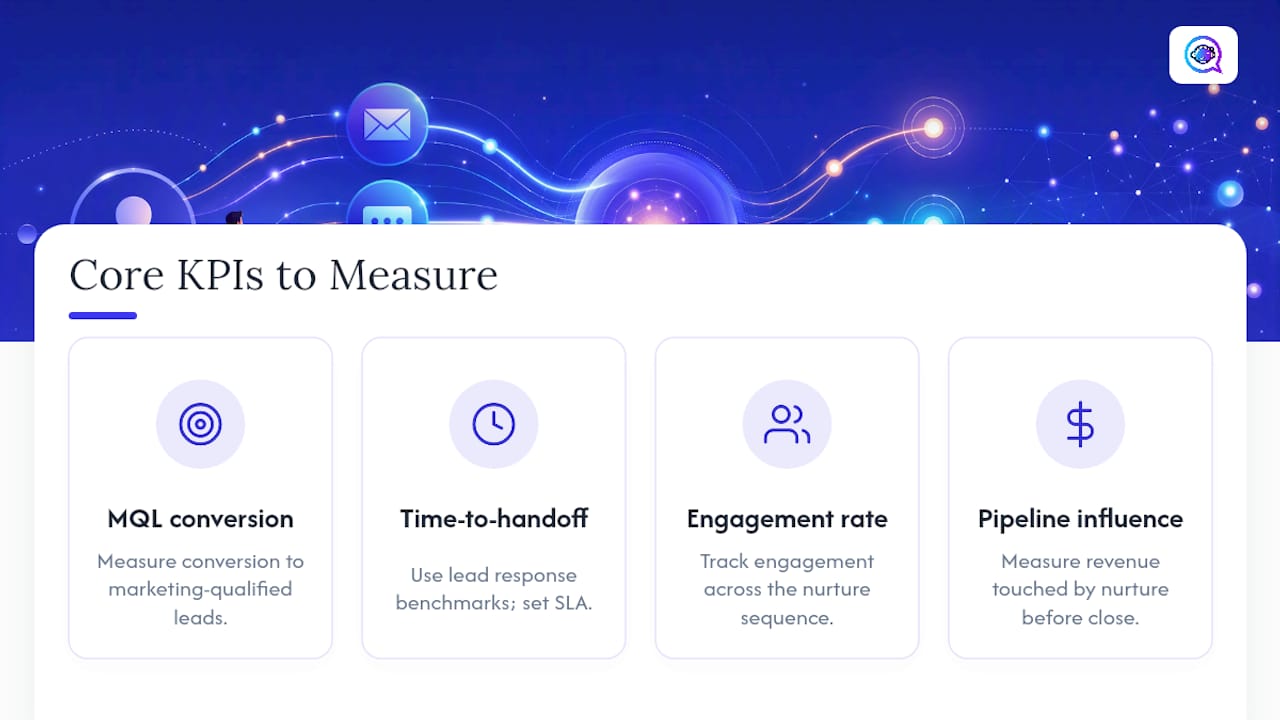
Four KPIs matter more than the rest: conversion rate to marketing-qualified lead, time-to-handoff, engagement rate across your sequence, and pipeline influence (how much revenue touched your nurture flow before closing). Time-to-handoff deserves particular attention. Response speed benchmarks show how much conversion likelihood erodes with every hour of delay, and a lead response time benchmark is worth reviewing before you set your SLA.
Don’t try to automate everything at once. IBM recommends starting with a small A/B pilot: automate delivery for half your leads and keep the other half manual, then compare outcomes before committing to a full rollout, per its marketing automation strategy guidance.
Set expectations honestly. A 2025 AMA study found automated nurturing improves interaction quality and sales conversation depth, but it does not guarantee higher conversion rates across every industry. Results vary enough by sector that measurement discipline matters more than the tool you pick, per the AMA’s research on automated lead nurturing. Plan for measurable engagement lifts within 30 days of launch, with full ROI typically showing up in the 90 to 180 day range as sequences mature and scoring gets tuned.
Where Nurture Programs Break, and How to Fix Them Fast
Most broken sequences share the same handful of root causes.
No scoring model. Every lead looks the same to sales, so reps ignore the alerts entirely.
Unclear handoff rules. Marketing thinks a lead is ready; sales disagrees, and the lead sits untouched.
Overautomation. Every touchpoint is automated, including the moments that need a human voice, and leads feel like they’re talking to a machine.
Content-stage mismatch. Sending a demo offer to a lead still in the education stage, or a blog link to someone ready to book.
Run a one-hour audit: pull your last 20 handoffs and check whether sales contacted each one within your stated SLA. If fewer than half did, your threshold or your alert system needs fixing before you touch content.
Pro Tip: Recalibrate cadence and rotate content every quarter. A sequence that converted well in January can go stale by summer if you’re sending the same three case studies on repeat.
How Astreaux Applies This for Service Professionals
The platform runs conversational AI that replies to new leads instantly, then nurtures them through scheduling automatically. Real estate agents use it to keep buyers warm between showings. Contractors use it to turn estimate requests into booked appointments before a competitor calls back. Therapists use it to handle intake conversations and reduce no-shows. The platform connects with thousands of apps to integrate with existing CRM or scheduling tools.
Compliance: Consent, Privacy, and Opt-Out Rules
Every message in your sequence needs a documented consent trail. If a lead filled out a form, keep a timestamped record of what they agreed to and which channel they opted into, since email consent and SMS consent are treated separately under most regulations.
SMS carries the strictest requirements. You need explicit opt-in language before the first text, not just an email checkbox, and every message must include a clear opt-out instruction such as “reply STOP to unsubscribe.” Failing to honor an opt-out within a reasonable window creates real regulatory exposure, not just an annoyed lead.
Segment your suppression lists carefully. A lead who unsubscribes from your educate-stage emails but never opted into SMS shouldn’t suddenly start receiving texts because your workflow logic didn’t check channel-specific consent. Build your scoring and branching logic to check consent status before every send, not just at the start of the sequence.
Data retention matters too. Decide how long you keep contact records for leads who never converted, and build an automatic purge or archive rule into your workflow rather than leaving stale data sitting in your CRM indefinitely. Review your consent language and suppression logic on a quarterly cadence, the same way you’d review message content, so a policy change on a platform you use doesn’t quietly put you out of compliance.
A Practitioner’s Take on What Actually Moves the Needle
Most teams overbuild their first sequence and underbuild their scoring model. The fix is almost always the opposite of what people assume: fewer messages, tighter triggers, and a scoring threshold you actually enforce. Start with this: Message 1 on day zero (instant acknowledgment plus a scheduling link), Message 2 on day two (a case study matched to their stated interest), Message 3 on day five (a direct offer with urgency). Watch time-to-handoff, engagement rate, and booked-call rate. Adjust one variable at a time.
— Jamaal
Ready to Put This on Autopilot?
Everything in this playbook, from behavioral branching to scoring thresholds to instant handoff alerts, is what Astreaux runs by default instead of asking you to stitch it together yourself. Where most marketing stacks need a CRM, an email platform, an SMS tool, and a separate AI layer wired together by hand, Astreaux replies to new leads instantly in your business’s own voice and carries them through scheduling without a separate automation build.
A demo typically shows how fast setup runs against your existing CRM or ad platform, as the platform connects with thousands of apps. It is used in various service professions to cut response time and reduce no-shows without hiring additional staff. If you run lead flow for a real estate team, the Astreaux page for real estate agents shows how instant replies translate into booked showings. Contractors can see estimate-to-appointment workflows on the contractor-focused page. Start a trial through Astreaux’s main platform and map your first pilot sequence this week.
Sources
FAQ
What Is Automated Lead Nurturing?
Automated lead nurturing is a behavior-triggered, multi-channel workflow that sends the right message based on what a lead does, not just how much time has passed, moving them from first contact toward a sales-ready conversation.
How Do You Automate Lead Generation, Not Just Nurturing?
Lead generation automation typically pairs ad platforms and landing page forms with a CRM integration that captures leads instantly and starts a nurture sequence the moment someone converts, removing the manual step of adding contacts by hand.
Can You Use AI to Generate Leads?
AI can personalize outreach, predict which leads are most likely to convert, and generate content at scale, but it works best layered on top of solid data and workflows rather than replacing lead generation strategy entirely, per LeadIQ’s research.
How Is Automated Lead Nurturing Different From a Drip Campaign?
A drip campaign sends messages on a fixed schedule regardless of lead behavior, while automated lead nurturing uses branching logic that changes the message and timing based on what the lead actually does.
What Metrics Matter Most in a Nurture Sequence?
Conversion rate to marketing-qualified lead, time-to-handoff, engagement rate, and pipeline influence are the four KPIs that show whether a sequence is working, with time-to-handoff often the fastest to improve.