
7 Day Mortgage Lead Nurturing Turns Clicks Into Apps for Loan Officers
Mortgage lead nurturing is the structured, multi-touch process of building trust with a prospect over an extended period from first contact through application, often spanning several months. The single biggest upgrade you can make right now is dropping fixed weekly drips in favor of behavior-triggered, multi-channel cadences. Start by deploying an intense 0 to 7 day sequence and a rate-watch trigger inside your CRM before you touch anything else.
TL;DR:
Behavior-triggered follow-up, especially within the first seven days, significantly increases response rates and lead conversions in mortgage nurturing.
Segmentation into four lead buckets—ready now, shopping, planning, and long-range—determines personalized cadences and messaging strategies.
Matching communication channels to lead behavior, such as SMS for immediacy and email for education, enhances engagement and minimizes ignored messages.
Automated triggers based on site activity and engagement signals improve speed-to-contact and help prioritize high-value leads for immediate action.
Focusing on measurable KPIs like response rates and lead-to-application conversions ensures continuous optimization of nurturing efforts.
AstreauxRespond Faster to Mortgage LeadsAstreaux helps service professionals automate personalized lead engagement, streamline scheduling, and follow up instantly with qualified prospects.See how Astreaux works
What Makes Mortgage Lead Nurturing Actually Work
Nurturing isn’t a newsletter.
Education beats promotion every time. A lead who doesn’t understand PMI, APR, or why underwriting takes three weeks isn’t ready to talk rate. Answer those questions before you pitch anything, and you build the kind of trust that survives a competitor’s cold call.
Speed matters just as much as persistence. Contacting a lead within the first few minutes dramatically raises the odds of a response, and automated, behavior-triggered nurturing can hit that window at a scale no human team can match, then sustain contact for months without going dark.
Here’s what ties it together:
Segmentation and progressive profiling so a first-time buyer gets different content than someone refinancing a jumbo loan
Consistent measurement tracking lead-to-application lift, not just open rates
Trigger response that fires within minutes of a rate page visit, not days
Channel discipline matching the message to the medium a lead actually checks
Skip any one of these and the whole system degrades into noise the lead eventually mutes.
How Do You Segment Leads and Build a Nurture Cadence?
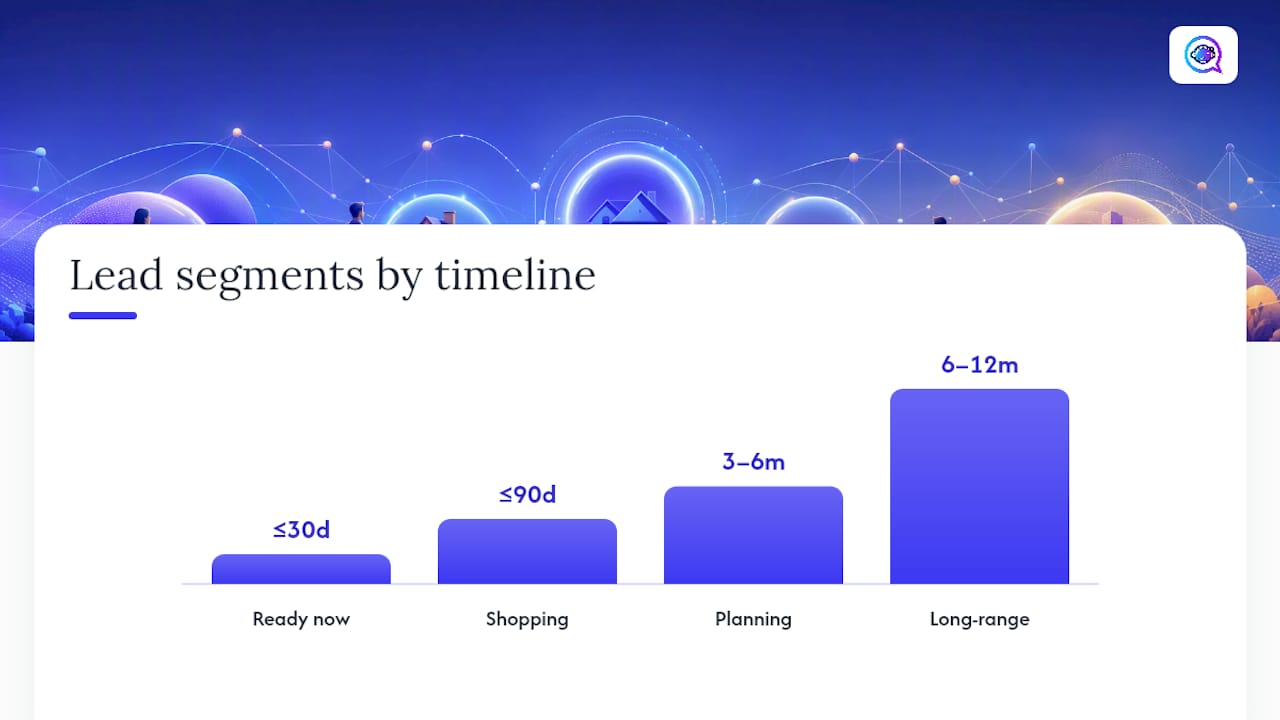
Every lead belongs in one of four buckets, and the bucket determines the cadence:
Ready now — pre-qualified or actively shopping rates within 30 days. Move fast, involve a senior loan officer immediately.
Shopping — comparing lenders, likely to close within 3 months. Heavy touch, rate-focused content.
Planning — saving, house hunting, or waiting on life events, 3 to 6 months out. Educational cadence with periodic check-ins.
Long-range — early researchers, 6 to 12+ months out. Light-touch, high-value content designed to keep you top of mind.
The first seven days set the tone for everything after. Following practitioner-tested mortgage nurture cadences, a strong week-one sequence looks like this:
Day 0: Instant SMS acknowledgment, followed by a call attempt within minutes and a welcome email within the hour.
Day 1: Educational email covering loan types, plus a follow-up text if no response.
Day 2 to 3: Second call attempt, short SMS nudge referencing a specific question they submitted.
Day 4: Email with a rate comparison tool or calculator link.
Day 5 to 6: Value-add content, like a checklist for documents needed to apply.
Day 7: Direct check-in call or text asking where they are in the process.
Months 1 through 3 shift to more spaced touches mixing market updates and borrower education. Frequency typically reduces over subsequent months with longer-term leads maintained on lighter-touch schedules unless engagement increases.
Build drop rules into every stage. If a lead goes cold for 90 days with zero opens or clicks, move them to a less frequent reactivation track instead of continuing frequent contact with someone disengaged.
Pro Tip: Set a requalification trigger for any lead who clicks a rate alert twice in a short time. That behavior alone should prompt a timely phone call, regardless of what stage they’re technically in.
Which Channels Should You Use for Mortgage Follow-Up?
Match the message to the channel, or you’ll train leads to ignore you.
Email carries your educational weight. Use it for loan-type breakdowns, document checklists, and market updates sent weekly to hot leads and monthly to long-range prospects.
SMS wins on immediacy. Texts get opened within minutes, making them ideal for rate-drop alerts, appointment confirmations, and simple check-ins. Keep every message under two sentences and always include an opt-out.
Phone calls belong at inflection points: first contact, after a rate-watch trigger fires, or once a lead requests a pre-approval walkthrough. This is where a lead converts from a name in a database to an actual applicant.
Rate-watch programs ask leads to set a target rate at signup, then notify them the moment it’s hit. According to research on long-cycle mortgage nurturing, rate watches create some of the highest-converting re-engagement moments in the entire funnel because they’re tied to a decision the lead already made to care about.
Direct mail still earns its place for high-value leads, jumbo loans, refinances, or anyone who’s gone quiet on digital channels. A well-timed postcard around a life event, like a rate anniversary, can outperform another email.
Setting Up Triggers and CRM Automation That Actually Fire
Behavioral triggers turn a static database into a living pipeline. Capture at minimum: rate page visits, calculator usage, repeat site visits within 48 hours, and email opens or clicks on rate-specific content. Each of these signals should nudge a lead score up and, past a threshold, hand the lead to a human.
Progressive profiling keeps this from feeling invasive. Instead of a ten-field form up front, ask one or two questions tied to each engagement, like loan purpose after a calculator click, then timeline after a second visit. The profile builds itself over weeks instead of demanding everything on day one.
CRM integration needs a clear service-level agreement. A common structure:
Leads scoring above a set threshold route to a specific loan officer within 5 minutes
Mid-tier leads enter automated nurture with weekly check-ins
Low engagement leads move to quarterly maintenance automatically
Trigger-based nurturing produces measurably better outcomes than static drips, with nurtured leads generating a documented lift in sales opportunities compared to leads left on generic sequences.
This is where conversational AI earns its place in the stack. Astreaux replies to a new lead within seconds, in a voice trained on how your business actually talks, then books the consultation and logs everything back to your CRM automatically, closing the exact speed-to-contact gap that kills so many mortgage pipelines.
What KPIs Should You Track for Mortgage Nurturing?
Report weekly on primary conversion metrics and monthly on channel-level detail. The goal isn’t more data. It’s fewer wasted touches.
Metric Type | What to Track | Reporting Cadence |
|---|---|---|
Primary | Response rate, lead-to-application rate, time-to-application | Weekly |
Primary | Cost per originated loan | Monthly |
Secondary | Open/click rate by channel | Monthly |
Secondary | Engagement-to-call ratio | Monthly |
Secondary | Reactivation lift from cold leads | Quarterly |
Run small experiments constantly: test SMS send times against email open windows, adjust the click threshold that triggers a call, and A/B subject lines on your educational sequence. A partner resource like Paid Lens offers useful frameworks for blended cost tracking if you’re managing paid and organic leads through the same dashboard.
What Compliance Rules Apply to Mortgage Lead Nurturing?
TCPA governs every text and call you automate. You need documented consent before texting, a working opt-out on every message, and immediate suppression once someone opts down. The FCC’s consumer complaint guidance makes clear how seriously unwanted-contact complaints are treated, so build throttling and human handoff thresholds into your automation before you scale it, not after.
Why This Guide Leans on Behavior Over Guesswork
Most nurture advice treats every lead like they’re on the same clock, which is exactly backward. A shopper who clicked a rate alert twice this week deserves a phone call, not the next scheduled email in a drip. The mortgage market is projected to grow to $2.2 trillion in originations in 2026, and that volume rewards loan officers who can act on signals quickly rather than those running the same static sequence on everyone. Conversational AI helps act on behavioral signals at a scale that is difficult for human teams to sustain alone. If you’re testing this approach, start with a 7-day sequence template and watch what the response data tells you before building anything longer.
— Jamaal
How Astreaux Turns This Cadence Into a System
Everything in this guide, the instant first touch, the rate-watch trigger, the CRM handoff, is exactly what Astreaux automates for mortgage brokers day to day. It learns your business’s voice and replies to a new lead in seconds, books the consultation directly onto your calendar, and logs every interaction back to your CRM without you touching a keyboard.

Where this guide describes triggers to build manually, Astreaux connects to more than 7,000 apps so your rate-watch alerts, calculator clicks, and repeat visits already flow into a working system instead of a spreadsheet you have to maintain. That means faster response times on hot leads and fewer of them going cold while you’re on another call. Start a trial and connect your lead sources to see how quickly instant reply automation shortens your time-to-application.
Sources
For deeper reference, check the FCC’s guidance on unwanted calls and texts for TCPA basics, MBA’s origination forecasts for market context, and our own CRM integration setup guide for connecting lead sources to your workflow.
Automated lead nurturing: How it works and benefits | Salesforce
MBA forecast — total single-family mortgage originations to increase to $2.2 trillion in 2026 | MBA
Mortgage lead nurturing: How to convert the 80% who aren’t ready yet | LeadPops
Mortgage lead nurturing: Long sales cycle guide | Leadgen-economy
FAQ
How Much Do Mortgage Leads Typically Cost?
Cost varies widely by source and exclusivity, ranging from a few dollars for shared internet leads to substantially more for exclusive, high-intent leads, which is exactly why nurturing existing leads costs less than buying new ones.
What Are the 3 C’s in a Mortgage?
The 3 C’s typically refer to credit, capacity, and collateral, the core factors underwriters evaluate when assessing a borrower’s loan eligibility.
How Much Commission Do Loan Officers Make on a $500,000 Loan?
Commission structures vary by lender and compensation plan, but they’re commonly based on a percentage of loan volume, so a larger loan pays proportionally more than a smaller one under the same commission rate.
How Do You Generate Leads for a Mortgage Loan Officer?
Common sources include referral partnerships with real estate agents, paid digital campaigns, rate-watch sign-ups, and organic content, but the leads you already have on file convert better when they receive consistent, trigger-based follow-up instead of sitting untouched. Tools like Astreaux help capture and immediately respond to leads pulled from ad platforms and referral forms alike.
How Do I Nurture Mortgage Leads Who Have Gone Cold?
Move unresponsive leads to a quarterly reactivation sequence with fresh, value-driven content like a market update or rate comparison, and watch for any engagement spike that signals it’s time to move them back into active nurture.