5 Rollout Steps to Deploy TCPA Safe AI Texting for U.S. Service Teams
AI texting for business automates the reply, qualification, and booking work that used to sit in someone’s inbox until they got around to it. It reads an inbound lead, matches it against your knowledge base and CRM history, and answers in your voice within seconds instead of hours. For service professionals, real estate agents, contractors, therapists, and similar teams, Astreaux is built specifically to run this loop without losing the personal tone that closes deals. The rest of this guide covers how it works, how to roll it out, and what U.S. compliance rules you cannot skip.
TL;DR:
AI texting speeds up response times for leads and can qualify prospects instantly, often before a human reviewer sees the message.
Proper setup involves selecting the right phone number type, registering 10DLC, and building vetted reply templates to maintain tone consistency.
Compliance requires prior consent, opt-out handling, and maintaining detailed audit trails to avoid legal issues in the United States.
Early implementation should start with low-volume lead sources and a clear escalation process to prevent tone drift and oversights.
High-volume businesses with organized CRMs benefit most, while over-automation on complex issues may undermine trust and compliance.
What Are the Main Business Uses of AI Texting?
The value of AI texting shows up fastest where speed and volume collide. A contractor getting many web-form leads a week can’t text each one back inside a minute. An AI SMS assistant can, and speed alone often decides who gets the job.
Here’s where teams see the clearest returns:
Instant lead reply and qualification. The moment a lead fills out a form or texts in, an AI text reply goes out asking the two or three questions that determine fit (budget, timeline, location) before a human ever sees the thread.
Appointment booking and reminders. The assistant checks calendar availability, proposes times, confirms the booking, and sends reminder texts that cut no-shows.
Support triage. Routine questions (“What’s your service area?” “Do you take insurance?”) get answered instantly, freeing staff for the calls that actually need a human.
Personalized campaigns at scale. Bulk SMS to a list of past clients can still reference their name, last service date, or property address instead of reading like a blast.
Escalation to a human. Gating rules should trigger a handoff on anything involving price negotiation, a complaint, or a question the knowledge base can’t answer confidently.
That last point matters more than it sounds. Forrester’s research on customer service finds that consumer expectations for speed and consistency routinely outpace what companies actually deliver, which is exactly the gap AI texting is designed to close.
How Does an AI Texting System Actually Work?
Underneath the friendly reply is a fairly specific technical stack, and understanding it helps you ask better vendor questions.
Generative models plus a knowledge base produce the reply. The system pulls from your FAQs, pricing sheets, and past conversations to draft a response that sounds like your business, not a generic bot. This is the same principle behind tools like Microsoft Copilot for administrative drafting: AI acts as a co-pilot on repetitive text tasks so staff can handle the complex ones.
AI agents detect intent and run flows. A message about scheduling triggers a booking flow; a message with a complaint keyword triggers escalation. This is the automated texting layer that separates a smart AI SMS bot from a basic autoresponder.
Context comes from your CRM, web forms, and conversation history. Personalization depends on the system knowing who the lead is and what they’ve already said, not starting cold every time.
Phone number type affects throughput and trust. 10DLC (10-digit long code) numbers work for standard local-feeling conversations but have per-carrier sending limits. Toll-free numbers offer higher throughput after verification. Short codes handle the highest volume but cost more and take longer to provision. Choosing wrong here is one of the most common early mistakes.
Shared inboxes, routing, and audit logs keep humans in control. Every AI-generated message should be visible to your team in real time, with a record of who (or what) sent it and when.
Simple drafting tools like QuillBot’s response generator show the drafting piece in isolation, but a real AI texting platform combines that drafting with intent detection, CRM context, and compliant sending, which is a different order of complexity.
How Do You Roll Out AI Texting Without Breaking Things?
Adopting automated texting for businesses works best as a staged rollout, not a flip of a switch.
Map outcomes and pick pilot KPIs first. Decide what you’re measuring: reply time, booking rate, or lead-to-appointment conversion. Without a baseline, you can’t prove the pilot worked.
Select your number type and confirm 10DLC registration. Brand and campaign registration takes time; start it before you need to send anything.
Build 5 to 10 approved reply templates tied to CRM fields. This is the single fastest way to limit tone drift and speed up review, since the AI is drafting from vetted language instead of improvising.
Set human-in-the-loop rules and an escalation list. Decide upfront which topics always route to a person.
Integrate with your CRM and calendar, run a small pilot, then scale. Start with one lead source or one location before turning it on everywhere.
Pro Tip: Run your pilot on your slowest lead source first, not your busiest one. You’ll catch tone and logic problems with less exposure before scaling to your highest-volume channel.
Is B2B Texting Legal, and What Rules Apply?
Yes, business texting is legal in the United States, but it’s tightly regulated, and getting the mechanics wrong causes real deliverability and legal problems. Compliance basics for how to use AI for business texting come down to four things.
Prior express consent under the TCPA. The Telephone Consumer Protection Act generally requires documented consent before you send marketing texts to a consumer, and the consent needs to cover the specific type of message you’re sending.
10DLC brand and campaign registration. Carriers filter or block unregistered traffic. Registering your brand and declaring your use case with your provider reduces the odds of your texts getting silently dropped.
Opt-out handling. STOP, STOPALL, and UNSUBSCRIBE requests must be honored automatically and confirmed back to the sender, every time, with no exceptions.
Consent audit trails. Keep timestamped records of when and how each contact opted in. If a complaint or audit ever comes up, this is what protects you.
Astreaux’s own TCPA compliance guide for SMS marketers walks through consent language and opt-out flows in more depth, and for anything unusual, like cross-border contacts or bundled consent across multiple services, a quick legal review beats guessing.
What Results Are Service Professionals Seeing From Astreaux?
Astreaux was built around the specific rhythm of service businesses: leads come in unevenly, and the first reply usually decides whether the lead becomes a client. The platform learns each business’s voice, then handles instant lead replies, appointment booking, and prospect nurturing without sounding like a script. Voice training lets a therapist’s assistant sound noticeably different from a contractor’s, even though both run on the same underlying system. Integrations with more than 7,000 apps mean the CRM and calendar you already use plug in rather than getting replaced.
Real estate agents using instant, AI-driven replies to new leads see faster response times and more booked showings, while contractors report fewer no-shows once automated reminders are part of the workflow.
For teams wanting the integration details, Astreaux’s guide on connecting CRM tools to AI outreach covers the setup steps directly.
When Should You Actually Adopt This, and What Trips Teams Up?
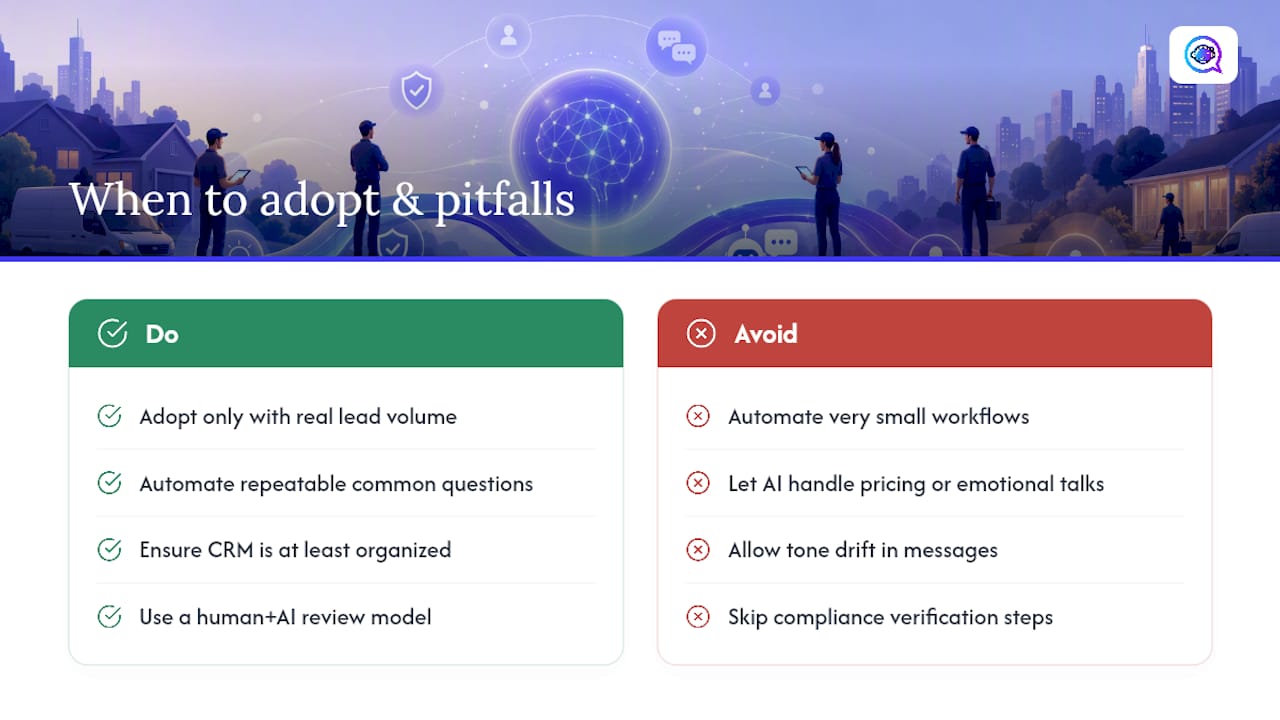
Adopt AI texting once you have real lead volume, a repeatable set of questions you answer over and over, and a CRM that’s at least somewhat organized. Below that threshold, you’re automating something too small to matter.
The failure pattern I see most is over-automation: letting the AI handle pricing objections or emotionally loaded conversations it was never trained for. Tone drift and skipped compliance steps follow close behind. The fix isn’t less AI, it’s a tighter human-plus-AI model, where a person reviews flagged conversations daily during the pilot and weekly once it’s stable.
— Jamaal
Get AI Texting Working for Your Business
Astreaux turns the lead response gap into your advantage instead of your bottleneck. Where a general chatbot gives you generic replies, Astreaux learns your specific business voice and applies it the moment a lead comes in, so contractors get faster estimate requests answered and therapists get intake questions handled without sounding automated.
If you run a contracting business, the contractor-specific landing page shows exactly how estimate booking works end to end. Therapists and counselors can see intake automation built for their workflow on the therapist landing page. Compliance and onboarding support are built into setup, so you’re not left figuring out 10DLC registration alone. Start a trial or book a demo at Astreaux and see your own lead response time before and after.
Sources
FAQ
What Is the Best AI Chat Tool for Business Texting?
The best option depends on your industry, but for service professionals specifically, platforms built around lead response and appointment booking, like Astreaux, outperform general-purpose chat tools because they’re trained on your voice and connected to your CRM.
Is B2B Texting Legal in the United States?
Yes. Business-to-business and business-to-consumer texting are both legal under U.S. law, but the TCPA requires documented prior consent for marketing messages, and 10DLC registration is needed to avoid carrier filtering.
Is There a Free Texting App for Business?
Basic free texting apps exist for simple one-to-one messaging, but they lack the AI reply generation, CRM context, and compliance tools that automated business texting requires. Most service teams outgrow free tools quickly once lead volume increases.
How Much Does an AI Texting Subscription Cost?
Pricing varies by provider and typically scales with message volume, number of users, and integration depth. Rather than quoting a flat rate, most vendors, including Astreaux, offer a free trial or demo so you can see the actual cost against your lead volume before committing.
Do I Need a Special Phone Number for AI Texting?
Yes. Most businesses use 10DLC numbers for standard conversations, while higher-volume senders may need toll-free or short code numbers, each with different registration steps and throughput limits.