

Conversational AI for Sales: The Revenue Leader’s Guide
Conversational AI for sales is the technology layer that lets an AI agent handle real-time, two-way dialogue with prospects across chat, SMS, voice, and email — qualifying leads, booking meetings, and updating your CRM without a rep lifting a finger. Gartner’s research on B2B sales interactions signals a broad industry shift toward digital-first buyer engagement, making this the right moment for sales leaders to pilot it. If you run a service business and your team is still manually chasing inbound leads, the fastest win is deploying a conversational AI agent on your highest-traffic lead channel first.
Three immediate use cases to start with:
Lead capture and qualification across web chat, SMS, and landing pages
Automated meeting scheduling with direct calendar handoff to a rep
Instant follow-up sequences for leads that go cold after the first touch
Key Takeaways
Conversational AI for sales delivers the fastest ROI when deployed on your highest-volume lead channel first, with clear human handoffs and CRM integration in place before launch.
Point | Details |
|---|---|
Start with one channel | Pick your highest-traffic lead source and deploy a single use case — qualification or scheduling — before expanding. |
CRM data quality is the prerequisite | A single source of truth in your CRM determines whether your AI qualifies leads accurately or produces unreliable signals. |
Measure meetings booked per 100 leads | Track this metric from day one of your pilot alongside response time and rep hours saved. |
Compliance comes before launch | Review TCPA consent requirements and state recording laws before any outbound voice or SMS campaign goes live. |
Astreaux for service verticals | Astreaux automates instant lead replies, appointment booking, and follow-up for real estate agents, contractors, and mortgage brokers with 7,000+ app integrations. |
What is conversational AI for sales, and how does it work?
Conversational AI for sales is not a scripted chatbot. It uses natural language processing (NLP) and natural language understanding (NLU) to interpret what a prospect actually means, not just what they typed. That distinction matters in practice: a rule-based bot breaks when a prospect says “I’m looking for something around $400K” instead of clicking a price-range button. A conversational AI agent handles that variation naturally.
The architecture has five core components working in sequence:
Intent recognition (NLP/NLU): Parses the prospect’s message to identify what they want — information, pricing, a meeting, or a human rep.
Dialog manager: Tracks conversation context across multiple turns so the agent remembers what was said two messages ago.
Response generation: Produces a reply, either from a trained template library or a generative model fine-tuned on your business voice.
Speech-to-text / text-to-speech: Enables voice channel support, converting spoken input to text for processing and returning audio output.
Integrations layer: Connects to your CRM, calendar, telephony platform, and analytics stack so every conversation creates a data record automatically.
“A single source of truth reduces data fragmentation and improves the reliability of downstream AI and automation.” Centralizing your CRM data before deploying a conversational agent is not optional — it is the prerequisite that determines whether your AI qualifies leads accurately or sends garbage signals to your pipeline. MuleSoft’s explanation of SSOT makes this case clearly.
Data flows like this: a prospect submits a form or starts a chat → the conversational agent engages, collects qualification signals, and schedules a meeting → the CRM record is created or updated → a rep receives a briefed handoff notification. No manual data entry, no lag.
Should you focus on inbound or outbound conversational AI first?
The answer depends on where your lead volume actually lives.
Inbound conversational AI activates when a prospect reaches out first — through your website, a landing page, or an inbound call. The agent’s job is to respond instantly (within seconds, not hours), qualify the lead against your criteria, and book a meeting before the prospect moves on. Key KPIs: response time, lead-to-meeting rate, and cost per qualified appointment.
Outbound conversational AI puts the AI in the role of an SDR — initiating contact via SMS, email, or voice with a list of prospects. AI SDR workflows can run personalized multi-touch sequences at scale without proportional headcount. For a practical look at how outbound AI SDR workflows are structured, LeadPilot’s AI SDR resources offer a useful reference. Key KPIs: reply rate, meetings booked per sequence, and sequence-to-opportunity conversion.
Use this decision checklist to pick your starting point:
High inbound traffic, low SDR capacity? Start with inbound. The ROI is immediate and the setup is simpler.
Large outbound list, limited rep bandwidth? Outbound AI sequences let you work more leads without adding headcount.
Average deal size above $10K? Keep human reps in the loop for closing; use AI for top-of-funnel qualification only.
Regulated vertical (mortgage, insurance, healthcare)? Review TCPA and state consent requirements before launching any outbound voice or SMS campaign.
A real estate agent running paid search ads benefits most from inbound conversational AI — every new lead gets an instant, personalized reply the moment they fill out a form, even at 11 PM. A mortgage broker with a cold list of refinance prospects benefits more from an outbound AI sequence that surfaces interested buyers before a competitor does.
How does conversational AI differ from chatbots, IVR, and sales automation?
These four technologies are often conflated, and deploying the wrong one for a use case wastes both budget and buyer goodwill.
Rule-based chatbots: Follow a decision tree. They work well for FAQs and simple routing but break on anything outside their scripted paths. Maintenance is high because every new scenario requires a manual update.
IVR (Interactive Voice Response): Menu-driven phone systems (“Press 1 for sales”). They handle call routing efficiently but create friction for buyers who want a natural conversation. Abandonment rates climb fast when menus are long.
Sales automation / workflow engines: Task-driven tools (think sequence schedulers, email drip platforms) that trigger actions based on rules and timers. They do not converse — they execute.
Conversational AI: Context-aware and adaptive. It understands intent, handles multi-turn dialogue, learns from new data, and integrates deeply with CRM and calendar systems to take action, not just respond.
The buyer experience gap between a scripted chatbot and a well-trained conversational AI agent is significant. A chatbot that fails to understand a prospect’s question sends them to a competitor. A conversational AI agent that answers naturally and books the meeting keeps them in your funnel.
Pro Tip: Never automate a step where a wrong answer costs you the deal. High-stakes objection handling, contract negotiation, and complex needs discovery should always trigger a human handoff. Build your escalation rules before you build your conversation flows.
Gartner’s guidance on hybrid sales models reinforces this: conversational AI performs best as part of a model that blends digital automation with human sellers, not as a full replacement for them.
What concrete benefits does conversational AI deliver for your sales team?
The business case for conversational AI in sales rests on four measurable outcomes.
Faster response time is the most immediate. Leads contacted within the first five minutes of inquiry are significantly more likely to convert than those contacted after an hour. An AI agent responds in seconds, around the clock, without rep involvement.
More meetings booked per lead. When an AI agent qualifies and schedules in the same conversation, the drop-off between “interested prospect” and “calendar invite accepted” shrinks. Astreaux’s lead outreach automation documents how platform-led automation speeds outreach and reduces the manual steps between first contact and booked appointment.
Higher rep productivity. Reps spend less time on data entry, follow-up emails, and unqualified calls. That time shifts to closing. A systematic review of conversational agents found they can improve communication and task outcomes in operational workflows when properly designed — a finding that translates directly to sales team efficiency.
Scale without proportional headcount growth. A single conversational AI deployment can handle hundreds of simultaneous conversations. For service businesses with seasonal lead spikes — contractors in spring, real estate agents in Q2 — that elasticity is a real operational advantage.
Key metrics that typically improve:
Lead response time (from hours to seconds)
Meetings booked per 100 leads
Rep hours saved per week on admin and follow-up
Lead-to-opportunity conversion rate
Pipeline velocity (days from first contact to qualified opportunity)
Which conversational AI use cases deliver the highest ROI for sales teams?
Not every use case is worth piloting first. These six deliver the clearest, fastest returns.
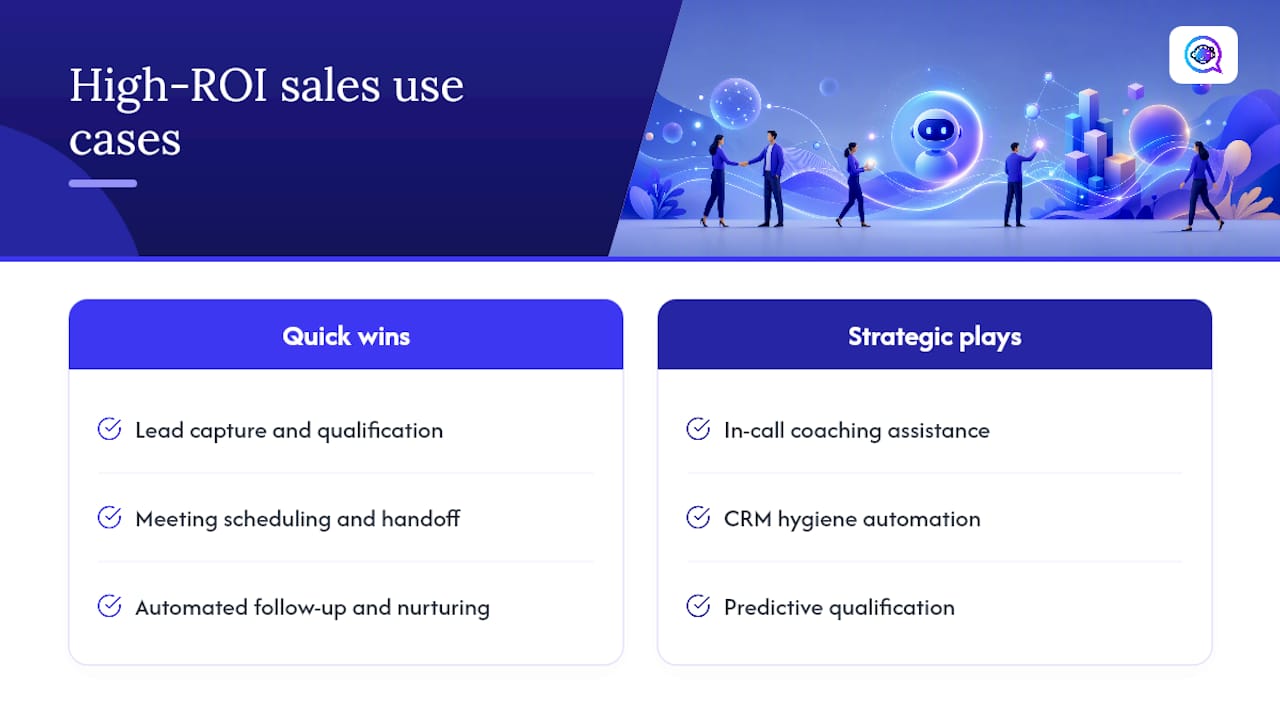
Lead capture and qualification is the highest-ROI starting point for most service businesses. The AI agent asks qualification questions, scores the lead, and routes it — all before a rep is involved. For real estate agents, this means every web or ad lead gets a personalized reply and a qualification conversation instantly. See how this works in practice for real estate lead outreach.
Meeting scheduling and handoff eliminates the back-and-forth that kills momentum. The agent checks rep availability, offers time slots, and sends a calendar invite in the same conversation. AI appointment setting covers the mechanics of reducing no-shows alongside booking rates.
Automated follow-up and nurturing keeps leads warm between touchpoints. A contractor who gets a quote request at 7 PM gets an immediate reply, a follow-up the next morning, and a check-in three days later — all without a rep scheduling any of it.
Live transcription and call summaries give reps a structured record of every conversation without manual note-taking. Summaries feed directly into the CRM, so pipeline data stays current.
CRM hygiene automation updates contact records, deal stages, and activity logs based on conversation outcomes. This is where CRM integration quality directly affects pipeline accuracy.
In-call coaching assistance surfaces objection-handling prompts and relevant talking points during live calls, helping newer reps perform closer to your top performers from day one.
Quick wins: Lead capture, scheduling, and follow-up sequences. Strategic plays: Live coaching, CRM automation, and predictive qualification.
How do you implement conversational AI in sales? A step-by-step rollout
A 12-week pilot is the right frame for a first deployment. Move faster and you skip the data work that determines quality. Move slower and you lose organizational momentum.
Weeks 0–2: Define objectives and select your pilot use case. Pick one channel and one use case. Write down your success metrics before you build anything. Stakeholder alignment at this stage — sales ops, IT, and legal — prevents costly rework later. Change management guidance from Baylor University emphasizes that clear ownership and defined processes are critical for successful tech adoption.
Weeks 2–4: Map data sources and integrations. Audit your CRM data quality. Connect your calendar, telephony, and lead sources. Establish your single source of truth before the agent goes live.
Weeks 4–6: Build conversation flows and training data. Write scripts that match your brand voice. Design fallback rules for every scenario the AI cannot handle confidently. Test in a sandbox with real historical conversations.
Weeks 6–8: Soft launch with a small lead segment. Run the AI agent on 20–30% of inbound leads. Monitor every conversation manually for the first two weeks.
Weeks 8–10: A/B test and iterate. Compare AI-handled leads against a control group. Measure response time, meeting rate, and conversion. Label edge cases and retrain.
Weeks 10–12: Scale and train reps. Expand to full lead volume. Brief reps on handoff protocols and how to use AI-generated summaries. Set a monthly review cadence for conversation quality.
Pro Tip: Build your human escalation trigger before your first conversation goes live. Define the exact conditions — a prospect expresses frustration, asks a legal question, or requests a specific rep — and make sure the handoff is instant and warm, not a dead end.
U.S. compliance note: If your conversational AI touches outbound voice or SMS, review TCPA requirements for prior express written consent. For recorded calls, most U.S. states require at least one-party consent, but several require all-party consent. Confirm your state’s rules before recording any sales call.
How do you measure ROI from conversational AI in sales?
Track these metrics from day one of your pilot.
Response time: Seconds from lead submission to first AI reply (baseline vs. pilot)
Meetings booked per 100 leads: Your primary conversion metric
Lead-to-opportunity rate: How many AI-qualified leads become active pipeline
Win rate on AI-sourced opportunities: Tracks quality of AI qualification over time
Rep hours saved per week: Quantifies productivity gain for the business case
Pipeline velocity: Days from first contact to closed-won, compared to non-AI leads
A simple ROI frame: multiply the lift in meetings booked per month by your average deal value, then multiply by your close rate. Subtract the platform cost. If a conversational AI agent books additional qualified meetings per month and your average deal is several thousand dollars with a reasonable close rate, that can result in meaningful incremental revenue against software cost.
For A/B testing, split your inbound leads randomly into AI-handled and rep-handled groups. Run the test for at least 30 days and 200 leads per group to get statistically meaningful results. Isolate one variable at a time — do not change your conversation script and your qualification criteria simultaneously.
What are the most common conversational AI deployment pitfalls?
Most failed deployments share the same root causes.
Poor training data: An AI agent trained on generic scripts instead of your actual sales conversations will misread intent and frustrate prospects. Use real historical chat logs and call transcripts as your training foundation.
Over-automation with no human fallback: When a prospect hits a dead end because the AI cannot escalate, they leave. Every flow needs a clear “connect me to a person” path.
Fragmented data pipelines: If your CRM, calendar, and lead sources are not connected, the AI makes decisions on incomplete information. Fix your data architecture first.
Ignoring CRM hygiene: Garbage in, garbage out. An AI agent that pulls stale or duplicate contact records will send the wrong message to the wrong person.
Unrealistic success metrics: Expecting a 10x lift in week one sets the project up for cancellation. Set 90-day targets and measure incrementally.
Privacy and compliance hotspots: Under the TCPA, automated calls and texts to cell phones require prior express written consent. Several states, including California under the CPPA framework, impose additional data handling requirements on AI-driven outreach. Document your consent workflows and data retention policies before launch.
How Astreaux addresses these requirements
Astreaux is built specifically for service professionals who need conversational AI that works out of the box, not a six-month enterprise integration project.
Feature-to-checklist mapping:
Instant lead replies: Astreaux responds to new leads in seconds, matching your business voice through its voice training capability — so prospects get a personalized reply, not a generic bot message.
Appointment booking: Direct calendar integration handles scheduling and confirmation, with automated reminders that reduce no-show rates for real estate agents, contractors, and mortgage brokers.
CRM and calendar integrations: Astreaux connects with over 7,000 apps, covering the CRM, calendar, and ad platform integrations your team already uses.
Bulk SMS campaigns: Outbound nurturing sequences run automatically, keeping your pipeline warm without rep involvement.
Analytics and pipeline tracking: Built-in reporting surfaces the metrics — response time, meetings booked, conversion rates — that your business case requires.
For contractors, the platform automates estimate-request replies and books consultations without a rep on call. For mortgage brokers, it qualifies and schedules refinance and purchase leads around the clock. For therapists, it handles intake and scheduling in a compliant, low-friction flow.
What most sales leaders get wrong about conversational AI
The most common mistake is treating conversational AI as a cost-cutting tool rather than a revenue acceleration tool. Teams that deploy it primarily to reduce headcount tend to under-invest in conversation design, skip the training data work, and end up with an agent that frustrates prospects instead of converting them.
The teams that see real pipeline impact treat the AI agent as a top-of-funnel rep that needs onboarding, coaching, and performance reviews just like a human. They review conversation logs weekly, label failures, retrain the model, and iterate on scripts.
One tactic that consistently gets overlooked: use your AI agent’s conversation logs as a coaching resource for your human reps. The patterns that cause prospects to disengage in AI conversations are the same patterns that kill deals in human calls. Your AI’s failure cases are your rep training curriculum.
Astreaux makes your first pilot straightforward
Most service professionals lose qualified leads not because their offer is wrong but because their response time is. Astreaux closes that gap by putting a trained AI agent on your highest-traffic lead channel from day one, with integrations to the CRM and calendar tools you already use.
Whether you are a real estate agent running paid ads, a contractor fielding estimate requests, or a mortgage broker working a refinance list, Astreaux’s AI lead outreach platform is built for your workflow. The setup connects to over 7,000 apps, the voice training adapts to your business tone, and the analytics show you exactly which leads converted and why. Visit Astreaux to start your trial and see your first AI-booked appointment within the week.
Sources
Vendor product pages (Salesloft, Pipedrive, Nextiva) were reviewed for feature context only and are not cited as neutral industry evidence.
FAQ
What is conversational AI for sales?
Conversational AI for sales uses NLP and NLU to conduct real-time, two-way dialogue with prospects across chat, SMS, voice, and email — qualifying leads, booking meetings, and updating CRM records automatically.
How is conversational AI different from a standard sales chatbot?
A standard chatbot follows a fixed decision tree and breaks on unexpected inputs. Conversational AI understands intent, tracks context across multiple turns, and adapts its responses — making it far more effective for open-ended sales conversations.
What metrics should I track during a conversational AI pilot?
Track response time, meetings booked per 100 leads, lead-to-opportunity conversion rate, and rep hours saved per week. Run the pilot for at least 30 days and 200 leads before drawing conclusions.
Is conversational AI compliant with U.S. sales regulations?
TCPA requires prior express written consent for automated calls and texts to cell phones. Several states impose additional data handling rules. Document your consent workflows and confirm your state’s call-recording consent requirements before launch.
Can Astreaux handle conversational AI for service professionals?
Yes. Astreaux automates instant lead replies, appointment booking, and follow-up sequences for real estate agents, contractors, mortgage brokers, and therapists, with integrations to over 7,000 apps including major CRM and calendar platforms.