Best Drift Alternatives for B2B Teams in 2026
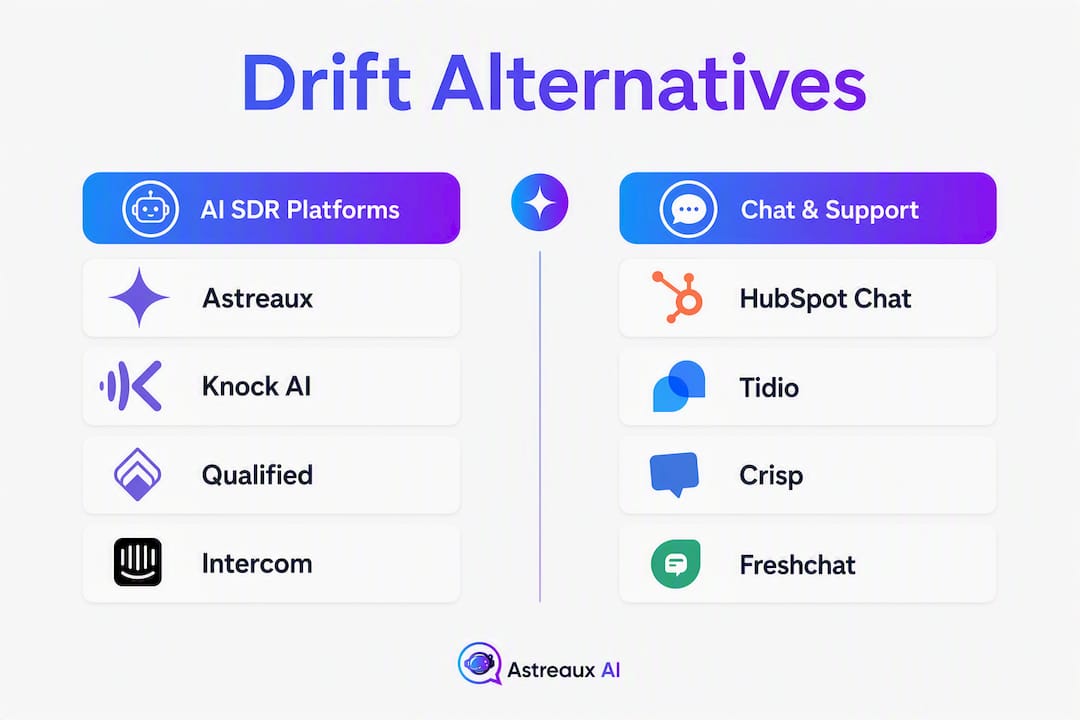
The strongest drift alternatives available right now are Astreaux, Knock AI, HubSpot Chat, Intercom, Qualified, Tidio, Crisp, Freshchat, LiveChat, Chatbase, and Landbot. For service professionals — real estate agents, contractors, therapists, and anyone whose pipeline depends on booked appointments rather than support tickets — Astreaux is the recommended pick. It combines voice-trained AI responses, automated appointment booking, CRM continuity, and connections to over 7,000 apps in a single platform built specifically for service-led conversion.
Tool | Best For | AI SDR Capability | Omnichannel | Appointment Booking | CRM Integrations | Pricing Shape |
|---|---|---|---|---|---|---|
Astreaux | Service professionals | Voice training + AI SDR | SMS, email, multi-channel | Yes, automated | 7,000+ apps via Zapier | Subscription SaaS |
Knock AI | Multifamily real estate | AI leasing agent | Email, SMS | Yes | Property management CRMs | Contact for pricing |
HubSpot Chat | HubSpot-native teams | Basic bot flows | Email, CRM-linked | Via HubSpot calendar | Native HubSpot CRM | Free tier; paid plans |
Intercom | Mid-market SaaS support | AI Fin agent | Email, in-app | Limited | Salesforce, HubSpot | Per-seat + usage |
Qualified | Enterprise Salesforce teams | Pipeline Cloud AI | Web-first | Yes | Native Salesforce | Enterprise pricing |
Tidio | SMB e-commerce | Lyro AI chatbot | Email, Messenger | Limited | Shopify, WooCommerce | Free tier; paid plans |
Crisp | Small teams / startups | Basic AI replies | Email, Messenger, SMS | No | Zapier, Slack | Free tier; paid plans |
Freshchat | Mid-market support | Freddy AI | Email, WhatsApp | Limited | Freshworks suite | Per-agent pricing |
LiveChat | Support-first teams | ChatBot add-on | Email, SMS | Via integrations | Salesforce, HubSpot | Per-seat pricing |
Chatbase | Custom AI chatbot builders | Custom GPT-4 agent | Web widget only | No | Zapier, Slack | Usage-based |
Landbot | No-code flow builders | Flow-based bot | WhatsApp, web | Via Calendly | Zapier, HubSpot | Per-conversation |
Quick situational picks:
You run a service business and need automated scheduling with a consistent brand voice: start with Astreaux.
You live inside Salesforce and need enterprise-grade pipeline routing: evaluate Qualified.
You are an SMB on a tight budget needing basic live chat with a free entry point: Tidio or Crisp.
Why are teams leaving Drift in 2026?
Drift’s acquisition by Salesloft, and its subsequent consolidation into the Salesloft/Clari ecosystem, changed the product roadmap in ways that left many mid-market and SMB buyers without a clear upgrade path. Post-acquisition product consolidation pushed enterprise customers toward expensive bundled suites while smaller teams found themselves paying for capabilities they never needed.
The practical pain points show up fast in pipeline operations:
Pricing and enterprise lock-in. Drift’s pricing was never SMB-friendly, and the acquisition made it worse. Teams that only needed meeting booking and lead qualification found themselves paying for a full revenue-engagement suite.
Chat-only limits. A website widget cannot follow a buyer to LinkedIn, WhatsApp, or their inbox. When website traffic dips, a chat-only tool goes quiet — and so does your pipeline.
CRM disconnects. Drift’s CRM sync has historically required significant configuration. When that sync breaks, reps work from stale data and leads fall through the gaps.
Implementation overhead. Onboarding Drift at full capability required dedicated RevOps support. For teams without that resource, the tool never reached its potential.
Roadmap uncertainty. With Drift being sunset as a standalone product, buyers have legitimate concerns about feature deprecation and support continuity.
The result: mid-market and SMB teams are moving to specialized AI platforms that offer faster time-to-value and self-serve onboarding, while enterprise teams are being absorbed into legacy suites whether they want to be or not.
Pro Tip: Before you evaluate any replacement, document exactly which Drift features your team actually uses. Most teams use fewer than four. That list becomes your minimum viable feature set — and it will save you from over-buying a replacement.
How do you pick the right Drift alternative for your team?
The single biggest mistake teams make when replacing Drift is picking a support-first tool for a pipeline problem. A live chat widget optimized for CSAT will not move your pipeline velocity number. Match the tool to the job first, then evaluate features.
The 6 criteria that actually matter
Primary use case alignment. Is your core metric pipeline velocity, support CSAT, or appointment volume? Every tool on this list optimizes for one of those. Confusing them leads to mismatched implementations and low conversion after migration.
AI SDR capabilities, including voice training. Can the AI qualify leads, route them, and reply in your brand’s voice from the first message? Generic bot replies erode trust. Custom voice training and deep CRM integration produce higher conversion because replies feel human and contextually accurate.
Omnichannel persistence. Can the tool continue a conversation after a visitor leaves your website? Platforms that persist across LinkedIn, WhatsApp, and email dramatically reduce lead drop-off when buyers research across channels.
CRM and data continuity. Does every conversation write back to your CRM in real time? Broken sync means reps work blind.
Appointment and SDR automation. For service professionals especially, automated scheduling with calendar sync and reminder sequences directly reduces no-shows.
Total cost of ownership. Per-seat pricing looks cheap until you add integrations, overages, and onboarding fees. Ask for the all-in number.
Vendor demo checklist
Run every shortlisted vendor through these questions before signing:
“Show me a live CRM sync — what happens in Salesforce/HubSpot within 60 seconds of a conversation ending?”
“How does the bot handle a lead who leaves the website and comes back three days later on mobile?”
“What triggers a pricing tier upgrade, and what is the overage cost?”
“What is your median onboarding time for a team our size, and do we need a dedicated RevOps resource?”
“What is your SLA for support, and what channel does it come through?”
“Can we train the AI on our own brand voice and sales scripts?”
“Show me the suppression logic — how does the system stop marketing campaigns from firing on leads already in active sales conversations?”
Pro Tip: Ask the vendor to run the demo using your actual CRM data, not a sandbox. The gap between demo performance and live performance is where hidden implementation costs live.
Red flags to watch for
No native CRM write-back (only Zapier workarounds for core data)
Pricing tied to “conversations” with no clear definition of what counts
Onboarding requires a professional services engagement before you can go live
No suppression rules between marketing automation and sales sequences
Side-by-side feature and pricing snapshot
The table below maps each tool to the dimensions that change selection decisions. Read the “AI capabilities” and “omnichannel” columns first if your goal is pipeline; read “ease of setup” and “pricing model” first if you are an SMB replacing a basic chat widget.
Tool | Best For | Core Chat Features | AI Capabilities | Omnichannel | Appt. Booking | CRM Integrations | Setup Ease | Pricing Model | Reporting | Scalability |
|---|---|---|---|---|---|---|---|---|---|---|
Astreaux | Service professionals (pipeline + scheduling) | Chat widget, AI agent, bulk SMS | Voice training, custom AI model, LLM orchestration | SMS, email, multi-channel | Yes, automated + reminders | 7,000+ apps (Zapier) | High — self-serve | Subscription SaaS | Pipeline analytics | High |
Knock AI | Multifamily leasing | Chat widget, AI leasing agent | Leasing-specific AI | Email, SMS | Yes | Property management CRMs | Moderate | Contact for pricing | Leasing funnel | Mid-market |
HubSpot Chat | HubSpot-native teams | Chat widget, basic bots | ChatSpot AI (limited) | Email, CRM-linked | Via HubSpot calendar | Native HubSpot | Very high | Free + paid tiers | HubSpot dashboards | High |
Intercom | Mid-market SaaS | Chat widget, Fin AI agent | Fin AI (GPT-based) | Email, in-app | Limited | Salesforce, HubSpot | Moderate | Per-seat + usage | Conversation analytics | High |
Qualified | Enterprise Salesforce | Chat widget, Pipeline Cloud | Piper AI SDR | Web-first | Yes | Native Salesforce | Low — needs RevOps | Enterprise | Revenue analytics | Enterprise |
Tidio | SMB / e-commerce | Chat widget, Lyro AI | Lyro AI chatbot | Email, Messenger | Limited | Shopify, WooCommerce | Very high | Free + paid tiers | Basic | SMB |
Crisp | Startups / small teams | Chat widget, shared inbox | Basic AI replies | Email, Messenger, SMS | No | Zapier, Slack | Very high | Free + paid tiers | Basic | SMB |
Freshchat | Mid-market support | Chat widget, Freddy AI | Freddy AI | Email, WhatsApp | Limited | Freshworks suite | Moderate | Per-agent | Support analytics | Mid-market |
LiveChat | Support-first teams | Chat widget, ticketing | ChatBot add-on | Email, SMS | Via integrations | Salesforce, HubSpot | High | Per-seat | Support analytics | Mid-market |
Chatbase | Custom AI chatbot builders | Web chat widget | Custom GPT-4 agent | Web widget only | No | Zapier, Slack | Very high | Usage-based | Basic | SMB |
Landbot | No-code flow builders | Flow-based chat | Flow-based bot | WhatsApp, web | Via Calendly | Zapier, HubSpot | High | Per-conversation | Flow analytics | SMB–mid-market |
For pipeline-focused buyers, the columns that matter most are AI capabilities, omnichannel support, and appointment booking. For support-focused buyers, prioritize ease of setup, per-agent pricing, and reporting depth.
Which Drift alternatives are worth your time in 2026?
Astreaux
Astreaux is an AI-powered lead management and sales engagement platform built for service professionals. It trains on your brand voice, replies to new leads instantly, books appointments automatically, and syncs every interaction back through its integration layer. The platform connects to over 7,000 apps, supports bulk SMS campaigns, and includes pipeline analytics for tracking conversion velocity.
Pros: Voice-trained AI that sounds like your business; automated appointment booking with reminder sequences; broad integration ecosystem via Zapier. Cons: Designed for service verticals — less suited to pure SaaS support use cases; enterprise-grade features may exceed SMB needs. Pricing: Subscription SaaS with paid plans; free trial available. Best for: Real estate agents, contractors, therapists, insurance agents, and mortgage brokers who need automated lead response, scheduling, and CRM-driven nurturing.
Knock AI
Knock AI is a purpose-built AI leasing agent for multifamily real estate. It handles prospect inquiries, schedules tours, and manages follow-up sequences across email and SMS. Its AI is trained specifically on leasing workflows, which makes it highly accurate within that vertical but narrow outside it.

Pros: Deep leasing-workflow specialization; strong email and SMS persistence; integrates with major property management CRMs. Cons: Limited to multifamily real estate; not a general-purpose sales tool. Pricing: Contact for pricing. Best for: Multifamily property management teams replacing a leasing-specific chat solution.
HubSpot Chat
HubSpot Chat is the native live chat and bot tool inside HubSpot’s CRM platform. If your team already runs on HubSpot, the zero-friction CRM sync and shared contact timeline make it a logical default. The AI capabilities are more limited than dedicated AI SDR platforms, but the setup time is minimal.

Pros: Native HubSpot CRM integration; free tier available; very fast setup. Cons: AI bot logic is basic compared to dedicated platforms; limited omnichannel persistence outside HubSpot’s ecosystem. Pricing: Free tier available; paid features unlock with HubSpot’s Marketing and Sales Hub plans. Best for: HubSpot-native teams that want chat without adding another vendor.
Tidio
Tidio combines live chat with its Lyro AI chatbot, targeting SMBs and e-commerce teams. Lyro handles a high volume of repetitive questions automatically, and the platform integrates natively with Shopify and WooCommerce. Setup takes minutes, and the free tier is genuinely usable.
Pros: Fast setup; strong e-commerce integrations; free tier with meaningful functionality. Cons: Lyro AI is support-oriented, not pipeline-oriented; appointment booking is limited. Pricing: Free tier available; paid plans scale by conversation volume. Best for: SMB e-commerce teams that need affordable live chat with basic AI deflection.
Qualified
Qualified is an enterprise-grade pipeline automation platform built natively on Salesforce. Its Piper AI SDR handles real-time visitor identification, qualification, and routing. The platform is powerful but requires dedicated RevOps resources to configure and maintain.
Pros: Native Salesforce integration; strong real-time visitor intelligence; purpose-built for enterprise pipeline. Cons: High cost; implementation requires RevOps expertise; overkill for SMBs. Pricing: Enterprise pricing; contact for a quote. Best for: Enterprise B2B SaaS teams running Salesforce as their system of record.
Crisp
Crisp is a shared inbox and chat platform aimed at startups and small teams. It covers email, Messenger, SMS, and web chat in one interface, with basic AI reply suggestions. The free tier is generous, and the UI is clean.
Pros: Generous free tier; multi-channel inbox; easy to set up. Cons: AI capabilities are basic; no appointment booking; limited scalability for larger teams. Pricing: Free tier; paid plans available. Best for: Early-stage startups that need a unified inbox without a large budget.
Freshchat
Freshchat is Freshworks’ messaging platform, powered by Freddy AI. It handles web chat, WhatsApp, and email, and integrates tightly with the broader Freshworks suite (Freshdesk, Freshsales). The platform leans support-first, though Freddy AI adds some qualification capability.
Pros: Strong WhatsApp support; tight Freshworks ecosystem integration; per-agent pricing is predictable. Cons: Support-oriented by default; pipeline automation requires additional Freshworks products. Pricing: Per-agent pricing; free tier available for small teams. Best for: Mid-market teams already using Freshworks for support and CRM.
LiveChat
LiveChat is a mature, support-focused chat platform with a large integration marketplace. Its AI capabilities come through a separate ChatBot product, which means pipeline automation requires connecting two tools. The platform is reliable and well-documented.
Pros: Mature platform with strong support analytics; large integration marketplace; reliable uptime. Cons: AI SDR capability requires a separate ChatBot subscription; not built for pipeline automation. Pricing: Per-seat pricing; no meaningful free tier. Best for: Support teams that need a dependable, well-integrated chat platform.
Intercom
Intercom’s Fin AI agent, built on GPT-4, handles a wide range of customer queries and can escalate to human agents. The platform covers in-app messaging, email, and web chat, with strong analytics. Pricing scales quickly with usage, which catches growing teams off guard.
Pros: Fin AI is genuinely capable; strong in-app messaging; good analytics. Cons: Pricing scales steeply; less suited to outbound SDR automation; setup complexity increases with team size. Pricing: Per-seat plus usage-based fees. Best for: Mid-market SaaS teams that need AI-assisted support with some sales capability.
Chatbase
Chatbase lets you build a custom GPT-4-powered chatbot trained on your own documents and data. It is a builder tool, not a full sales platform — you get a web widget with custom AI, but no omnichannel persistence, no appointment booking, and limited CRM integration.
Pros: Highly customizable AI responses; fast to deploy; usage-based pricing is cost-effective for low volume. Cons: No omnichannel; no appointment booking; requires technical setup for advanced use cases. Pricing: Usage-based; free tier available. Best for: Teams that need a custom AI chatbot for a specific knowledge base or FAQ use case.
Landbot
Landbot is a no-code conversational flow builder that works across web and WhatsApp. It is strong for structured lead capture flows and connects to Calendly for appointment booking. The per-conversation pricing model can become expensive at scale.
Pros: No-code flow builder; strong WhatsApp support; Calendly integration for booking. Cons: Per-conversation pricing scales poorly; flow-based logic is less flexible than AI-driven responses. Pricing: Per-conversation pricing; free tier available. Best for: Marketing teams that need structured lead capture flows on web or WhatsApp without coding.
Why an AI SDR operating system outperforms chat-only tools
The strategic shift in 2026 is philosophical: top teams no longer shop for “chat.” They shop for automation that orchestrates the entire inbound-to-pipeline workflow. A chat widget answers a question. An AI SDR operating system qualifies the lead, routes it, books the appointment, suppresses irrelevant marketing campaigns, and syncs everything to CRM — without a human touching it.
The gap shows up most clearly in three places. First, response time: a lead that gets an instant, personalized reply converts at a significantly higher rate than one that waits for a human rep to pick up the queue. Second, channel persistence: platforms that continue conversations off-site across LinkedIn, WhatsApp, and email reduce lead drop-off when website traffic is declining and buyers are engaging elsewhere. Third, CRM continuity: orchestration across systems automates reprioritization, suppresses irrelevant campaigns, and keeps rep queues synchronized — none of which a standalone chat widget can do.
For service professionals, the ROI case is concrete. Automated appointment booking with reminder sequences reduces no-shows. Voice-trained AI that replies in your brand’s tone builds trust from the first message. CRM enrichment means every follow-up is personalized to what the lead already told you. Astreaux is built around exactly this stack: voice training, appointment automation, bulk SMS, and a Zapier-powered integration layer that connects to over 7,000 apps. You can see how this plays out in practice for AI-enabled lead funnels for realtors and for contractors managing estimate booking.
The reason AI sales agents are replacing SDRs in 2026 is not cost alone. It is speed, consistency, and the ability to operate across every channel simultaneously — capabilities that a chat widget, however well-configured, cannot replicate.
What should you actually do next? Final picks by team type
The right tool depends entirely on your primary metric and your existing stack. Here is the short version:
Enterprise Salesforce-heavy teams: Qualified is the strongest native fit. Expect a significant implementation investment and a RevOps resource to maintain it.
HubSpot-native teams: HubSpot Chat is the path of least resistance. Add a dedicated AI SDR layer if your pipeline demands more than basic bot flows.
SMBs on a budget: Tidio or Crisp give you a functional free tier and fast setup. Neither will replace a full SDR workflow, but both cover basic chat and AI deflection.
Service professionals focused on appointment booking and voice automation: Astreaux is the recommended pick. The combination of voice training, automated scheduling, CRM integrations, and multi-channel persistence is purpose-built for this use case.
What to validate in your first 14 days
Run every trial against these checkpoints before committing:
Does the AI reply in your brand voice from day one, or does it sound generic?
Does a completed booking appear in your CRM within 60 seconds?
Can the system send an SMS follow-up to a lead who did not book?
Does the suppression logic prevent a marketing email from firing on a lead already in an active sales conversation?
Pro Tip: Use the 7-question demo checklist from the decision framework above during your trial, not just during the vendor demo. Real-world performance gaps almost always surface in the first week of live traffic.
If you are evaluating multiple tools simultaneously, the AI SDR agent selection guide gives you a structured scoring framework to compare them side by side.
Key Takeaways
The strongest Drift replacement for service professionals is an AI SDR operating system with voice training, appointment automation, CRM continuity, and omnichannel persistence — not a chat widget.
Point | Details |
|---|---|
Match tool to job first | Pipeline tools and support tools are not interchangeable; picking the wrong category is the most common migration mistake. |
Omnichannel persistence matters | Platforms that continue conversations off-site reduce lead drop-off when buyers engage across LinkedIn, WhatsApp, and email. |
Voice training drives conversion | AI that replies in your brand’s voice from first touch converts better than generic bot responses. |
Appointment automation reduces no-shows | Automated scheduling with reminder sequences is the highest-ROI feature for service professionals. |
Astreaux for service professionals | Astreaux combines voice training, automated booking, bulk SMS, and 7,000+ app integrations in a single subscription platform. |
The gap between “chat” and “pipeline” is wider than most teams expect
Most teams replacing Drift underestimate how much of their pipeline was held together by Drift’s CRM integrations and routing logic, not the chat widget itself. When they migrate to a simpler tool, the widget works fine — but leads stop getting routed, follow-ups stop firing, and no-show rates climb. The chat is visible; the orchestration layer is not.
The vendors that market themselves as Drift alternatives span a wide range: some are genuine AI SDR platforms, some are support-first live chat tools, and some are no-code flow builders. The category label tells you almost nothing. What matters is whether the tool can persist a conversation across channels, write back to your CRM in real time, and automate the next step in your sales playbook without a human in the loop.
For service professionals specifically, the migration risk is real but manageable. If you are moving off Drift, the safest path is to run your new platform in parallel for two to four weeks before cutting over, using live leads rather than test data. That window will surface CRM sync gaps, suppression failures, and voice inconsistencies before they cost you pipeline. Staying on a legacy provider for a short period while you validate the replacement is a reasonable call — the risk of a rushed migration outweighs the cost of a few extra weeks on an imperfect tool.
Astreaux replaces Drift for service professionals without the enterprise overhead
Most Drift replacements ask you to choose between enterprise power and SMB simplicity. Astreaux is built for service professionals who need both: instant AI responses trained on your brand voice, automated appointment booking that reduces no-shows, and CRM-driven follow-up sequences that keep every lead moving through your pipeline.
Where other platforms require RevOps configuration and professional services onboarding, Astreaux connects to your existing stack through its Zapier integration and goes live in days, not weeks. The result is faster response times, fewer missed appointments, and a lead funnel that runs without manual intervention.
Automated scheduling with reminder sequences, purpose-built for real estate agents, contractors, and therapists
Voice-trained AI that replies in your brand’s tone from the first message
7,000+ app integrations for CRM continuity and multi-channel persistence
Start your Astreaux trial and run the 14-day validation checklist above against live traffic. If you serve real estate clients, the real estate agent landing page shows exactly how the platform maps to your workflow.
Further reading and resources for vendor evaluation
Use these resources during your evaluation to go deeper on pricing, security, migration, and AI SDR selection criteria:
G2: Top Drift Alternatives and Competitors — peer reviews and feature ratings across the full competitive set; start here for unfiltered user sentiment.
Astreaux: How to choose the best AI SDR agents in 2026 — structured scoring framework for comparing AI SDR platforms side by side.
Astreaux: AI lead outreach automation for small and large teams — practical guide on appointment booking and scheduling best practices.
When reading any vendor’s own comparison content, apply the decision framework from this article: identify the primary use case, check for real CRM write-back, and ask for the all-in pricing number before evaluating features.
FAQ
What is the best Drift alternative for service professionals?
Astreaux is the strongest pick for service professionals. It combines voice-trained AI, automated appointment booking, bulk SMS, and integrations with over 7,000 apps in a single subscription platform built for real estate agents, contractors, and therapists.
Is there a free alternative to Drift?
Yes. Tidio, Crisp, HubSpot Chat, and Chatbase all offer free tiers. These cover basic live chat and limited AI deflection, but none replicate Drift’s full pipeline automation at the free tier level.
What happened to Drift, and why are teams switching?
Salesloft acquired Drift and is consolidating it into the Salesloft/Clari revenue engagement suite. The standalone Drift product is being sunset, which has pushed mid-market and SMB teams to evaluate modern AI platforms with faster onboarding and lower overhead.
How do I avoid picking the wrong Drift replacement?
Match the tool to your primary metric before evaluating features. Pipeline-focused teams need an AI SDR operating system with CRM continuity and omnichannel persistence. Support-focused teams need a live chat platform with strong ticketing and CSAT reporting. Confusing the two categories is the most common migration mistake.
Does Astreaux integrate with existing CRM tools?
Astreaux connects to over 7,000 apps through its Zapier integration, covering major CRMs including Salesforce and HubSpot, as well as ad platforms, calendar tools, and marketing automation systems.