Cut Therapy No Shows 20–50%: Clinic Playbook Mapping Causes to Fixes
The most effective way to reduce therapy no shows combines four levers used together: automated SMS reminders on a two-message schedule, targeted phone calls for high-risk clients, a clear and consistently enforced cancellation policy, and flexible reschedule or telehealth options. Practices that layer these approaches, rather than relying on one fix, see the steepest drops in missed sessions. You’ll find scripts, policy language, and measurement templates below, along with an automation example from Astreaux.
TL;DR:
Automated SMS reminders with two messages scheduled three and two days before appointments can reduce no-shows by around 11 percent.
High-risk clients benefit from targeted phone calls about a week prior, which are more effective than reminders alone, though they require more staff time.
Clear, consistent policies communicated during intake—such as a 24-48 hour cancellation window and explicit no-show rules—prevent repeated absences.
Building in backup human contact, especially for clients with limited communication channels or language barriers, improves engagement and reduces missed sessions.
Using automation tools like Astreaux can streamline reminders, intake, and outreach, helping practices test and improve their no-show reduction strategies efficiently.
Astreauxcalendly.comTurn More Inquiries Into AppointmentsAstreaux helps therapists automate personalized engagement, streamline scheduling, and nurture leads through timely follow-up.Book a call
Why clients miss therapy: matching the fix to the barrier
Before you change a policy or buy a new tool, figure out why sessions are actually being missed. Layering fixes onto the wrong problem wastes staff time and frustrates clients who needed a different kind of help.
Forgetfulness: the client intends to come but loses track of the date. Reminders solve this cleanly.
Symptoms or ambivalence: anxiety, depression, or mixed feelings about treatment keep someone from showing up. This calls for a clinical conversation, not another text.
Access and transportation: no ride, no childcare, or a schedule conflict with work. Outreach that offers collaborative planning, like a call to problem-solve logistics, works better than a reminder alone.
Technology failures: a broken telehealth link or an unfamiliar portal. A short tech-check call or a simpler login process fixes this fast.
Therapeutic rupture: the client is avoiding a hard topic or feels disconnected from the clinician. This needs direct, non-punitive outreach from the therapist, not administrative staff.
Equity matters here. Clients without reliable phone service, limited English proficiency, or unstable housing may not respond to the channels that work for everyone else, so build in a human backup for anyone who goes quiet after two automated attempts.
Core practice policies that prevent repeat no-shows
A policy only works if clients understand it before their first missed session, not after. Build it into intake paperwork, your consent form, and the welcome email you send after the first booking.
Set a clear cancellation window. Twenty-four to forty-eight hours’ notice is standard for outpatient therapy; state it in writing.
Give clients three ways to cancel. A text reply, a portal link, and a phone number cover most preferences and reduce the odds someone simply skips notifying you.
Decide your fee or credit policy up front. Some practices charge a missed-session fee, others use a session credit system. Either way, state it plainly and apply it the same way for every client.
Clarify telehealth no-show rules. Logging in late or having a connection problem should have a defined grace period before it counts as a no-show.
Set a review threshold. After two or three unexplained absences, schedule a conversation about whether the current cadence or modality still fits.
Present the policy with warmth, not warning. A line like “life happens, and we want to make rescheduling easy, here’s how” lands better than a list of penalties.
Pro Tip: Document every missed-appointment contact in the chart, even a quick text. It protects you clinically and administratively if a pattern needs addressing later.
Enforce consistently across your caseload. When a missed session might reflect something clinical, like a client withdrawing, treat the follow-up as a therapeutic check-in first and an administrative matter second.
Reminder systems: channels, timing, and what to say
Reminders are the highest-leverage, lowest-effort intervention available, and the evidence backs a specific pattern: sending two texts instead of one.
A randomized quality-improvement study of 33,593 mental-health visits found that adding a second text reminder, sent three and two days before the appointment, reduced no-shows by 11% relative to a single reminder.
A 2023 systematic review and meta-analysis of 61 studies found reminders were the most frequently tested intervention and confirmed SMS, phone, and mail reminders all help, but no single channel or timing outperformed the others consistently.
A notable drop in no-shows followed a targeted phone call sent about a week before an appointment in a randomized trial of high-risk primary care patients, showing that live outreach adds value reminders alone can’t.
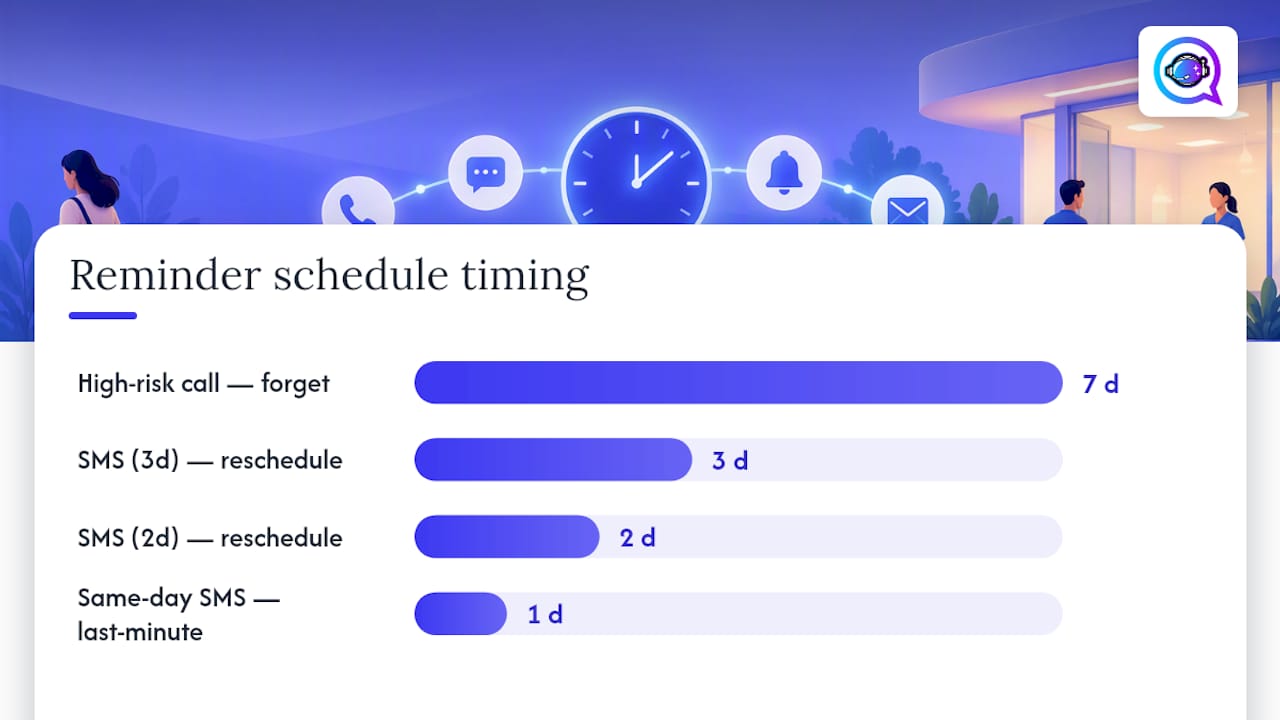
A schedule worth piloting: a phone call 7 days out for clients flagged as high-risk, an SMS at 3 days, another SMS at 2 days, and a same-day confirmation 24 hours ahead. Each layer targets a different failure point: forgetting entirely, forgetting to reschedule, and last-minute uncertainty.
Keep content logistical. HHS guidance confirms appointment reminders count as treatment communication and don’t require separate authorization, but they should avoid clinical details, and any vendor handling protected health information needs a signed business associate agreement. Document each client’s preferred channel and confirm consent where your state or payer requires it. Astreaux’s guide to HIPAA-safe text reminders covers the vendor checklist in more detail.
Targeted human outreach: who to call and what to say
Staff time is limited, so spend it on the clients most likely to miss without a personal touch.
Flag high-risk clients early. A prior no-show, a long wait before their first session, active clinical symptoms like acute depression, or known transportation and housing instability all raise risk.
Call with a plan in mind, not just a reminder. Ask what could get in the way this week, offer a telehealth swap if travel is the barrier, and confirm a backup contact number.
Set an explicit fallback. If something comes up, ask the client to text or call at least a few hours ahead rather than simply not showing.
A rapid systematic review found targeted phone reminders carried a median risk ratio of 0.61 compared with 0.91 for targeted texts, meaning the phone call did more to prevent missed visits when reserved for higher-risk clients, though the authors caution that cost-effectiveness and equity effects still need local testing.
Pro Tip: Time-box your calling windows to a single hour block each day and log the outcome of every call. It keeps the workload predictable and prevents any one staff member from absorbing all the outreach.
Rotate who makes these calls. Outreach that touches on missed sessions, financial stress, or clinical ambivalence is emotionally taxing, and spreading it across the team protects against burnout while keeping the tone consistent for clients.
Scripts and message templates for common scenarios
Adapt these rather than copying them word for word. Consistency in tone matters more than exact phrasing.
First no-show, SMS: “Hi {{firstName}}, we missed you today. No worries, life gets busy. Reply here or call us to grab a new time.”
First no-show, email follow-up: A brief note restating the appointment date they missed, an invitation to reschedule within 48 hours, and a direct phone number.
Repeat no-show, phone or email: “We’ve noticed a couple of missed sessions and want to check in. Our policy asks for 24 hours’ notice, and we’d like to find a schedule that actually works for you. Would a different day or telehealth option help?”
Telehealth login failure: “It looks like the video link didn’t connect. Want to try again now, or would a phone session work better today?”
Insurance or payment barrier: “If cost is making appointments harder to keep, let’s talk about a payment plan or sliding scale option before we look at scheduling.”
Safety concern: Any message following a no-show from a client with active safety risk should follow your practice’s existing crisis protocol first, with scheduling as a secondary step.
Keep repeat no-show language firm but never punitive. The goal is problem-solving, not a warning shot, even when a fee applies.
How to measure results and run quick tests
You can’t tell if a change worked without separating no-shows from cancellations. A no-show is an unannounced absence; a same-day cancellation still gives you time to fill the slot. Track both, along with advance cancellations booked more than 24 hours out.
Run one change at a time so you know what actually moved the number: one SMS reminder versus two, an automated call versus a staff call, or a shorter cancellation window. Review results at 30 days for an early read and again at 90 days to confirm the pattern holds, since a single month can be skewed by holidays or a handful of clients.
Evidence summary and implementation benchmarks
The strongest evidence points to reminders as a reliable, if modest, lever, and to targeted calls as a stronger one for high-risk clients. What’s still uncertain is which exact timing and channel mix works best in a given practice, and how much equity effects vary by population. A large pragmatic trial found that brief behavioral-nudge letters alone did not significantly reduce missed mental-health appointments, a reminder that wording without a concrete offer often falls flat.
No-shows have been reported to drop significantly over 90 days when using automated reminder and outreach systems similar to Astreaux’s.
A 20% to 50% reduction in no-shows has followed SMS reminder rollouts among service firms using Astreaux, according to the platform’s 90-day benchmark playbook. These are publisher-reported implementation figures, not independent research, and worth testing against your own baseline before assuming the same range applies to your caseload.
Balancing boundaries, alliance, and operations
Missed sessions carry information. A client who no-shows twice in a row is telling you something, sometimes about logistics, sometimes about ambivalence toward the work itself. Treat the pattern as clinical data before treating it as an administrative problem.
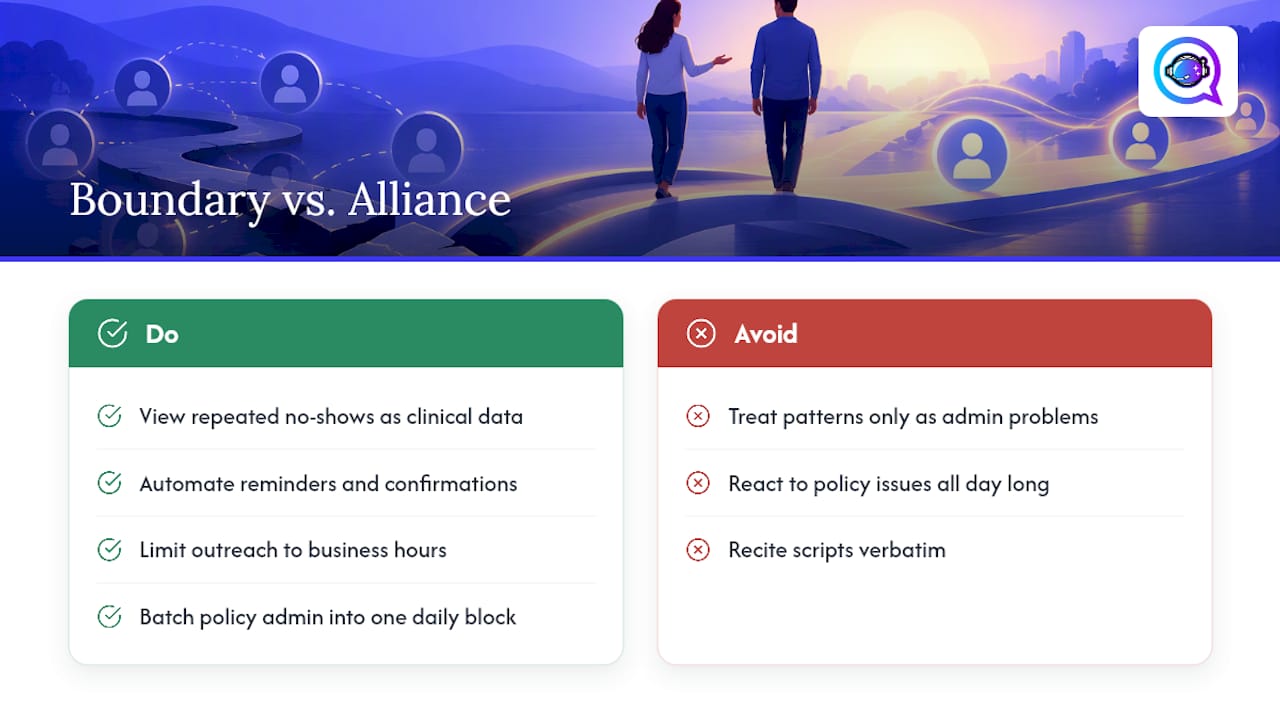
Protect your own time too. Automate the reminders and confirmations that don’t need a human touch, cap outreach calls to business hours, and batch policy-related admin into one block a day rather than reacting all day long.
Use the scripts here as a starting point, not a script to recite. Your clients will hear the difference.
— Jamaal
How Astreaux implements this playbook for therapists
Running this playbook by hand takes staff time most small practices don’t have. Astreaux automates the parts that don’t need a clinician’s judgment: SMS reminder sequences, AI-driven intake that captures a client’s preferred contact channel, and predictive targeting that flags who’s likely to miss so outreach goes where it matters.
Automated reminders on a two-message schedule, matched to the timing evidence above.
AI intake designed to adapt responses to a practice’s communication style and respond to new clients promptly.
Integrations available with a wide range of scheduling and CRM applications to fit existing setups.
Starter step | What it does |
|---|---|
Run a 90-day pilot | Test the reminder and outreach playbook against your baseline |
Use the benchmark playbook | Compare your results to published implementation figures |
Connect existing tools | Link your calendar and CRM through Astreaux’s integrations |
Start a pilot on the Astreaux therapist page and see how the automation fits your caseload.
Sources
Pragmatic Randomized Study of Targeted Text Message Reminders to Reduce Missed Clinic Visits
Are appointment reminders allowed under HIPAA without authorization?
FAQ
What happens if you no show therapy?
Most practices apply their stated cancellation policy, which may include a missed-session fee or a session credit deduction, and the absence gets documented in the client’s chart. A pattern of no-shows often triggers a check-in conversation about whether the current schedule, modality, or treatment plan still fits.
What is the 2 year rule for therapists?
This isn’t a standardized clinical or ethical rule, and definitions vary depending on the context someone means, whether licensure renewal cycles, record retention periods, or state-specific practice regulations. Check your state licensing board or professional association for the specific requirement you’re asking about.
What to do if a therapy client no shows twice?
Reach out directly with a compassionate but clear message restating your cancellation policy and inviting a conversation about what’s making sessions hard to keep. Treat the pattern as clinical information first, since ambivalence or a logistical barrier often explains repeated absences better than simple forgetfulness.
What should I do if I miss my therapist after termination?
If treatment has formally ended, a missed appointment usually isn’t relevant since no future sessions are scheduled. If you want to resume care, contact the practice directly to ask about reopening your case or getting a referral.