
SimpleTexting Alternatives for SMBs: Best Options for Teams
If you need a direct answer: Astreaux is the recommended alternative for service businesses that need AI-driven lead outreach combined with SMS. For teams focused on two-way messaging, pay-as-you-go pricing, or developer-grade APIs, the right category depends on your primary use case. Here is the shortlist.
AI-powered lead outreach + SMS (service businesses): Astreaux. Instant AI replies, appointment booking, CRM integrations, and A2P 10DLC support built for real estate agents, contractors, mortgage brokers, and therapists.
Team-first platforms (Textline, Heymarket, MessageDesk): Best for operations teams that need a shared inbox, internal notes, and two-way conversations at scale.
API-first platforms (Twilio): Best for developers who need programmable messaging, custom workflows, and deep backend integrations.
Pay-as-you-go services (ClickSend, TextMagic): Best for businesses with irregular send volumes that want no monthly commitment.
Growth-focused SMS tools (SlickText, EZTexting, Textedly, SMSBump/Yotpo, Attentive): Best for marketing teams running subscriber list growth, promotional campaigns, and ecommerce automations.
Simple mass-texting services (EZTexting, Textedly): Best for nonprofits, churches, and small businesses that need straightforward bulk alerts with minimal setup.
If your primary goal is capturing inbound leads and booking appointments automatically, skip the broadcast-only tools. They are built for campaigns, not conversations.
Key Takeaways
The strongest SMS platform for a service business is one that converts inbound leads into booked appointments automatically, not just one that sends bulk messages efficiently.
Point | Details |
|---|---|
Match platform to use case | Service businesses need AI lead reply and booking; marketing teams need list growth and campaigns. |
A2P 10DLC is non-negotiable | Unregistered U.S. SMS traffic gets filtered by carriers; register before your first send. |
Pricing shape drives total cost | Subscription tiers beat pay-as-you-go at consistent volume; credits win for irregular senders. |
Migration needs documented consent | TCPA requires prior express written consent; preserve opt-in timestamps when porting contacts. |
Astreaux for service professionals | Astreaux combines AI lead outreach, appointment booking, and bulk SMS in one platform for real estate, contractors, mortgage brokers, and therapists. |
How do these alternatives compare to SimpleTexting at a glance?
Category | Best for | Pricing model | Key features | Integrations & API | Compliance/A2P | Support & onboarding | Scalability |
|---|---|---|---|---|---|---|---|
AI lead outreach (Astreaux) | Service businesses: real estate, contractors, therapists, mortgage brokers | Subscription SaaS; tiered plans | AI reply, appointment booking, bulk SMS, CRM sync, voice training | 7,000+ apps, HubSpot, CRM, ad platforms | A2P 10DLC supported | Dedicated onboarding, account management | High; scales with lead volume |
Team-first platforms | Ops teams, customer support, sales teams | Subscription tiers; per-seat or per-message | Shared inbox, internal notes, two-way SMS, MMS | CRM, Zapier, webhooks | A2P 10DLC; varies by vendor | Team inbox, onboarding docs | Mid-to-high; multi-user |
API-first platforms | Developers, custom workflows | Usage-based (pay per message/segment) | Programmable SMS, voice, WhatsApp, RCS | Full REST API, webhooks, 400+ integrations | A2P 10DLC; carrier-grade | Developer docs, community support | Very high; enterprise-grade |
Pay-as-you-go services | Irregular senders, small teams | Per-message credits; no monthly fee | Bulk SMS, MMS, email SMS, landing pages | Zapier, basic API | A2P 10DLC; varies | Email/chat support | Mid; credit-based |
Growth-focused SMS tools | Marketing teams, ecommerce brands | Tiered by subscribers or messages | List growth, campaigns, automations, popups | Shopify, Klaviyo, Zapier | A2P 10DLC; ecommerce-focused | Onboarding, live chat | High; list-based scaling |
Simple mass-texting services | Nonprofits, churches, small businesses | Tiered by contacts or credits | Bulk alerts, keywords, basic two-way | Zapier, limited API | A2P 10DLC; basic | Self-serve, chat | Low-to-mid |
TL;DR by scenario:
Running a service business with inbound leads? Astreaux handles the AI reply and booking automatically.
Need a shared inbox for a support or sales team? Team-first platforms are purpose-built for that workflow.
Building a custom messaging product or integration? API-first platforms give you the most control.
Sending occasional bulk alerts with no monthly overhead? Pay-as-you-go services keep costs predictable.
Growing an ecommerce subscriber list? Growth-focused SMS tools connect directly to Shopify and Klaviyo.
Need the simplest possible mass-text setup? Simple mass-texting services get you live in under an hour.
Detailed profiles: which alternative fits your business?
Astreaux: AI lead outreach for service professionals
Astreaux is not a broadcast SMS tool. It is an AI-powered lead management platform that uses conversational AI to reply to new leads instantly, qualify them, and book appointments, all over SMS and other channels. For a real estate agent, contractor, mortgage broker, or therapist, that distinction matters: the platform learns your business’s voice and responds to inbound inquiries the way you would, without you being at the keyboard.
Pros:
Instant AI replies to new leads, reducing response time to seconds
Appointment booking and calendar sync built into the lead flow
Bulk SMS campaigns alongside one-to-one conversational outreach
Integrates with over 7,000 apps including HubSpot and major CRM platforms
A2P 10DLC support and compliance built in
Voice training so AI responses match your brand tone
Cons:
Designed for service businesses; less suited to pure ecommerce or developer API use cases
Subscription model; not pay-as-you-go
Pricing: Subscription tiers; see Astreaux AI for current plan details.
Integrations: HubSpot, major CRMs, ad platforms, Zapier, and 7,000+ connected apps. Read the HubSpot SMS integration guide for a practical setup walkthrough.
Migration note: Number porting to Astreaux follows standard U.S. carrier processes. Expect 5–10 business days for toll-free numbers and up to 4 weeks for short codes. A2P 10DLC registration should be completed before your first campaign send.
Best for: Real estate agents, contractors, mortgage brokers, therapists, and any service professional who needs to convert inbound leads into booked appointments automatically.
Team-first platforms (Textline, Heymarket, MessageDesk)
These platforms are built around the shared inbox. Multiple agents can see, claim, and respond to conversations from a single number, with internal notes and assignment features that keep handoffs clean. Textline, Heymarket, and MessageDesk all sit in this category, and they are the go-to choice when your primary need is coordinating a team around two-way SMS conversations rather than broadcasting to a list.
Pros:
Shared inbox with agent assignment and collision detection
Internal notes and conversation history visible to the whole team
Two-way SMS and MMS with contact management
CRM and helpdesk integrations (Salesforce, HubSpot, Zendesk)
A2P 10DLC support across the category
Cons:
Per-seat pricing adds up quickly for larger teams
Automation depth varies; some platforms lack advanced workflow builders
Not designed for high-volume broadcast campaigns
Pricing: Subscription tiers, typically per seat or per message block. Starting prices vary; check vendor sites for current figures.
Integrations: Zapier, webhooks, CRM platforms, and helpdesk tools. API availability varies by vendor.
Migration note: Most team-first platforms support number porting. Plan for 5–10 business days on toll-free numbers. Export your contact list as a CSV before switching and confirm opt-in records transfer cleanly.
Best for: Customer support teams, sales teams, and operations groups that need coordinated two-way messaging with clear ownership.
Review aggregates on G2 and Capterra for this category commonly flag per-seat pricing as a pain point for growing teams, and some users note that automation features feel limited compared to dedicated marketing platforms.
API-first platforms (Twilio)
Twilio is the reference point for programmable messaging. You get a REST API, webhooks, and support for SMS, MMS, WhatsApp, RCS, and voice in a single platform. The trade-off is setup time: Twilio requires developer resources to configure, and costs scale with usage. For a non-technical SMB owner, it is likely overkill. For a developer building a custom lead routing system or a SaaS product with embedded messaging, it is the most flexible option available.
Pros:
Full REST API with extensive documentation
Supports SMS, MMS, WhatsApp, RCS, and voice
Usage-based pricing means you pay only for what you send
Carrier-grade deliverability and global reach
A2P 10DLC registration supported
Cons:
Requires developer resources to set up and maintain
No native shared inbox or marketing campaign UI out of the box
Costs can be unpredictable at scale without careful monitoring
Pricing: Usage-based; per-message and per-number fees. No flat monthly fee for the core API.
Integrations: 400+ integrations, full REST API, webhooks, and Zapier.
Migration note: Porting numbers into Twilio follows standard carrier timelines. Developer teams should plan A2P 10DLC registration as part of the initial setup, not an afterthought.
Best for: Developers, technical teams, and SaaS builders who need maximum flexibility and are comfortable managing infrastructure.
Pro Tip: SMS open rates are reported as high as 98%, with most messages read within minutes. That engagement advantage only holds if your messages reach the inbox. A2P 10DLC registration and CTIA best practices are the two levers that protect deliverability across every platform in this list.
Pay-as-you-go services (ClickSend, TextMagic)
ClickSend and TextMagic both operate on a credit model: you buy message credits and spend them as needed, with no monthly subscription required. That pricing shape is genuinely useful for businesses with irregular send volumes, such as a contractor who sends appointment reminders in bursts or a small retailer running occasional flash promotions. Neither platform is built for deep automation or AI-driven conversations, but both handle bulk SMS, MMS, and basic two-way messaging reliably.
Pros:
No monthly commitment; pay only for messages sent
Simple setup with minimal technical knowledge required
Bulk SMS, MMS, and email-to-SMS in one place
Basic API available for simple integrations
Cons:
Per-message costs are higher than subscription tiers at volume
Limited automation and workflow depth
No AI-driven lead engagement or appointment booking
Pricing: Per-message credits; rates vary by volume purchased.
Integrations: Zapier, basic API, and some direct CRM connectors.
Migration note: Number porting is supported. Confirm A2P 10DLC registration requirements with the vendor before porting, as credit-based platforms sometimes have different onboarding flows for registered campaigns.
Best for: Small businesses and teams with unpredictable or low send volumes who want cost control without a monthly fee.
Growth-focused SMS tools (SlickText, EZTexting, Textedly, SMSBump/Yotpo, Attentive)
This category covers the platforms most commonly compared to SimpleTexting in marketing contexts. SlickText, EZTexting, Textedly, SMSBump (now part of Yotpo), and Attentive all focus on list growth, promotional campaigns, and ecommerce automations. Attentive and SMSBump/Yotpo lean heavily into Shopify and Klaviyo integrations, making them natural fits for DTC brands. SlickText and EZTexting are more accessible for general SMB marketing teams that are not running ecommerce.
Pros:
Strong list-growth tools: keywords, popups, QR codes, and opt-in landing pages
Campaign scheduling, A/B testing, and segmentation
Ecommerce integrations (Shopify, WooCommerce, Klaviyo) for SMSBump and Attentive
MMS support and template libraries
A2P 10DLC support across the category
Cons:
Primarily broadcast-focused; two-way conversation depth is limited
Pricing scales with subscriber count, which can get expensive for large lists
Ecommerce-specific tools (SMSBump, Attentive) are less useful for service businesses
Pricing: Tiered by subscriber count or message volume. Most offer a free trial or freemium tier.
Integrations: Shopify, Klaviyo, Zapier, Mailchimp, and basic webhooks depending on the platform.
Migration note: Subscriber list portability varies. Export contacts and opt-in timestamps before switching. Confirm that your new platform accepts imported lists with documented consent records, which is a TCPA requirement for continued outreach.
Best for: Marketing teams running subscriber list campaigns, ecommerce brands on Shopify, and SMBs focused on promotional SMS.
Simple mass-texting services (EZTexting, Textedly)
At the most accessible end of the spectrum, EZTexting and Textedly offer straightforward bulk SMS with keyword opt-ins, basic scheduling, and contact management. Setup takes under an hour, pricing is transparent, and neither platform requires technical knowledge. They are the right call for a nonprofit sending event reminders, a church communicating with its congregation, or a local business running a simple loyalty keyword campaign.
Pros:
Fast setup with no technical requirements
Keyword opt-in campaigns and basic two-way replies
Affordable entry-level pricing
A2P 10DLC support
Cons:
Limited automation and no AI-driven engagement
Not built for complex workflows or CRM-heavy operations
Scalability ceiling is lower than other categories
Pricing: Tiered by contacts or message credits; free trials available.
Integrations: Zapier and limited direct integrations.
Best for: Nonprofits, churches, local businesses, and any team that needs simple, reliable bulk alerts without complexity.
How do you choose the right SMS platform and migrate cleanly?
The right platform is the one that fits your primary use case, not the one with the longest feature list. Work through this checklist before committing to a trial.
Selection checklist
Define your primary use case. Are you managing inbound leads, running broadcast campaigns, coordinating a support team, or building a custom integration? The answer eliminates most categories immediately.
Map your integrations. List the CRM, ecommerce platform, and marketing tools you already use. Confirm the candidate platform connects to all of them natively or via Zapier before you sign up.
Evaluate pricing shape against your volume. Calculate your monthly message volume and compare subscription tiers against pay-as-you-go rates. At high volume, subscriptions almost always win; at low or irregular volume, credits are cheaper.
Check A2P 10DLC support. Any platform you use for U.S. business texting must support A2P 10DLC registration. Carriers filter unregistered traffic aggressively. Read the A2P 10DLC registration guide for a step-by-step walkthrough of the registration process.
Verify number porting. Confirm the platform supports porting your existing number and ask for the expected timeline. Toll-free numbers typically port in 5–10 business days; short codes can take up to 4 weeks.
Test support responsiveness. Send a pre-sales question via chat or email and time the response. Slow pre-sales support is a reliable predictor of slow post-sales support.
Review security and compliance documentation. For platforms handling customer data, ask for SOC reports or third-party attestations. The AICPA SOC framework is the standard reference for evaluating these documents.
Run a 3–6 week pilot. Send a representative sample of your actual messages, track deliverability, response rates, and support ticket resolution time. Do not commit to an annual plan before the pilot completes.
Red flags that should stop a purchase
No A2P 10DLC support or vague answers about carrier registration
Hidden carrier pass-through fees not disclosed upfront
No number porting option or no clear porting timeline
Poor or missing API documentation for any platform you plan to integrate
No clear opt-out (STOP) mechanics, which creates FCC compliance exposure
No SLA or response time commitment for support
Compliance and deliverability essentials
U.S. business texting operates under two overlapping frameworks. The TCPA (47 U.S.C. §227) sets the legal floor: you need prior express written consent before sending marketing texts, and every message must include a clear opt-out path. The CTIA messaging principles add the operational layer: opt-in language, STOP/HELP keyword support, and message content standards that reduce carrier filtering.
Registration is now mandatory for application-to-person SMS in the U.S. traffic in the U.S. Register your brand and campaign through The Campaign Registry before sending. Toll-free numbers require a separate verification process. Short codes offer the highest throughput but carry the longest provisioning timeline and the highest cost.
Pro Tip: Keep your opt-in records with timestamps. If a carrier or regulator ever questions your campaign, documented consent is your first line of defense. Most platforms store this automatically, but confirm it before you import a list.
Migration workflow
Export your full contact list with opt-in timestamps from SimpleTexting.
Complete A2P 10DLC brand and campaign registration on the new platform.
Port your existing number (submit the porting request on day one; it runs in parallel with setup).
Import contacts and verify opt-in records are preserved.
Rebuild your templates and automations in the new platform.
Run a test campaign to a small internal list before going live.
Monitor deliverability for the first two weeks and compare against your SimpleTexting baseline.
What most SMS comparisons get wrong about service businesses
The standard comparison article treats every SMS buyer as a marketer running a broadcast list. That framing fits ecommerce brands well. It fits a real estate agent, a contractor, or a therapist almost not at all.
Service businesses have a fundamentally different problem. Their leads arrive one at a time, often from paid ads or referrals, and the first response time is the single biggest predictor of whether that lead converts. A broadcast SMS tool does nothing for you at 9 PM when a homeowner fills out your contact form. An AI-driven platform that replies instantly, qualifies the lead, and offers a booking link does.
The category-based approach in this article reflects that reality. Team-first platforms, growth-focused tools, and simple mass-texting services are all legitimate choices for the right buyer. But if you are a service professional whose revenue depends on converting inbound inquiries, you are not shopping for a broadcast tool. You are shopping for a lead engagement system that happens to use SMS as its primary channel.
One practical note on pilots: the most common mistake service businesses make when testing a new SMS platform is measuring the wrong metric. Open rates and click rates matter for broadcast campaigns. For lead outreach, the metric that predicts revenue is lead-to-appointment rate, measured from the moment a lead enters the funnel to the moment a booking is confirmed. Set that as your pilot success metric before you start, and you will know within three weeks whether the platform is working.
Pro Tip: When running an AI appointment setting pilot, configure a human handoff trigger for any lead that asks a question the AI cannot answer confidently. That single setting prevents the most common pilot failure: a lead who gets a confusing AI response and disengages before a human can recover the conversation.
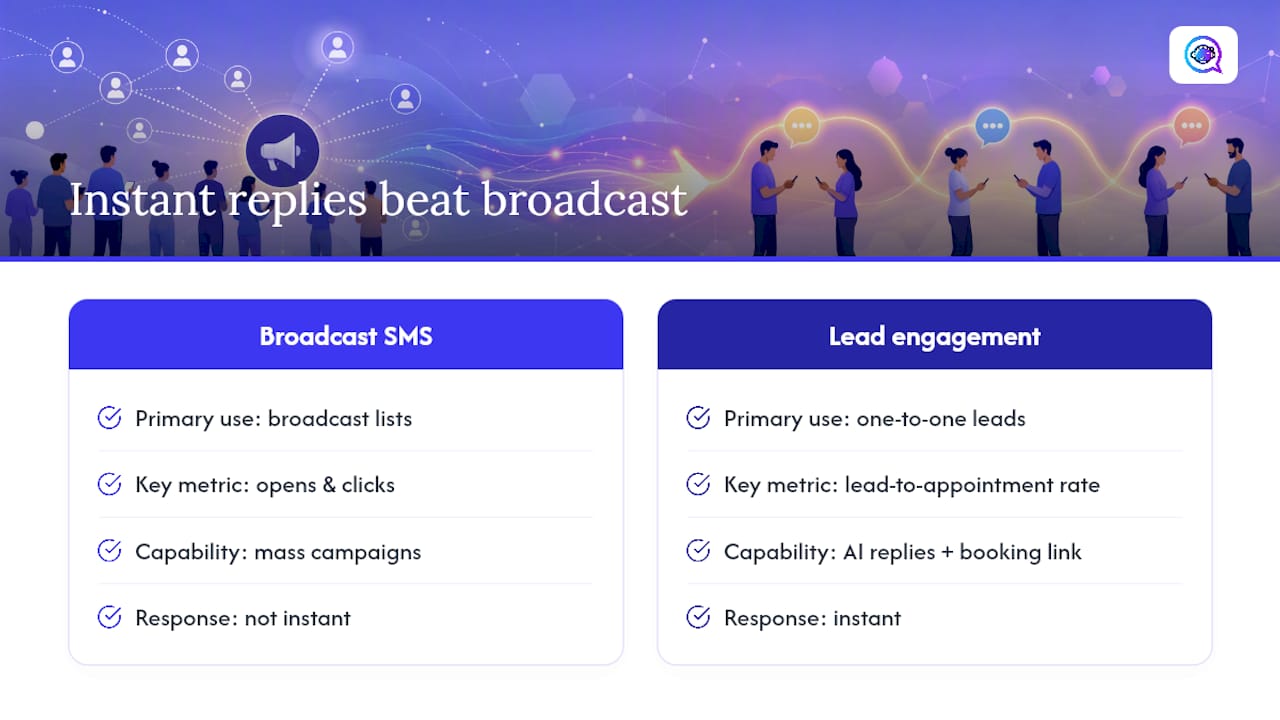
Astreaux gives service businesses a faster path from lead to booked appointment
Most SMS platforms on this list do one thing well: they send messages. Astreaux does something different. It replies to new leads the moment they come in, qualifies them through a conversational AI that learns your business’s voice, and books appointments directly into your calendar, all without manual intervention.
For a real estate agent managing 30 new leads a week, a contractor fielding estimate requests, or a mortgage broker nurturing prospects through a multi-week decision cycle, that difference in workflow is significant. You are not just sending texts. You are running an automated lead funnel that operates around the clock.
Astreaux connects to HubSpot, major CRM platforms, and over 7,000 apps, so it fits into the stack you already use. A2P 10DLC compliance is built in, and the platform supports bulk SMS campaigns alongside one-to-one AI conversations. Whether you are a real estate agent looking to convert more inbound inquiries or a mortgage broker who needs consistent follow-up without adding headcount, Astreaux is built for that workflow.
Start a trial at Astreaux AI and see how quickly the AI adapts to your business’s voice.
Sources
Compliance, deliverability, and vendor evaluation resources worth bookmarking:
Stop unwanted robocalls and texts | Federal Communications Commission
47 U.S. Code § 227 - Restrictions on use of telephone equipment | Cornell Law School
Internal resources for implementation:
For technical pilots, consult the API documentation and developer guides published directly by each vendor. Those pages change frequently and are best reviewed during your trial period rather than before it.
FAQ
What are some free alternatives to SimpleTexting?
Several SMS platforms offer free trials or freemium tiers, including EZTexting and Textedly. Pay-as-you-go services like ClickSend and TextMagic have no monthly fee, so you only pay for messages sent.
What is the best bulk text messaging service for small businesses?
The best choice depends on your use case. For service businesses that need AI-driven lead replies and appointment booking, Astreaux is the recommended option. For straightforward bulk campaigns, growth-focused tools like SlickText or EZTexting are purpose-built for that workflow.
Is SMS becoming obsolete?
No. SMS open rates are reported as high as 98%, with most messages read within minutes of delivery. Channels like WhatsApp and RCS are growing as complements to SMS, not replacements, particularly for richer media and international audiences.
What compliance requirements apply to U.S. business texting?
The TCPA (47 U.S.C. §227) requires prior express written consent before sending marketing texts, and every message must include a clear opt-out path. A2P 10DLC registration is also required for application-to-person SMS traffic sent through U.S. carriers.
How long does it take to port a number away from SimpleTexting?
Toll-free numbers typically port in 5–10 business days. Short codes can take up to 4 weeks. Submit your porting request on day one of your migration so it runs in parallel with platform setup and A2P 10DLC registration.
This article is general information, not legal or compliance advice. Confirm current TCPA rules and A2P 10DLC requirements with the FCC, CTIA, or a qualified telecommunications attorney before launching campaigns.