

Cut Therapist No Show Rates 47%: Benchmarks and a 90 Day Playbook
Behavioral health practices typically run no-show rates between 18% and 22%, though outpatient therapy settings sometimes report figures as high as 50% depending on population and payer mix. Calculate yours by dividing missed appointments by total scheduled appointments (excluding your own cancellations) for a rolling 30 days. If your number sits above 20%, start with two-way text reminders sent 48 and 24 hours out, and shorten booking lead time for new clients to under a week.
TL;DR:
Practices with high no-show rates should track their own baseline and segment data by visit type, payment method, and client status to set realistic targets.
Shortening booking lead times, using two-way text reminders, and identifying high-risk clients for targeted outreach can significantly reduce missed appointments.
Combining multiple interventions, such as reminders, live follow-ups, and incentive policies, can decrease no-show rates by nearly 50 percent.
Automated workflows that flag risk factors and facilitate easy rescheduling alongside personalized messaging yield the strongest results.
Implementing a clear, consistent cancellation policy with proper client education helps enforce accountability and minimizes missed sessions.
Astreauxcalendly.comKeep Therapy Appointments On TrackAstreaux helps therapists engage leads instantly, streamline scheduling, and nurture prospects with personalized conversational AI.Book a call
What Is a Normal Therapist No-Show Rate?
Published numbers on this topic vary widely, which can confuse many practice owners trying to benchmark themselves. Academic reviews find higher average missed-appointment rates, while self-reported figures from practice management associations tend to be lower, reflecting differences in measurement and reporting. That gap isn’t a contradiction. It’s a measurement artifact. Practices that self-report tend to undercount, exclude late cancellations, or only track chronic offenders rather than every missed slot.
A VA pragmatic trial and related health services analyses found mental health missed-appointment rates substantially higher than those seen in primary care. That gap matters for how you set targets: comparing your therapy practice against a general medical benchmark will always make your numbers look worse than they are.
Behavioral health benchmark snapshot:
Clinic-level behavioral health no-show rates commonly fall between 18% and 22%, while outpatient therapy settings, particularly those serving lower-income or safety-net populations, can report rates as high as 20% to 50%.
A few factors drive the spread you’ll see across reports:
Denominator rules. Some counts include same-day cancellations as no-shows; others exclude them entirely.
Population mix. Sliding-scale and Medicaid-heavy caseloads run higher than fee-for-service or EAP-referred clients.
Visit type. Intake appointments no-show at different rates than established, ongoing sessions.
Reporting incentive. Practices publishing marketing content have reason to round down.
Rather than chase an industry-wide number, set your target from your own trailing 90-day baseline, segmented by visit type and payer. A community mental health center taking walk-in intakes will realistically sit higher, and that’s not a sign of poor management. It’s a sign of who you serve.
Why Do So Many Clients Skip Therapy Appointments?
The drivers behind therapy attendance issues are different from the ones behind a missed dental cleaning, and treating them the same way is where a lot of well-intentioned reminder systems fall short.
Depression, anxiety, and executive dysfunction directly interfere with the exact skills needed to keep an appointment: remembering the date, initiating the call to cancel, and tolerating the discomfort of showing up. A client isn’t being flaky when they no-show during a depressive episode. The symptom that brought them to you is also the thing keeping them from you.
Logistical friction compounds the clinical picture. Transportation gaps, unreliable childcare, hourly-wage jobs with no flexibility, and out-of-pocket costs all stack against attendance, especially for the populations most likely to need consistent care.
Several other forces show up again and again in why clients skip therapy:
Ambivalence about treatment itself, particularly early in the therapeutic relationship before trust is established.
Stigma, which can make canceling feel easier than explaining a no-show to family or an employer.
Treatment timeline fatigue, where clients drop off once acute symptoms ease, even if the clinical work isn’t finished.
Engagement signals, like failing to confirm a reminder or going silent after a rescheduling request, which research on reducing appointment no-shows treats as measurable predictors, not just anecdotal red flags.
That last point deserves attention because it’s actionable. A client who doesn’t reply to a confirmation text is statistically more likely to no-show than one who confirms promptly. Track that signal and you have an early warning system instead of a surprise on your schedule.
What Does a Missed Session Actually Cost You?
A single missed 50-minute session at a $150 rate isn’t just $150 lost. It’s an unfillable hour, because most therapy clients book weeks out and same-day backfill is rare without an active waitlist system.
Run the math for a solo practitioner seeing many clients weekly at a moderate session rate with a typical no-show rate: that’s several missed slots each week, resulting in substantial unrecovered revenue before counting the admin time spent rescheduling. Scale that to a small group practice with multiple clinicians and the same rate, and the potential lost revenue grows significantly.
Assumes $150 average session rate; actual figures will vary with your fee schedule.
The clinical cost compounds the financial one. Missed sessions interrupt momentum in ways that are hard to reverse. A client working through trauma processing or building coping skills for anxiety loses continuity every time a session drops, and repeated gaps are strongly associated with premature dropout rather than a simple pause and resume.
Cutting your no-show rate significantly, consistent with improvements seen in multi-site implementation work, doesn’t just recover revenue. It means more clients stay in treatment long enough to achieve better outcomes. That’s the real payoff, and it’s why the fixes in the next few sections are worth the operational lift.
How Do You Calculate and Segment Your No-Show Rate?
The formula itself is simple: No-show rate = (missed appointments ÷ total scheduled appointments) × 100, counting only appointments where the client was responsible for the missed slot. Exclude therapist-initiated cancellations, and decide up front whether late cancellations (say, inside a 4-hour window) count as no-shows or as a separate cancellation category. Whichever rule you choose, apply it consistently every month.
Run this weekly at minimum, monthly for trend tracking. A single monthly number hides too much.
Segment the raw rate into at least these four cuts:
New vs. returning clients. First-time intakes almost always no-show at a higher rate than established clients with rapport already built.
Visit type. Compare intake sessions, standard follow-ups, and telehealth vs. in-office visits separately.
Booking lead time. Appointments scheduled more than two weeks out tend to no-show more than same-week bookings.
Payer type. Self-pay, insurance, and sliding-scale clients often show meaningfully different patterns.
Once you have those segments, build a simple dashboard, even a shared spreadsheet works, that tracks:
Overall monthly no-show rate against your 90-day baseline
Rate by segment, updated monthly
Reminder confirmation rate (percentage of clients who respond to a reminder)
Revenue impact using your average session rate
Review it monthly, but don’t wait a full quarter to act on an outlier. If new-client no-shows spike two months running, that’s your next pilot segment, not something to note and revisit later.
What Actually Reduces Therapy No-Shows?
Some fixes here are backed by solid evidence. Others have real face validity but softer data. Knowing the difference helps you prioritize.
Reminders help, but modestly. Meta-analyses on text message reminders for appointment attendance find a modest relative improvement in show rates, though reminders alone do not eliminate no-shows. Send one reminder 48 hours out and a second 24 hours out, and word the second one to require a response (“Reply YES to confirm your Thursday 2pm session”) rather than a passive notification.
Lead time matters more than most practices realize. Shortening the gap between booking and the appointment, and re-confirming any visit booked more than two weeks out, has strong observational support as a mechanism-based lever. If a client books six weeks ahead, plan on a mid-point check-in call or text, not just the standard 48-hour reminder.
Two-way confirmation beats one-way notification. A reminder a client can’t respond to gives you no signal. A reminder they can reply to, confirm, cancel, or request to reschedule, gives you an early warning and a chance to backfill the slot. Pair this with one-tap rescheduling links so a client on the fence has a frictionless alternative to silently no-showing.
Live outreach works best on your highest-risk slots, not everyone. Phone calls from a live person to flagged high-risk appointments have shown reductions as steep as 40% to 45% for patients actually reached, according to reports and trials on targeted outreach. That’s labor-intensive, so reserve it for clients flagged by your risk segments: new intakes, long lead-time bookings, or anyone who’s already no-showed once this quarter.
Telehealth helps some clients and does nothing for others. For clients whose barrier is transportation or childcare, a virtual option removes the obstacle entirely. For clients whose barrier is symptom-driven avoidance or ambivalence, telehealth changes nothing, and evidence on its effect on no-show rates overall stays mixed.
Reminders alone aren’t a guarantee. One large safety-net network’s automated robocall and text program showed no meaningful change, holding steady near 42% before and after rollout. High-barrier populations need reminders paired with access fixes, not reminders as a standalone solution.
Deposits and confirmation fees cut both ways. A small deposit or credit-card-on-file requirement filters out low-commitment bookings, but it can also create a real access barrier for lower-income clients who are already at higher risk of missing sessions. Weigh this against your practice’s population before adopting it broadly.
Pro Tip: Don’t launch every fix at once. Pick one segment, say, new-client intakes booked more than two weeks out, and run a single intervention (two-way confirmation plus a mid-lead-time check-in) for 30 days before layering on anything else. You won’t know what worked if you change five variables simultaneously.
How Should You Write a Cancellation and No-Show Fee Policy?
A cancellation policy only works if clients understand it before they need it and you enforce it consistently once they do.
Set your notice window. A 24-hour window is standard and defensible for most outpatient therapy practices; some choose 48 hours for high-demand schedules where backfill is genuinely difficult. Pick one and apply it uniformly.
Choose your fee structure. A flat fee ($50 to $75 is common) is easier to enforce and feels less punitive than charging the full session rate, though some practices charge the full rate specifically to discourage repeat no-shows.
Build in emergency exceptions. Illness, family emergencies, and severe weather should have a documented waiver path. Applying a rigid policy with zero exceptions erodes trust faster than the fee ever recovers.
Consider equity in enforcement. A client on a sliding scale who no-shows because their shift got extended isn’t in the same position as a private-pay client who simply forgot. Some practices tier fees or waive them below a certain income threshold.
Get written consent at intake. Include the policy in your intake paperwork with a specific signature line, not buried in a general terms document, and confirm the client actually read it before their first session.
Collect a card on file where your state and payer rules allow it. This removes the collections friction that makes so many practices abandon their own stated policy after the first uncomfortable conversation.
Whatever policy you choose, write it in plain language. “Sessions canceled with less than 24 hours’ notice, or missed entirely, will be charged $60” is clearer and more enforceable than a paragraph of legal hedging that leaves both you and the client confused about what happens next.
How Do You Automate the No-Show Reduction Workflow?
The interventions above only compound if they run without you manually tracking every slot in a spreadsheet.
Picture the workflow as five steps: a client books, an automated reminder sequence fires at 48 and 24 hours, the system flags high-risk bookings (new client, long lead time, prior no-show), a live team member calls or texts only the flagged slots, and any last-minute cancellation triggers an automatic waitlist backfill offer. That sequence turns a reactive front desk into a system that catches problems before they become empty chairs.
Four automation features are worth prioritizing when you’re evaluating tools for this:
Two-way SMS that lets clients confirm, cancel, or request a reschedule directly from the reminder text, not just receive a one-way notice.
One-tap rescheduling so a client who can’t make Thursday can move to Friday in ten seconds instead of playing phone tag.
Automatic waitlist backfill that texts the next eligible client the moment a slot opens up from a cancellation.
Analytics that segment by risk factor, so you can see which cohorts (new intakes, long lead-time bookings) are driving your rate before you commit to a fix.
Astreaux was built around this exact sequence for service professionals, including therapists managing their own intake and scheduling. Its conversational AI can send personalized reminder sequences, handle two-way confirmation replies, and route flagged risk signals to a live follow-up, all learning your practice’s own voice rather than sounding like a generic office bot. Vendor case data on SMS-based reminder systems for service firms has shown reductions in the 20% to 50% range for some client bases, though results depend heavily on your starting point and population, so treat any vendor figure as a hypothesis to test against your own baseline rather than a guarantee.
Pro Tip: Before automating anything, run one week of manual risk-flagging by hand, marking new intakes, long-lead bookings, and prior no-shows in a spreadsheet. That exercise tells you exactly what your automation rules should be before you configure a single workflow.
If you’re evaluating a broader set of quick fixes beyond automation alone, a practical rundown of five fixes that cut no-show appointments fast covers the operational side in more depth.
What Does the Research Actually Show About Reducing No-Shows?
The strongest evidence for meaningful reduction doesn’t come from reminders alone. It comes from combining interventions at scale.
Across 67 treatment organizations, a coordinated implementation of no-show reduction practices, not reminders in isolation, but a bundled set of scheduling, engagement, and outreach changes, reduced outpatient no-show rates from 37.4% to 19.9%.
That’s close to a 47% relative reduction, and it’s the single most persuasive data point available on this topic. It came from stacking interventions, not deploying one silver bullet.
A few honest caveats belong alongside that number:
Reminder evidence alone stays modest. The 11% relative lift from text reminders is real but far smaller than the 37% to 19.9% shift seen in bundled implementations.
Live outreach shows the largest single-lever gains, particularly for flagged high-risk slots, but it’s also the most labor-intensive fix on this list.
Some settings see no improvement at all. The safety-net network that saw no change from its robocall and text program is a reminder that context determines what works.
Published averages don’t transfer cleanly. A 67-organization implementation study reflects those specific practices, populations, and baselines. Your practice’s starting no-show rate, client mix, and existing infrastructure will shift how much of that improvement you can realistically capture.
A 90-Day Playbook For Cutting No-Shows
Most practices try to fix everything at once and end up with no clean data on what actually worked. A staged approach gets you real answers.
Days 0 to 14: Pull your trailing 90-day no-show rate and segment it by new versus returning clients, lead time, and payer. Pick one underperforming segment, usually new-client intakes booked more than two weeks out, as your pilot group. Resist the urge to fix everything simultaneously.
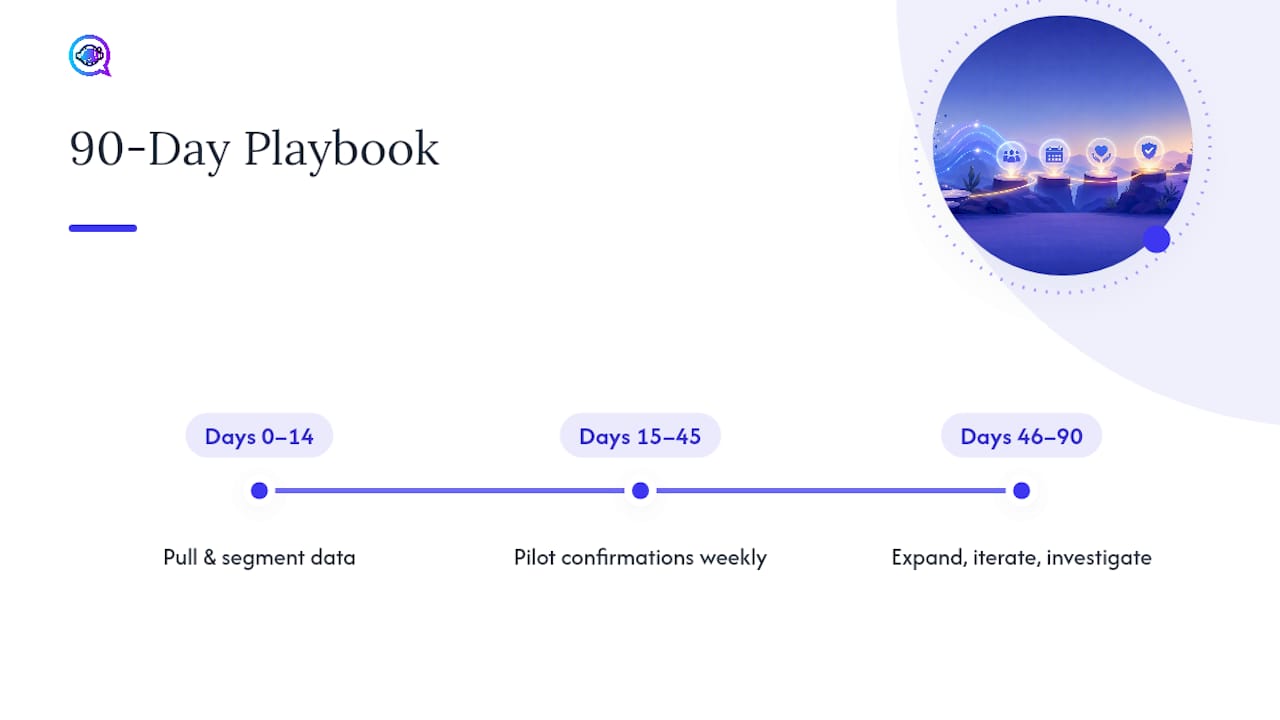
Days 15 to 45: Roll out two-way confirmation reminders for the pilot segment only, and shorten the booking lead time where your schedule allows it. Track weekly, not monthly, so you catch a trend before the pilot ends.
If it has improved, expand the reminder and lead-time changes practice-wide before adding the heavier-effort outreach layer.
Anything less means you’re solving the wrong problem, likely a barrier like transportation or ambivalence that a reminder text can’t touch.
— Jamaal
How Astreaux Fits Your No-Show Reduction Plan
If you’ve read this far, you already know reminders alone won’t fix your schedule. What actually moves the number is the combination: fast reminder timing, two-way confirmation, risk flagging, and a live follow-up path for the appointments most likely to fall through.

Some platforms are built to run that exact sequence without adding another task to your front desk. They can learn your practice’s voice to send personalized reminder and confirmation sequences, handle two-way replies so clients can confirm or reschedule in one tap, and connect to your existing scheduling and CRM setup through multiple app integrations. The AI intake automation built for therapists and counselors applies this specifically to booking and intake, so a new client inquiry moves to a confirmed appointment without you manually chasing a reply. If your practice is also thinking about how it presents itself to new clients online, a therapist headshot that meets Psychology Today’s crop requirements is a small but practical piece of that first impression.
If your current no-show rate sits above the 18% to 22% benchmark and you want to see the reminder and confirmation workflow running against your own booking data, start a demo with Astreaux and pilot it against one segment of your schedule before rolling it out practice-wide.
Sources
Reducing Appointment No-Shows: Going from Theory to Practice
Behavioral health no-show rates: Benchmarks & trends | Tebra
How to Reduce Patient No-Shows: The Complete Guide | VisitConfirmed Blog
FAQ
What is the 2-year rule for therapists?
This isn’t a standard clinical or billing rule tied to no-show management; it typically refers to licensure or supervision requirements that vary by state board, so check your specific state’s regulations rather than assuming a universal standard applies.
What happens if a client no-shows a therapy appointment?
The clinician typically documents the missed session in the chart, applies the practice’s stated cancellation policy (often a flat fee), and follows up with outreach to reschedule, since a documented no-show pattern is also a clinical engagement signal worth addressing directly with the client.
How much should you charge for a no-show fee?
Most outpatient therapy practices charge a flat fee between $50 and $75, though some charge the full session rate to more strongly discourage repeat no-shows; either approach works as long as it’s disclosed in writing at intake and applied consistently.
How long should a client wait if their therapist is running late?
There’s no universal rule, but most practices consider 10 to 15 minutes reasonable before a client reaches out to the front desk or office line, and clinicians should proactively notify clients of delays whenever possible rather than leaving them uncertain.