Two-Way SMS That Handles Replies 24/7 for Marketers and Ops
Two-way SMS is repliable business texting: customers and brands converse on the same number, instead of customers receiving a broadcast they can’t answer. It fixes the immediacy problem of email and the intrusiveness problem of cold calls, giving you faster support resolution, higher engagement than one-way blasts, and a direct channel for lead qualification. To run it, you need a provisioned number, either a long code or short code, connected to a messaging platform or CRM that can capture and route inbound replies.
TL;DR:
Long codes are suitable for conversational support and nurturing, while dedicated short codes are better for high-volume marketing campaigns.
Proper setup requires provisioning the number, configuring webhooks, and mapping replies to contact records to avoid disruptions.
Inbound SMS may arrive out of sequence across carriers, so timestamp-based reconstruction and robust retry testing are essential.
Automating responses with triggers and AI improves support availability and lead qualification but requires continuous monitoring and ownership.
Neglecting inbox management and staffing, rather than technical failure, is the primary cause of two-way SMS program breakdowns.
What Is Two-Way SMS and What Does It Take to Run It?
One-way bulk SMS pushes a message out and stops there. Two-way SMS keeps the line open: a customer texts back, and that reply lands somewhere your team or software can act on. That distinction is the whole reason marketers now treat interactive SMS messaging as a support and sales channel, not just an announcement tool.
Four pieces make it work:
A phone number provisioned for two-way traffic, either a long code or a short code
A messaging provider or gateway that receives inbound texts from carriers
A webhook or inbox where those replies land in real time
A CRM or message store that ties each reply back to a contact record
Businesses adopt this setup because SMS open rates dwarf email, replies resolve issues faster than a phone queue, and every inbound text is a chance to convert or qualify a lead without a human dialing first.
How Does Two-Way SMS Actually Work Behind the Scenes?
The message flow is simple to describe and trickier to build correctly. A customer’s reply travels from their carrier to your provider’s gateway, which fires a webhook (or posts to a messaging inbox) that your application or CRM listens for. From there, automation or a live agent decides what happens next.
Each inbound message carries metadata you’ll rely on constantly:
Timestamp: when the message was sent, per the notification
Originating number: which contact sent it
Keyword: the first word, often used for routing
Message SID: a unique ID for deduplication and tracking
One detail catches teams off guard: SMS delivery across carrier networks offers no ordering guarantee. Messages can arrive out of sequence, so AWS’s end user messaging documentation recommends using notification timestamps, not arrival order, to reconstruct a conversation. Build with push webhooks where possible, use pub/sub topics for scale, and always test retry behavior. If your webhook endpoint goes down for even a minute, you need to know whether the provider retries or drops the message.
Should You Use a Short Code or a Long Number?
Number choice determines throughput, cost, and how conversational your texting feels, and Cm frames this as the first real decision marketers face.
Dedicated short codes handle high message volume and look credible for mass campaigns, but they cost more, take longer to provision, and are scoped to a single country.
Shared short codes cost less upfront but require keyword routing so the provider knows which business a reply belongs to. That routing adds setup work and limits use cases like certain promotional campaigns.
Long numbers (long codes) look like a normal local phone number, reach international contacts more easily, and cost less to set up. They carry lower throughput, so a huge blast campaign will bottleneck.
The practical rule: pick long codes for conversational support, appointment threads, and one-to-one nurturing. Reserve dedicated short codes for high-volume marketing pushes where the cost is justified by reach.
What Are the Most Common Two-Way SMS Use Cases?
Vendor case studies consistently point to the same handful of workflows, and CM.com’s use-case examples map cleanly onto what service businesses actually run day to day.
Customer support: an automated FAQ responder handles simple questions, then escalates to a live agent when the reply contains an unrecognized keyword or a frustration signal.
Appointment confirmations: a reminder goes out, the customer replies “CONFIRM” or “RESCHEDULE,” and the CRM updates the booking automatically.
Lead qualification: a new inquiry gets a text asking for budget or timeline, the reply gets parsed for keywords, and a qualified lead routes straight into a sales rep’s queue.
Surveys and NPS: a short reply-based question (“Rate 1 to 5”) captures feedback right after service, and reply-based surveys typically pull far higher response rates than emailed forms.
Each workflow follows the same shape: trigger, incoming reply, then automated or human action. That repeatable pattern is what makes two-way SMS response systems easy to template across departments.
How Do You Set Up Two-Way SMS Step by Step?
Getting from zero to a working two-way SMS response system takes a fairly short list of decisions, but skipping one usually shows up as a support ticket later.
Choose your number type based on the throughput and geography needs covered above.
Provision the number with your messaging provider and confirm two-way capability is enabled, not just outbound.
Configure the webhook or inbox endpoint that will receive inbound messages, per Twilio’s guidance on receiving two-way SMS and MMS.
Map inbound messages to CRM contact records so a reply from a known number attaches to the right conversation history instead of creating a duplicate.
Set routing rules for keywords, escalation triggers, and business hours.
On the integration side, contact matching and session linking are where most bugs live. Test with real phone numbers in staging before launch, and run a shadow test where inbound messages hit a test endpoint alongside production for a few days.
Pro Tip: Tag every inbound conversation with its source campaign the moment it lands. When volume grows, that tag is the only fast way to tell which campaign is generating replies worth a human’s time.
Retention policy, reporting cadence, and a clear staff handoff procedure round out the operational side. Someone needs to own what happens when an SMS thread sits unanswered for six hours.
What Compliance Rules Apply to Two-Way SMS?
Consent rules split cleanly into two buckets, and mixing them up is the single most common compliance mistake marketers make.
If a customer texts you first, replying conversationally is generally permitted as implied consent covers that exchange.
If you want to send promotional messages, you need explicit opt-in collected separately, ideally through a double opt-in flow that timestamps consent.
Every program needs clear STOP handling that unsubscribes a contact immediately and confirms it back to them.
Keep a record of consent timestamps for every contact, since that’s your evidence if a complaint ever surfaces.
Deliverability ties directly back to number choice. Short codes carry higher throughput ceilings but stricter carrier filtering for spam-like content; long codes are more conversational but throttle faster under volume. A damaged sender reputation on either number type tanks delivery rates regardless of message quality, so review SMS deliverability best practices before you scale sending.
How Do You Automate Two-Way SMS Without Losing the Personal Touch?
Automation is what turns a handful of daily replies into a system that handles hundreds without a bigger team.
Keyword triggers route replies to the right inbox or campaign, especially critical on shared short codes where naming collisions across tenants are a real risk.
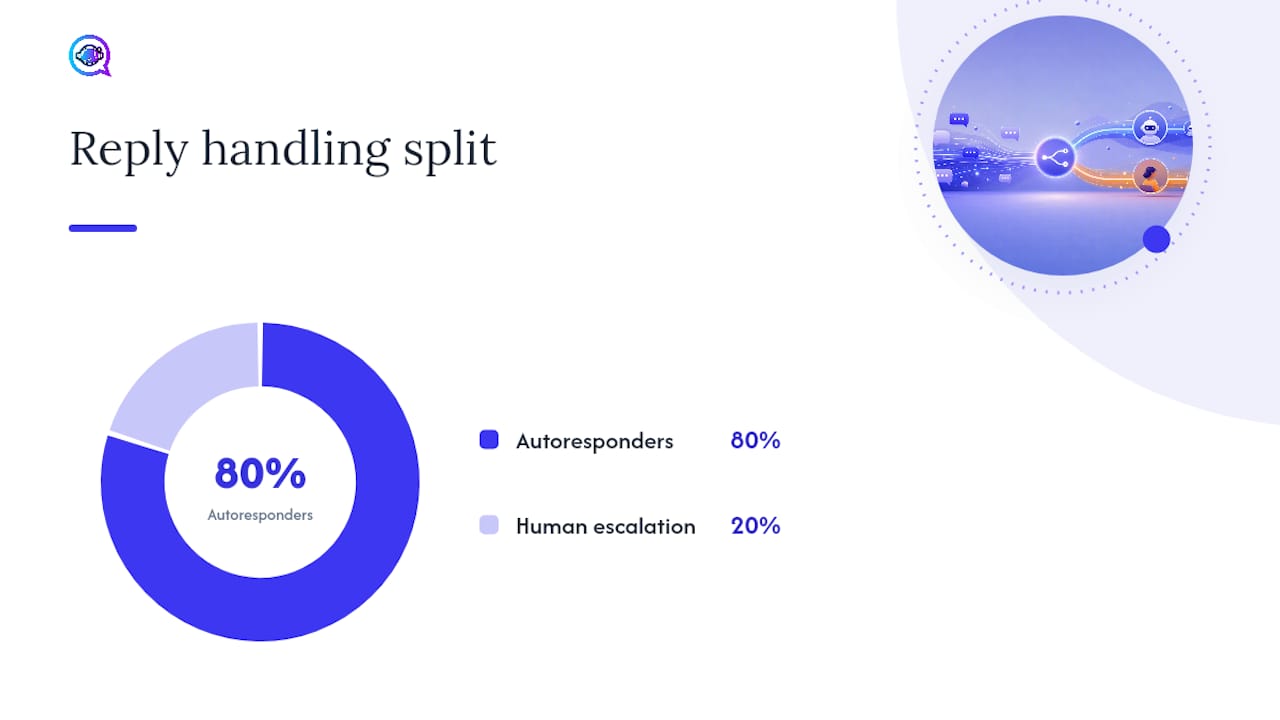
Autoresponders cover the predictable 80 percent of replies (confirmations, hours, pricing), with clear escalation rules for anything an autoresponder can’t confidently answer.
Conversational AI earns its place for qualification, appointment booking, and templated responses, but it performs best when you pass it metadata like lead source and last campaign so it has context without extra lookups.
Fallback paths matter as much as the happy path: know what happens to a message if your automation service goes down for ten minutes.
Pro Tip: Never let an autoresponder be the last word on a frustrated customer’s message. Route anything flagged as negative sentiment to a human within minutes, not hours.
Concurrency and message ordering deserve attention here too. If your AI or rules engine processes replies out of the order they were sent, a customer can end up getting an answer that no longer makes sense given what they said next.
How Astreaux Handles Two-Way SMS for Service Professionals
Two-way SMS solutions build around the reply, not the broadcast. When a lead texts back, conversational AI can answer instantly in the business’s own voice, ask qualifying questions, and book the appointment directly into the calendar, then sync the whole exchange to a CRM. That instant-engagement approach matters most for real estate agents, contractors, and therapists, where a slow reply often means a lost lead.
Some AI-driven platforms connect to thousands of apps, so the CRM mapping and routing rules covered above may be a configuration step rather than a custom build. If you want a walkthrough of the pieces before committing to a platform, connecting web forms to SMS and CRM integration for leads are good starting points.
Why Two-Way SMS Fails More Often From Neglect Than From Bad Tools
The technical failure points in two-way SMS are well documented: message ordering, webhook retries, keyword collisions. What’s underdiscussed is that most two-way SMS programs don’t die from a broken webhook. They die from nobody owning the inbox.
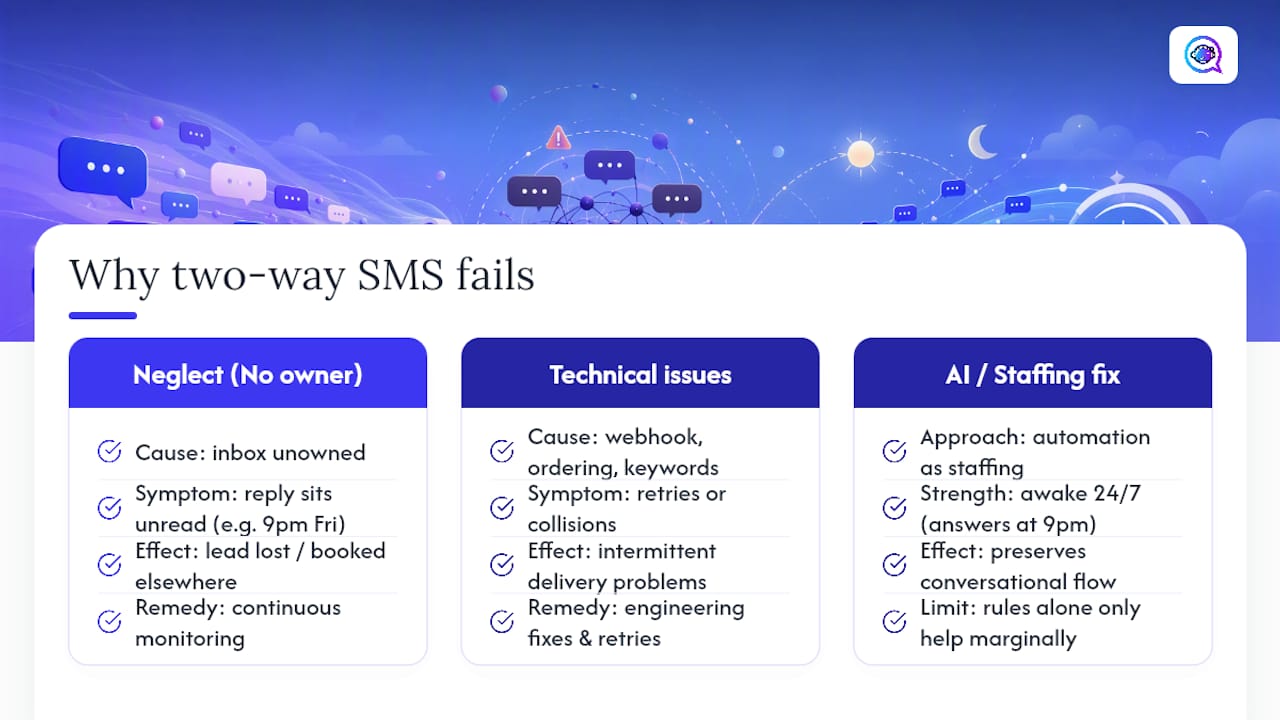
A business sets up the number, the CRM mapping, the autoresponder, and it works beautifully for three weeks. Then a lead texts back at 9 p.m. on a Friday with a real question, nobody’s watching the inbox, and the reply sits there until Monday. The lead has already booked with someone else. That’s not a technology failure. That’s a staffing and process failure wearing a technology costume.
The fix people reach for is usually more rules: more autoresponders, more keyword triggers, more branching logic. That helps at the margins, but it doesn’t solve the core problem, which is that conversational channels need something watching them continuously, not intermittently. This is exactly where AI-driven response genuinely earns its place, not as a gimmick, but as the thing that’s actually awake at 9 p.m. on a Friday. Teams that treat automation as a staffing solution first and a marketing tool second tend to get far more out of two-way SMS than teams that bolt AI onto a channel nobody was managing anyway.
— Jamaal
Get Instant Two-Way SMS Replies Without Hiring a Night Shift
If everything above sounds right in theory but heavy to build and staff, Astreaux is the alternative to hand-managing every inbound reply. It learns your business’s voice, then responds to new leads and existing contacts in seconds, day or night, qualifying them and booking appointments while the CRM updates itself in the background. For contractors juggling estimate requests and therapists managing intake, that means fewer missed leads and fewer no-shows without adding staff to watch a phone.
Real estate agents, contractors, and therapists use it specifically because the appointment-booking and follow-up work that used to eat evenings now happens automatically, with the same 7,000-plus app integrations covered earlier handling the CRM side. If your team runs estimates and bookings by text, the contractor-focused AI lead response tool shows exactly how that looks in practice, and if intake scheduling is your bottleneck, the therapist intake automation page walks through that flow. Start a trial at Astreaux and see how your first automated reply handles itself.
Sources
FAQ
Should both SMS and MMS be turned on for two-way messaging?
Turning on both is worth it if customers might reply with photos, like a contractor sending a job-site image or a customer sharing a receipt; otherwise, SMS alone covers most conversational and support workflows.
What’s the difference between a text message and SMS?
“Text message” is the everyday term for any message sent between phones, while SMS (Short Message Service) is the specific technical protocol carriers use to deliver most of those texts, including two-way business messages.
What is a two-way SMS short code?
A two-way SMS short code is a short, provisioned number that supports both inbound and outbound texting, commonly used for high-volume marketing and keyword-based campaigns, as opposed to a long code used for conversational, one-to-one texting.
What is a two-way texting device?
There’s no special hardware requirement. Two-way texting runs through a provisioned number connected to a messaging platform or CRM, like Astreaux, that businesses access from a computer, phone, or existing software, not a dedicated physical device.