Reduce No Shows With Brand Voice AI: One Page and 3 to 5 Samples
Brand voice AI turns your documented voice into enforceable guardrails, so every AI-generated or automated message reads like your brand wrote it. It works by extracting tone patterns from your existing content, then applying tone controls, blocklists, and alignment scoring to new output before it reaches a customer. The catch: none of it holds up without testing and an approval loop feeding edits back into the system.
TL;DR:
Brand voice AI extracts tone patterns from existing content and requires continuous testing and human feedback to prevent drift.
Building a one-page voice guide with specific traits, do/don’t rules, banned words, and sample sentences is key for effective training.
Prompt placement at the start of requests significantly improves voice consistency, with plugins suited for managing multiple tools and sources.
Regular scenario testing and scoring ensure AI-generated messages stay aligned with brand voice, especially for high-stakes or complex interactions.
Initial deployment should focus on one channel, such as social media or support chat, to validate and refine the system before expanding.
What Does Brand Voice AI Actually Do?
Brand voice AI reads your existing content, whether that’s your website copy, support transcripts, or sales emails, and builds a working model of how your brand actually talks. Some tools, like the Claude brand-voice plugin, pull directly from Notion, Google Drive, Slack, and meeting transcripts to distill scattered materials into one enforceable voice profile.
Others, like Junia AI’s brand voice generator, analyze sentence rhythm, vocabulary, and cadence to produce a reusable style profile with alignment scoring built in.
The features that actually matter fall into four categories:
Signal extraction: pulling tone patterns from documents, CRM notes, and past conversations rather than starting from a blank brief.
Tone controls and blocklists: dedicated fields for setting formality, warmth, and banned phrases, similar to how Gorgias lets support teams configure AI agent tone.
Cross-channel enforcement: applying one voice profile consistently across email, chat, and social rather than managing separate rules per channel.
Alignment scoring: a measurable signal showing how close each output lands to your approved voice, so drift gets caught before it reaches a lead.
How Do You Build a One-Page Brand Voice Guide for AI?
You don’t need a 40-page brand book to get consistent AI output. You need one page that an AI model, or a new hire, can read in three minutes and apply immediately. Here’s the structure that works:
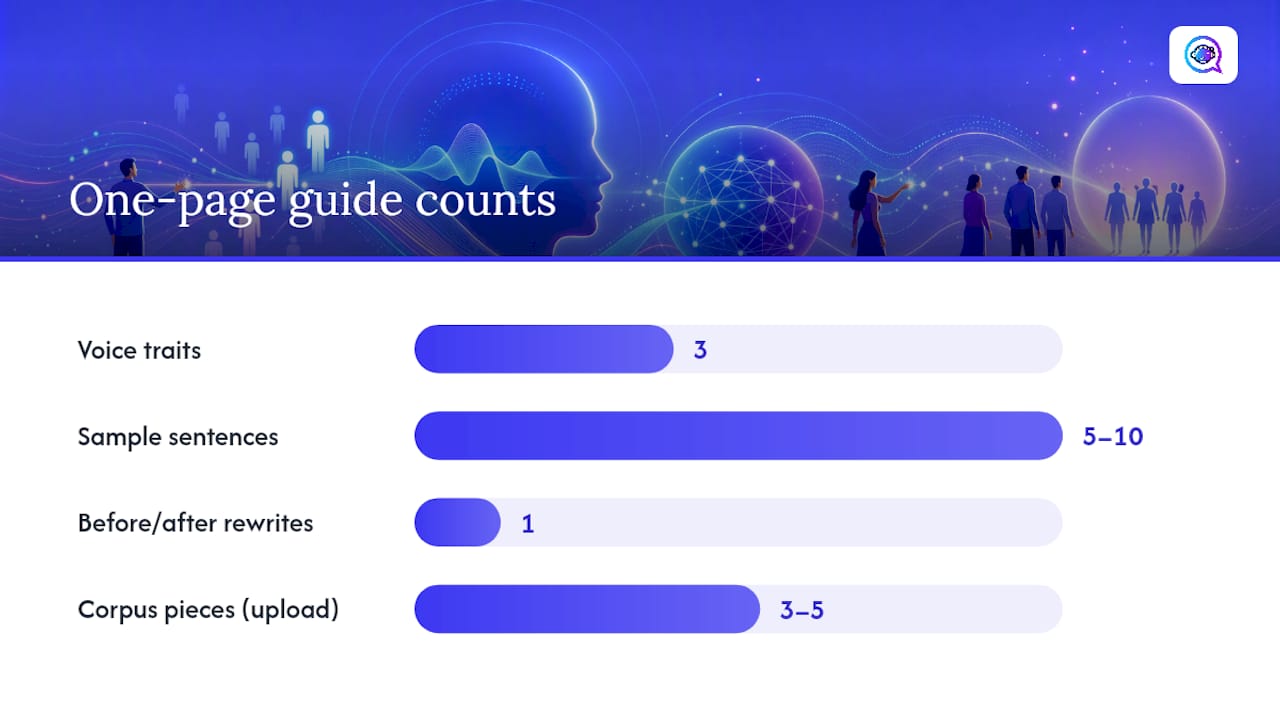
Name three voice traits with a “but not” clarifier. “Warm, but not casual.” “Confident, but not salesy.” “Direct, but not blunt.” The clarifier does the real work, since adjectives alone leave too much room for misreading.
List concrete dos and don’ts. Don’t write “be professional.” Write “use contractions, avoid exclamation points, never open with ‘Hi there!’”
Build a banned-words list. Include filler phrases, industry jargon your customers don’t use, and anything a competitor’s copy leans on that you want to avoid sounding like.
Write 5 to 10 sample sentences in your actual voice, covering different scenarios, a greeting, an objection response, a follow-up nudge.
Add one before/after rewrite. Take a generic AI-generated sentence and show the corrected version next to it. This single pairing teaches more than three paragraphs of description, according to Brand Brain’s guidance on training AI in your brand voice.
For the sample corpus you upload alongside this guide, aim for 3 to 5 of your best-performing pieces, totaling 1,500 to 3,000 words, per Junia AI’s recommended training approach. Plain text or exported docs work fine; you don’t need special formatting.
Pro Tip: Keep the one-page guide literally one page. If it doesn’t fit in a single prompt without scrolling, the AI won’t reliably apply all of it, and neither will your team.
How Do You Train AI on Your Brand Voice?
Training breaks down into two tiers: prompt-level guidance for most teams, and fine-tuning or plugin-based training for teams running high volume across many channels.
Prompt placement matters more than most people assume. Front-load your one-page guide and sample sentences at the very start of any prompt, before the actual request. Models weight early context more heavily, so burying your voice guide at the bottom of a long prompt weakens its influence.
For teams managing brand voice across multiple tools, brand-voice plugins that pull from Notion, Google Drive, Slack, and call transcripts remove the manual copy-paste step entirely. Tools like Tonos take a similar approach for individual writers, building a voice profile from message exports like Slack or WhatsApp so outreach reads as genuinely personal rather than templated.
Here’s how to decide which method fits your situation:
Use prompt guidance alone if you’re running one or two channels and updating messaging often.
Use a brand-voice plugin if your source material lives across five or more tools and changes weekly.
Fine-tune a model only if you’re generating high volume (thousands of messages monthly) and prompt guidance still produces inconsistent results.
Feed approved edits back into the system regardless of method. Every correction a human makes is training signal, and skipping this step is the single most common reason brand-voice AI drifts over time.
What Does a Brand-Voice Testing and Approval Checklist Look Like?
Before any AI-generated message reaches a real lead or customer, run it through scenario-based test conversations, not just single messages. Include edge cases: an angry customer, a price objection, a scheduling conflict. This is where most teams find the gaps a clean sample set never revealed.
Run multiple test conversations covering your most common and most difficult scenarios.
Score alignment using whatever metric your platform provides, or a simple 1 to 5 human rating against your one-page guide.
Set a human-in-the-loop threshold. Anything scoring below your bar gets reviewed before sending, not after.
Route corrections back into the training set. The approval loop is not a one-time gate; it’s ongoing.
Track edit rate over time. A dropping edit rate is the clearest sign your system is actually learning your voice.
Teams that build small pilots with tight approval loops and consistent alignment scoring see fewer edits needed and scale more predictably, according to Decagon’s research on AI tone consistency. Track key metrics going forward: edit rate, customer satisfaction on AI-assisted replies, and alignment score trends. If all three move the right direction for two weeks straight, you’re ready to expand the pilot.
Where Should You Deploy Brand Voice AI First?
Not every channel deserves the same rollout priority. Pick based on volume and risk tolerance.
Social and comment replies: shorter, more conversational, and lower stakes, making this a low-risk first pilot with tight moderation guardrails for anything sensitive.
Support chat and email: needs empathetic phrasing, clear escalation rules for anything legal or medical-adjacent, and stricter human review before full automation.
Marketing copy and ads: benefits most from sample phrases and a consistent personality, since this content gets the widest reach and the least individual review.
Conversational lead replies and appointment booking: the highest-impact use case for service businesses, where instant, voice-aligned responses directly affect booking rates and no-show reduction.
That last category is worth pulling apart further, because it’s where response speed and voice consistency compound each other.
How Does a Conversational Platform Apply Brand Voice to Leads?
A platform built for lead engagement ingests your one-page voice guide and sample sentences the same way any brand-voice tool does, then applies that profile to every automated reply a lead receives. Certain platforms learn a business’s voice from its existing messaging and apply it instantly when a new lead comes in, rather than waiting for a rep to draft a response manually.
The practical outcome for service businesses: faster first replies, more booked appointments, and fewer no-shows because the follow-up tone matches what the prospect already expects from the brand. Real estate agents, contractors, and therapists see this most clearly, since conversational AI for sales closes the gap between lead capture and first response.
When evaluating a platform, ask for its integration list, a sample alignment report, and real conversion metrics from comparable businesses, not just a feature demo.
What Should Brand Managers Prioritize First?
Start with one page and one channel. A polished 40-page brand book with a five-channel rollout is where most brand-voice AI projects stall, not where they succeed.
The approvals loop deserves more attention than the initial setup. Training comes from edits, not from a better initial prompt. Example-based teaching, real before/after rewrites, beats trait lists every time, because AI pattern-matches sentences far more reliably than adjectives. Save fine-tuning and deeper plugin integrations for after your pilot channel proves out, not before.
— Jamaal
Get Brand-Aligned Lead Replies Without Hiring a Full-Time Responder
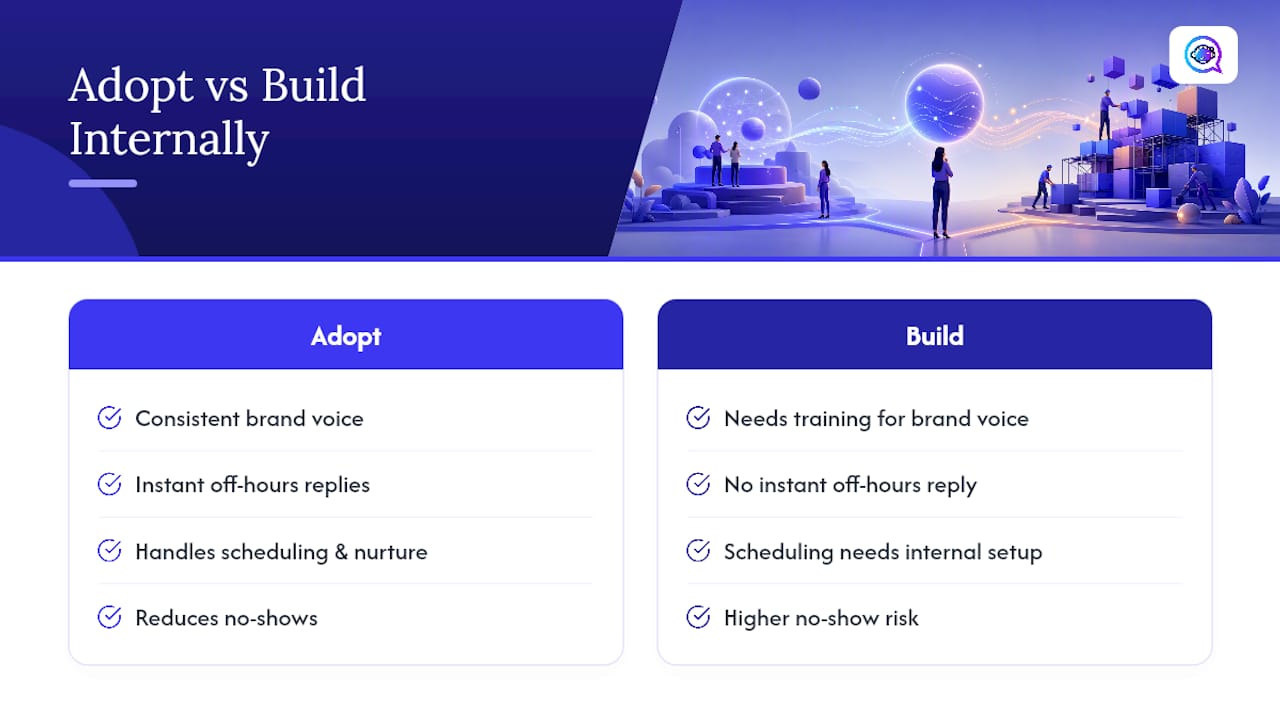
Some platforms help your business respond to new leads in a consistent voice without adding headcount or delay. These systems learn your business’s voice from existing messaging and apply it instantly, so a lead who reaches out outside business hours gets a personalized, on-brand reply immediately instead of a generic autoresponder or a missed opportunity.
Service professionals use such platforms to handle scheduling, nurture new prospects, and reduce no-shows, all while every message sounds like it came from the actual business rather than a script. These tools often connect with thousands of apps, allowing existing CRM and calendar tools to integrate without a separate migration project. For teams weighing whether to build this internally versus adopt it outright, AI lead appointment setting walks through what automated booking looks like in practice.
If instant, voice-matched replies to every new lead sound like what your pipeline is missing, start a trial with Astreaux and see how it responds to your own leads.
Selected Documentation and Practical Resources
For deeper implementation guidance, see the Claude brand-voice plugin documentation on signal extraction, Gorgias’s tone-of-voice setup guide for tone fields, and Brand Brain’s guide to writing in your brand voice with AI for sample-based training steps. For B2B pilot planning, SzopaLabs’s practical guide to generative AI pilots covers governance structure worth adapting.
Sources
FAQ
What Is Brand Voice AI?
Brand voice AI is software that learns your brand’s tone and language patterns from existing content, then applies that voice consistently to AI-generated or automated customer messaging.
How Many Writing Samples Do You Need to Train AI on Your Voice?
Most guidance recommends 3 to 5 of your best-performing pieces, totaling roughly 1,500 to 3,000 words, plus 5 to 10 short sample sentences covering different scenarios.
Should You Use Prompts or Fine-Tuning for Brand Voice?
Prompt guidance with a one-page voice guide works for most teams running one or two channels; fine-tuning only makes sense once you’re generating thousands of messages monthly and prompt guidance still misses the mark.
Can AI Handle Brand Voice for Lead Replies and Appointment Booking?
Yes. Platforms like Astreaux learn a business’s voice and apply it instantly to new lead replies, which speeds up response time and improves booking rates for service professionals like contractors and real estate agents.
What Metrics Show Whether Brand Voice AI Is Working?
Track edit rate on AI-generated drafts, customer satisfaction on AI-assisted replies, and alignment score trends over time; a declining edit rate is the clearest sign the system has learned your voice.