

Templates and 15–30 Minute Automations for Contractor Lead Follow Up
The single biggest fix for contractor lead follow up is pairing an instant automated acknowledgement with a documented 5-minute human callback. Send an SMS auto-reply the moment a lead lands, back it with missed-call text-back, and hold your team to a written callback SLA. Tools like AI sales agents can run the acknowledgement automatically while a real person still closes the call.
TL;DR:
Respond to leads within 60 seconds with an automated SMS acknowledgment and schedule a human callback within five minutes to maximize conversion rates.
Pair instant communication channels like SMS and missed-call text-back with documented SLA standards and regular timestamp reviews to increase contact and appointment rates.
Implement multi-touch follow-up sequences that include automated texts and calls over several days, adjusting based on lead intent and booking progress.
Assign a dedicated callback owner immediately after a lead arrives, using routing rules that prioritize urgent or high-budget projects for same-day responses.
Use simple automations such as autoresponders, missed-call texts, and lead routing, combined with compliance for TCPA consent to streamline follow-up workflows and reduce manual effort.
Astreauxcalendly.comTurn Contractor Leads Into AppointmentsAstreaux automates personalized lead engagement, follow-ups, and scheduling so contractors can respond quickly and manage estimates efficiently.Book a call
Why Speed to Lead Determines Whether You Win the Job
Homeowners requesting quotes almost never wait around. They are filling out three or four contractor forms in the same ten minutes, and whoever calls back first usually gets the walkthrough. That is the entire logic behind speed to lead, and the benchmarks are specific: an automated acknowledgement within 60 seconds, followed by a live human callback within 5 minutes.
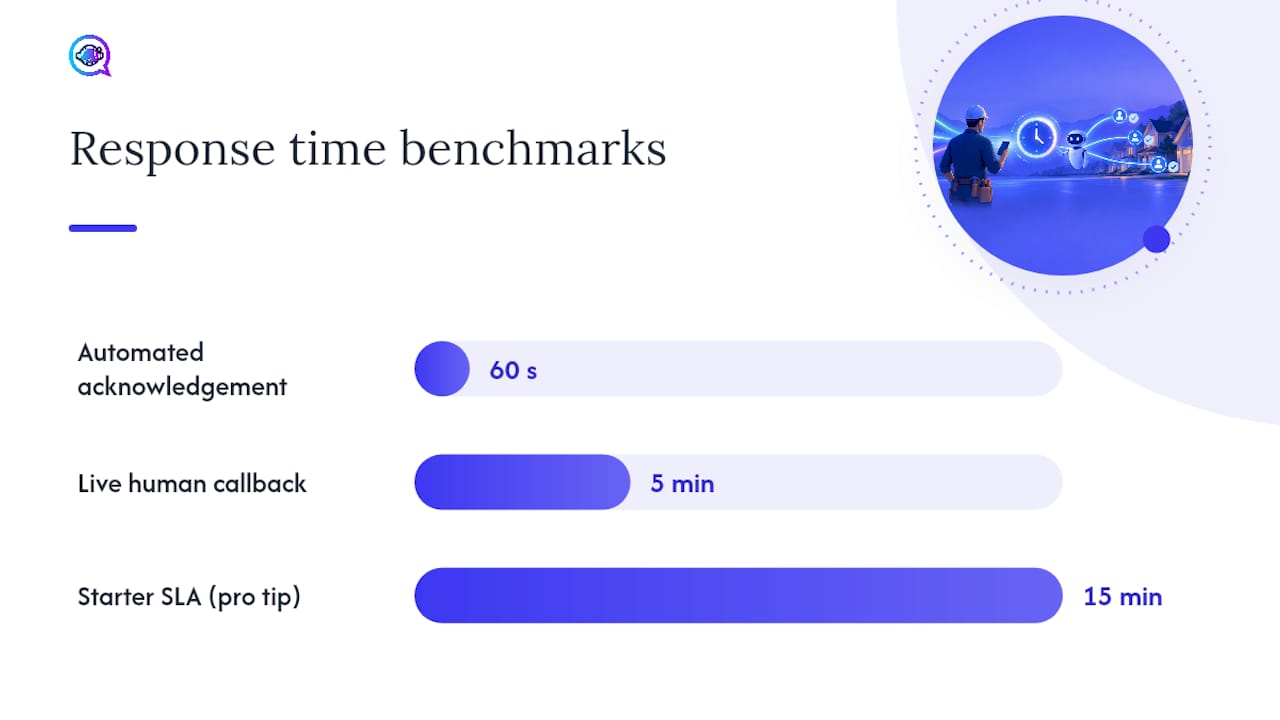
Contractors who hit that window qualify far more leads than those who call back thirty minutes later, according to research on contractor response times. The instant text buys you time; the human callback closes the trust gap a bot cannot close alone.
Getting there does not require new software from scratch — see these copyable contractor landing pages you can build in days for examples of simple contact-form best practices that reduce spam and improve lead capture. Here’s the minimum setup:
Connect your lead form or ad platform directly to an SMS tool so the auto-reply fires without anyone touching a keyboard.
Assign one person per shift as the “first call” owner, with a backup listed if they miss it.
Log every inbound lead with a timestamp, either in your CRM or a shared spreadsheet if that is all you have.
Review those timestamps every week, not once a month, so slow days get caught early.
Pro Tip: Start your SLA at 15 minutes if 5 feels unrealistic with your current crew size. Pushing that number down gradually still beats abandoning the goal entirely.
Which Channels Actually Keep a Lead Warm?
Email alone loses to text and phone every time, mostly because homeowners check texts within minutes and let quote emails sit in a folder for days. SMS and missed-call text-back convert better because they meet the lead where their attention already is, and pairing automated messages with a documented SLA consistently raises contact rates.
Set up these first-touch acknowledgements before you need them:
Instant SMS autoresponder: “Hi {{firstName}}, thanks for reaching out about your {{projectType}}. We received your request and someone from our team will call within 5 minutes.”
Missed-call text-back: “Sorry we missed your call! We’re reviewing your project now and will call you back shortly. Reply here if you’d rather text.”
After-hours email/SMS combo: “Thanks for your message. Our office opens at 7 AM and you’re first on our callback list.”
Email still has a role, but treat it as a supporting channel for sending estimates, photos, or scheduling confirmations, not as your first response. Chat and social messages need the same acknowledgement speed as SMS, since a slow reply on Facebook Messenger loses the lead just as fast as a slow reply anywhere else.
What Follow-Up Sequence Actually Closes the Job?
A single text or call rarely closes anything. Multi-touch sequences produce meaningfully more appointments than one-off outreach, because most homeowners need two or three nudges before they commit to a time slot, based on findings on lead response patterns.
For a high-intent inbound lead (someone who requested a quote directly), run this cadence:
Instant SMS acknowledgement (within 60 seconds).
Phone call attempt within 5 minutes; leave a voicemail if no answer.
Follow-up text 2 hours later if there’s been no response: “Still working around your schedule, {{firstName}}. What time works today?”
Second call attempt the next morning.
Final check-in text on day 3 before moving the lead to a longer nurture list.
For a low-intent inquiry (a general question or a “just looking” form fill), stretch it out:
Acknowledgement text same day.
Value-add follow-up on day 3 (a past project photo or a seasonal tip).
Check-in call on day 7.
Monthly nurture touch until they book or explicitly opt out.
Stop the sequence the moment someone books an estimate, and escalate immediately to your scheduler whenever a lead mentions a firm timeline or budget.
Who Owns the Callback, and How Do You Route It?
Every lead needs an owner within seconds of arriving, or it sits untouched until someone happens to check their inbox. Capture these fields the moment a lead comes in:
Project type and rough scope (roof, kitchen, addition, repair).
Timeline urgency (this week, this month, just researching).
Property address or service area, to confirm it’s within your footprint.
Preferred contact method and best callback window.
During business hours, one designated person owns the first call, typically the office manager or a dedicated intake person. After hours, that ownership hands off to either an on-call rotation or an automated system that books the lead directly onto tomorrow’s calendar.
Route urgent, high-budget leads (a burst pipe, a collapsed section of roof) straight to your estimator for a same-day call. Route routine or exploratory leads to a scheduler who can book a walkthrough within the week.
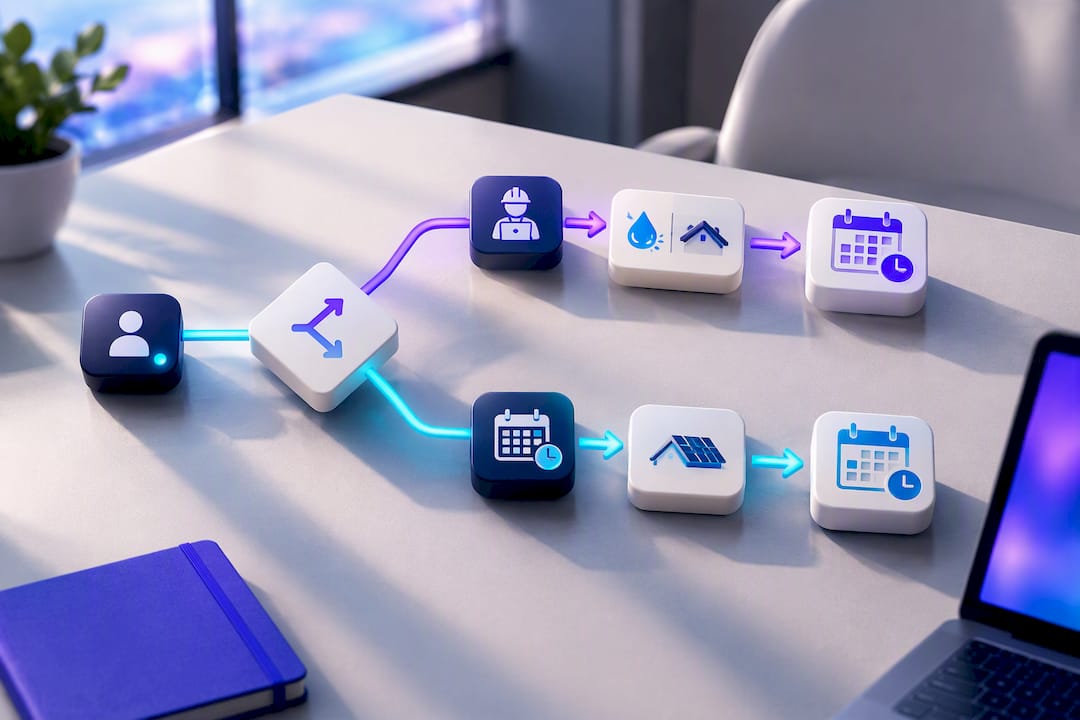
Pro Tip: Write your routing rules down on one page and post it by the phone. When it’s only in someone’s head, it disappears the day that person calls in sick.
Which Automations Actually Save Your Crew Time?
You don’t need an enterprise stack to close the biggest gaps. Four automations cover most of the risk: an SMS autoresponder for new leads, missed-call text-back, routing rules that assign leads to the right person automatically, and timestamp logging so nothing gets lost in a shared inbox.
The typical flow looks like this: a lead fills out a form or calls your business line, that data feeds into your CRM, the CRM triggers an SMS or VoIP acknowledgement, and a calendar link goes out for booking. Guides on automating this handoff walk through wiring each piece together without touching code.
Start with whichever piece you’re missing:
No autoresponder yet? Set one up first; it’s the fastest lift.
Missing missed-call text-back? Most VoIP providers offer it as a toggle, not a build.
No routing rules? Even a simple “if project type = X, notify person Y” rule beats a shared inbox everyone ignores.
Scripts and Templates You Can Use Today
Lead a phone opener with the project, not your company name: “Hi, this is Marcus from Bright Path Roofing, calling about the roof repair you asked about.” That gets a faster response than a generic company greeting, because it confirms you’re calling about their actual problem.
If it goes to voicemail, keep it under 20 seconds: “Hi {{firstName}}, this is Marcus calling about your {{projectType}}. I’ll try again shortly, or you can reach me directly at {{phone}}.”
Reuse the SMS templates from the channels section for instant acknowledgements, and keep every message honest about timing. Never promise a callback window you can’t hit. A missed promise costs more trust than a slightly longer wait ever will.
Keep scripts under 30 seconds when spoken aloud.
Always state the project type by name.
Never quote a price or timeline you haven’t confirmed with the crew.
What KPIs Actually Show a Follow-Up Problem?
Three numbers tell you almost everything: time-to-first-contact (how long between lead arrival and first human response), contact rate (percentage of leads you actually reach), and appointment rate (percentage of contacted leads who book an estimate). Businesses that pair automated first-touch messages with a documented SLA and CRM timestamps see meaningfully higher contact and appointment rates than those relying on manual callbacks alone.
Run a five-minute Friday sweep:
Pull last week’s timestamps and flag any lead with more than 5 minutes to first human contact.
Check contact rate: are more than 20% of leads going completely unreached?
Compare appointment rate week over week. A sudden drop usually means a broken automation, not a bad lead batch.
Use what you find to coach, not punish. If one person’s contact rate lags, it’s often a routing issue, not a work-ethic issue.
What Do Contractors Need to Know About TCPA Consent?
Recent FCC rulemaking requires one-to-one prior express written consent for robocalls and robotexts in most lead-generated contexts, closing a loophole that let purchased lead lists skip individual consent. Practically, that means you need the lead’s direct, documented agreement to be contacted by your business specifically, not a blanket opt-in buried in someone else’s form.
The FCC’s Report and Order also sets clear recordkeeping and revocation rules; you must honor opt-out requests promptly and keep proof of consent on file.
Use double opt-in when buying leads from third-party sources, and keep a timestamped consent record for each one.
Store consent language exactly as the lead agreed to it, not a paraphrase.
If a lead source doesn’t clearly document consent, default to email or a live phone call instead of automated texts until you can confirm it.
Detailed TCPA guidance for SMS can help you build a compliant texting workflow before you scale volume.
How Astreaux Handles the Speed and Follow-Up Playbook
Some platforms run conversational AI trained on your business’s own voice, so the instant acknowledgement a lead receives sounds like your company, not a generic bot. These platforms handle the first reply, can book appointments directly onto your calendar, and log every touch automatically, which covers the timestamping and routing steps this article walks through manually.
It also connects with over 7,000 apps, so the same lead that hits your form or ad platform can trigger the acknowledgement, the CRM update, and the follow-up sequence without a separate integration project. For contractors juggling crews on job sites all day, that automated re-engagement layer covers the gap between “lead comes in” and “someone finally calls back.”
A Realistic Take on Rolling This Out
Most contractors hit the same wall in week one: the automation works, but nobody’s actually watching the timestamps. That’s a process gap, not a tech gap. Fix it by naming one person, even part time, as the callback owner.
Automation without a human backstop still loses jobs. The winning setup is one accountable person plus a system like the SMS templates in this article, running together from day one. Turn on the autoresponder and missed-call text-back today. Everything else can wait a week.
— Jamaal
Automating Instant Replies Without Losing the Personal Touch
Every tactic in this article, the acknowledgement, the cadence, the routing rules, comes down to speed and consistency. Some AI platforms are built specifically to close that gap for contractors: they answer new leads in your own voice within seconds, book the estimate directly onto your calendar, and log the timestamp automatically so your weekly KPI sweep takes minutes instead of hours.
When you demo it, test three things first: how natural the instant reply sounds compared to your own scripts, whether the scheduling link actually lands on your real calendar, and how it handles a missed call versus a form submission. Those three checks tell you almost everything about fit for your crew.
If your team is losing bids to slower competitors simply because nobody answered fast enough, see how Astreaux works for contractors and book a demo to watch the acknowledgement and booking flow run on a real lead.
Sources
Speed to Lead for Contractors: The 60-Second Rule in 2026 - Contractor Guide Pro
Federal Register: Closing the lead generator loophole (FR-2024-01-26)
Federal Communications Commission FCC-24-24 (Report and Order)
FAQ
How Do You Follow Up With a Lead?
Send an automated acknowledgement within 60 seconds, then have a real person call within 5 minutes. Follow with a structured cadence of texts and calls over the next few days rather than a single one-off message.
How Much Do Contractors Pay for Leads?
Costs vary widely by trade, region, and lead source, so there’s no single industry figure to quote here. What matters more than the price per lead is your contact and appointment rate once a lead arrives, since a fast response turns more of those leads into booked jobs.
How Often Should You Follow Up With a Contractor Lead?
For a high-intent lead, plan on five touches across the first three days: an instant text, a call within 5 minutes, a follow-up text, a second call, and a final check-in. Low-intent inquiries can stretch to weekly or monthly touches until they book or opt out.
What Does “Follow Up on Leads” Mean?
It means every contact attempt made after a lead’s first inquiry, from the initial acknowledgement through scheduling the estimate. Tools like Astreaux automate the early acknowledgement and scheduling steps while still letting a human close the actual conversation.