

3 Lead Nurturing Sequences, 4 Hour Response for Financial Advisors
Financial advisor lead nurturing works best as an automation-first system anchored to your CRM, with advisor intervention at three specific checkpoints. Run three sequences: an education ladder, an objection-resolution track, and a readiness-signal reactor. Track three numbers above all others: substantive reply rate, second-meeting booking rate, and time-to-outreach on buying signals.
TL;DR:
Implementing a three-sequence lead nurturing system significantly improves conversion rates, especially when responses to readiness signals occur within four hours.
Segmentation based on client personas and content format variation are crucial for personalized engagement and higher reply rates around 8 to 12 percent.
Tracking reply and booking rates from the full funnel, rather than vanity metrics like opens and clicks, better predicts revenue outcomes and client acquisition success.
Compliance risks increase with automation, so templates must be approved, logged, and built with strict adherence to SEC and FINRA guidelines before implementation.
Using integrated platforms that connect CRM, sequencing, and calendar booking without manual patchwork enhances reliability and accelerates initial lead response times.
AstreauxRespond To Leads More QuicklyAstreaux helps financial advisors automate personalized lead engagement, follow-ups, and scheduling through conversational AI.Book a call
What Financial Advisor Lead Nurturing Sequences Actually Convert?
Most advisors run one generic drip campaign and call it nurturing. That’s why so many leads go cold. The fix is running three distinct sequences, each built for a different stage of a prospect’s decision.
Here’s how each one works:
Education ladder. Send 5 to 8 pieces over 6 to 10 weeks, moving from broad financial concepts to increasingly specific guidance tied to your services. Start with a welcome message, follow with an educational piece, add social proof, offer a checklist or downloadable tool, and close with a soft invitation to talk. Well-targeted ladders like this produce substantive reply rates around 8 to 12 percent.
Objection-resolution track. This one fires after a discovery call that didn’t close. Send 3 to 5 personalized pieces over 3 to 4 weeks, each addressing a specific objection the prospect raised (fees, timing, trust in a new advisor). Tracks mapped to recorded objections can book second meetings at a 30 to 40 percent rate within 45 days.
Readiness-signal reactor. This isn’t a drip campaign at all. It’s a rules engine watching for behavior: fee-page revisits, multiple resource downloads, or a click on your calendar link. When a trigger fires, it should alert a human team member immediately, not queue another automated email.
The reactor is the piece most practices skip, and it’s the one with the tightest timeline. Firms that respond to these signals within a median of under 4 business hours convert meaningfully better than those that let a hot signal sit in an inbox overnight.
How Do You Build the Nurture System Operationally?
Sequences only work if the plumbing behind them is sound. That starts with segmentation, not content.
Map each lead to an ideal-client persona before it enters any sequence. A 28-year-old first-time investor and a 58-year-old pre-retiree should never see the same education ladder. Run A/B tests within segments, not across them; comparing a subject line test between two different personas tells you nothing useful.
Content format matters as much as message timing. The Advice Engagement framework from Kitces makes the case that varying delivery format, not just message content, is what moves prospects from passive readers to active clients. In practice, that means mixing:
Short video, 60 to 90 seconds, for a personal introduction or a quick concept explainer
One-page checklists prospects can act on immediately
Simple calculators (retirement gap, tax-loss estimate) that create a reason to return to your site
Case vignettes that show, without naming clients, how a similar situation played out
An objection FAQ page that pre-answers the top three questions prospects ask before a first call
Cadence rules keep the system from wearing prospects out. During an active sequence, space touches every 5 to 7 days. Once a prospect moves to long-term nurture, drop to one monthly touch. Never exceed two sends per week; that’s the fastest way to trigger unsubscribes and spam complaints.
Build in three human checkpoints: a fit assessment before a prospect enters any sequence, a handoff when the objection-resolution track flags a stuck lead, and a pre-meeting briefing before any booked call.
Pro Tip: Give your readiness-signal alerts a name and an owner, not just a Slack notification. “Fee-page trigger, routed to Maria, 4-hour SLA” gets acted on. An unlabeled alert gets ignored by the third week.
Which Metrics Actually Predict Revenue From Lead Nurturing?
Opens and clicks feel productive to track, but they don’t predict revenue. Advisors who measure reply rates and booking rates instead of vanity metrics get a much clearer read on what’s actually working.
Five numbers deserve a permanent spot on your dashboard:
Substantive reply rate: 8 to 12% on education ladders
Prospect-to-meeting rate: 25 to 35% across your full funnel
Second-meeting booking within 45 days: 30 to 40% on objection-resolution tracks
Time-to-outreach on readiness signals: under 4 business hours, median
90-day funded-account rate: the number that ties nurturing directly to revenue
A low reply rate almost never means “the prospect isn’t interested.” It usually means one of three things: the content doesn’t match the segment, the cadence is off, or the message is landing at the wrong point in the prospect’s decision process.
Your CRM should tag every lead with the sequence it’s in and log every reply, click, and status change against that sequence. Without that tagging, you’re guessing at which sequence produced which outcome.
What Compliance Rules Apply to Automated Advisor Nurturing?
Automation doesn’t reduce your compliance exposure. It just moves the risk earlier, into template design.
Know the SEC Marketing Rule. The rule amended in 2020 broadened the definition of an “advertisement” to cover most nurture communications, and it sets specific conditions on testimonials, endorsements, performance claims, and recordkeeping. Every automated message a prospect receives falls under this framework.
Understand FINRA’s correspondence threshold. FINRA draws a line between correspondence and retail communication at 25 recipients. Cross that line and your template needs principal approval before it goes out, not after.
Lock your templates. Approve each sequence’s copy, version-lock it, and keep AI tools from generating new live copy inside an active template unless compliance has signed off on that specific workflow.
Log everything. Keep an audit trail of every version, every approval, and every send. If a regulator asks what a prospect received eighteen months ago, you need to produce it in minutes, not days.
What Technology Do You Need to Run This Reliably?
The nurture strategy above is only as good as the plumbing underneath it. Four pieces need to work together without manual patchwork.
Your CRM needs to support segmentation by persona, custom fields for objection type and readiness signals, activity-based triggers, and API or webhook access so it can talk to your sequencing tool in real time. A CRM integration built around webhooks rather than manual exports is what makes the readiness-signal reactor possible at all; without live event data, that sequence collapses into a delayed email.
On top of the CRM, you need:
A sequencing engine that supports conditional logic (branch a prospect out of the education ladder the moment they book a call)
Calendar booking integrated directly into your messages, not a link that dumps prospects onto a separate scheduling page
Analytics that report by sequence, not just by campaign
An audit log tied to compliance sign-off for every template version
Advisor-focused platforms tend to bundle these functions more tightly than enterprise CRMs built for broader financial services use, which usually means less custom development to get running. Before any sequence goes live, run a three-step checklist: test every template on a dummy lead, dry-run the full sequence end to end, and get final compliance review on copy and disclosures.
What Do the Numbers Say About Automated Nurturing?
The case for structure is strong before you even get to automation. Advisors who work from a defined marketing plan generate 168% more leads each month than those working without one, according to Broadridge’s 2024 survey data.
Automation adds a second layer on top of that structure. Industry analyses of advisor nurturing programs show automated sequences raising conversion rates by roughly 25% while lowering cost-per-acquisition, largely because timely follow-up replaces the delayed, inconsistent outreach most solo practices default to.
If you’re testing this for the first time:
Start with the education ladder. It’s the lowest-risk sequence to validate and gives you a full 6 to 10 week read on engagement.
Layer in the readiness-signal reactor second, since it needs the least content and the fastest feedback loop.
Save the objection-resolution track for last. It needs real call notes to personalize against, so it depends on the other two being live first.
None of this goes live, though, until compliance has approved every template you plan to send.
How Do You Define Your Ideal Client Before Nurturing Begins?
Nurturing fails most often when it starts too early, before you’ve defined who you’re actually trying to reach. A persona built on real client data (average account size, life stage, primary financial concern, referral source) tells you which content ladder a lead should enter and how fast to move them.
Pull this from your existing book, not guesswork. Look at your last 20 to 30 closed clients and find the patterns: Did they come in worried about a specific event (sale of a business, inheritance, divorce)? Did they need heavy education or did they arrive already informed? Group them into two or three personas, not ten. More than three personas usually just means your segmentation logic is too granular to maintain.
Each persona should map to a distinct entry point in your nurture system. A prospect who found you searching for retirement income strategies gets a different first message than one who downloaded a business-exit checklist. Build this mapping once, into your CRM’s tagging rules, and it runs itself from then on.
How Should You Score Leads to Prioritize Follow-Up?
Not every lead deserves the same attention on day one, and a scoring model tells you which ones do. Build your score from two categories: fit signals (does this person match your ideal-client profile on income, assets, or life stage) and intent signals (have they visited your fee page, opened three emails in a row, or clicked your calendar link).
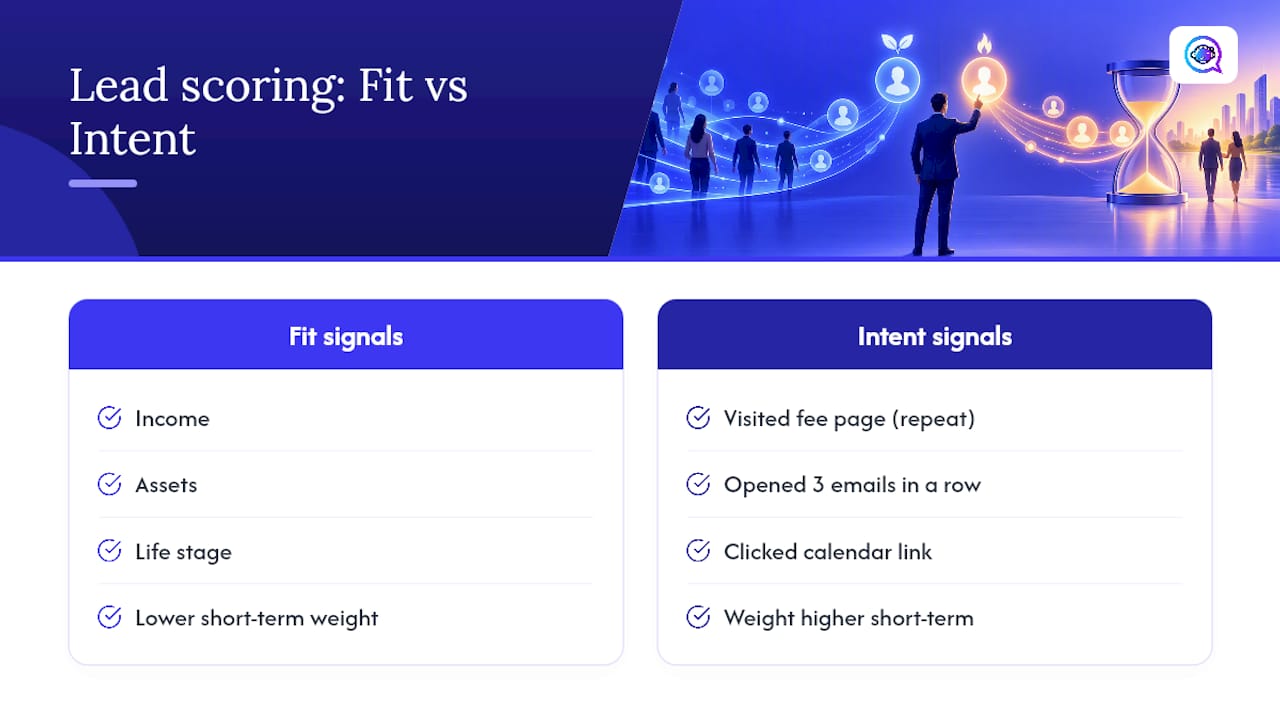
Weight intent signals higher than fit signals in the short term. A moderately-fit lead who’s visited your fee page twice this week is a better use of your time today than a perfectly-fit lead who hasn’t opened an email in a month. Assign point values, set a threshold (say, 50 points triggers a human call within a day), and let the score update automatically as behavior changes.
Keep the model simple enough that you can explain it out loud. A scoring system with 40 weighted variables looks sophisticated but becomes impossible to audit or adjust when your close rates shift. Five to eight variables, reviewed quarterly against actual conversion outcomes, will outperform a complex model nobody trusts enough to act on.
How Do You Re-Engage Dormant or Cold Leads?
A lead that’s gone quiet for 90 days isn’t dead. It’s often just waiting for a reason to re-engage, and a single well-timed message can restart the conversation.
Don’t restart a dormant lead at the top of your standard education ladder. That’s redundant and it reads as impersonal. Instead, send a short, direct check-in referencing something specific: a life event that may have changed their situation, a new piece of content relevant to what they originally inquired about, or a simple “still relevant?” message with one clear next step.
Segment your dormant list by original entry point before you re-engage it. Leads who dropped off mid-way through an objection-resolution track need a different message than leads who never responded to the education ladder at all. Give re-engagement its own short sequence, two or three messages over two weeks, and if there’s still no response, move the lead to a quarterly long-term touch instead of continuing to email weekly. Persistent low-value outreach damages your sender reputation more than it produces meetings.
How Do You Handle Objections and FAQs Without Sounding Scripted?
Objections during nurturing usually fall into a short, predictable list: fees, trust in a new advisor, timing, and whether they really need professional help at all. Build your objection-resolution content around these categories in advance, rather than writing a response from scratch every time one surfaces.
Personalize the delivery even when the underlying content is templated. Reference the specific concern the prospect raised on their discovery call, then send the relevant piece: a fee-transparency breakdown, a short case vignette showing outcomes for a similar situation, or a plain-language explanation of what working together actually looks like month to month. This is where the objection-resolution track’s 30 to 40% second-meeting rate comes from: specificity, not volume.
Keep a living FAQ document that your team updates every time a new objection comes up on a call. Within a year, you’ll have pre-built answers for nearly every question a prospect raises before you ever hear it directly.
What Privacy Rules Apply to Lead Data During Nurturing?
Automated nurturing runs on prospect data, which means privacy and security obligations start the moment a lead fills out a form, not after they become a client. Collect only the information each sequence actually needs, and store it inside systems with access controls, not shared spreadsheets that anyone on the team can open.
Be explicit about how prospects can opt out, and honor that request immediately across every sequence they’re enrolled in, not just the one where they clicked unsubscribe. State plainly, in your privacy disclosures, what data you collect through website tracking (like the fee-page visits your readiness-signal reactor watches for) and how it’s used. Prospects increasingly expect this transparency, and regulators increasingly expect you to document it.
Work with a compliance partner if your practice doesn’t have in-house expertise here. A firm like TLC Consulting can help translate data-handling and retention rules into policies your team can actually follow day to day, which matters more than having a policy that exists only on paper.
A 30 to 60 Day Rollout Plan for a Small Practice
Start narrow. Segment your active leads into two or three personas, pick one education ladder to build first, and set your readiness-signal SLA before you write a single email. Get compliance to preapprove every template before anything goes live.
Keep a human on the objection-resolution handoff and the pre-meeting briefing; don’t automate those touches. Run your first 90-day measurement window against reply rate and second-meeting booking, A/B testing one variable at a time (subject line, then send time, then content order).
— Jamaal
Get Your Nurture Sequences Running Without Building Them From Scratch
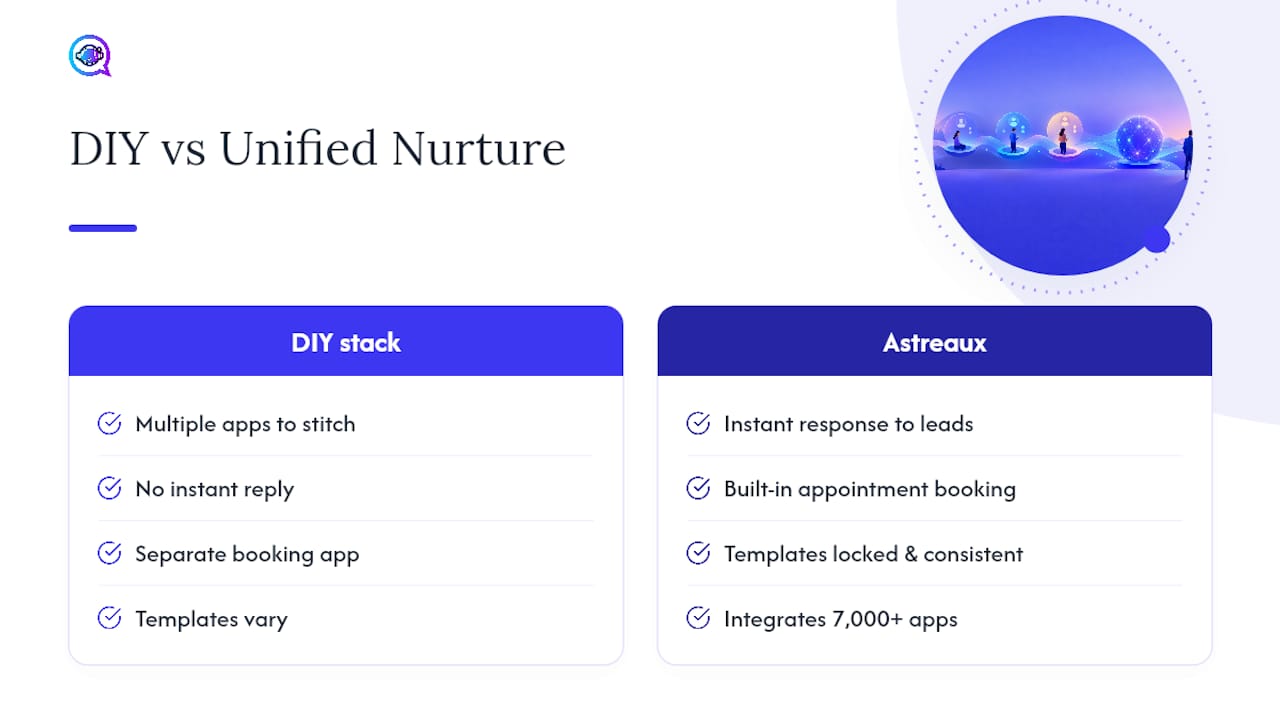
There are practical shortcuts to everything above: instead of stitching together a CRM, a separate sequencing tool, and a calendar app, you can get instant, personalized replies trained on your own voice, appointment booking, and readiness-signal alerts in one connected system.
That matters most for the readiness-signal reactor, the sequence with the tightest SLA and the highest payoff. Astreaux responds to a new lead the moment it arrives, which is how the platform closes the gap between a prospect clicking your calendar link and a human actually reaching out. Templates stay locked and consistent across every send, and Astreaux’s integrations span more than 7,000 apps, so it connects into whatever CRM and calendar your practice already runs on, no rebuild required. For a closer look at how a short, structured pilot performs in practice, the 3-message nurturing pilot walks through the setup start to finish.
If you’re ready to see how it handles your specific lead flow, request a demo of Astreaux and bring your current sequence benchmarks with you.
This article is general information, not a substitute for advice from a qualified financial advisor. Consult a qualified financial professional about your own circumstances before acting on anything here.
Sources
Automated Lead Nurturing for Financial Advisors (2026) - Lead-Lag Media
Investment adviser marketing (SEC small-business compliance guide)
Advice engagement strategies that encourage clients to act (Kitces)
Financial Advisor Lead Nurturing: 25% More Conversions (2026)
FAQ
What Is a Red Flag for a Financial Advisor?
Common red flags include pushing a sale before understanding a prospect’s full financial picture, avoiding clear answers about fees, and lacking any documented follow-up process. Prospects also flag advisors who disappear after an initial call. A structured nurture sequence with a defined second-meeting booking rate is one way practices avoid that specific credibility gap.
How Much Should You Pay for Lead Generation?
Costs vary widely by channel and market, and there’s no single benchmark that applies across all advisory practices. What matters more than the raw spend is what happens after the lead arrives: advisors who nurture leads through a defined marketing plan generate 168% more leads each month than those without one, which changes the cost-per-client math significantly.
What Is the 80/20 Rule for Financial Advisors?
In most advisory practices, roughly 80% of revenue comes from around 20% of clients, typically the highest-asset relationships. That’s the core reason lead scoring matters: it helps you identify which prospects are most likely to become part of that top 20% before you invest heavy nurturing time in them.
Is an Income of $100,000 Enough to Work With a Financial Advisor?
Yes. Most financial advisors work with clients across a wide range of income levels, with practices serving many different profiles, particularly fee-based and fee-only advisors focused on financial planning rather than strictly high-net-worth asset management. The right fit depends more on your financial goals and complexity than on a specific income threshold.
What’s the Fastest Way to Improve Financial Advisor Lead Nurturing Results?
Start by fixing time-to-outreach on readiness signals, since firms that respond within a median of 4 business hours consistently outperform slower responders. Platforms like Astreaux address this directly by replying to new leads instantly rather than queuing them for manual follow-up.