

60 Second First Reply: SMS First Lead Flow With AI for Service Pros
For inbound, time-sensitive service leads, send a short SMS first, within 60 seconds if you can manage it, and fire a simultaneous email for the details that need to stick around. SMS wins on speed and read rates; email wins on documentation. Run both in sequence, watch your compliance basics, and a platform like Astreaux can automate the whole handoff for you.
TL;DR:
Sending an SMS within the first minute after a lead arrives increases engagement and response rates, with open rates as high as 98%.
For detailed requests or proposals, email remains essential, while SMS is better suited for urgent or time-sensitive communication.
A proven communication sequence starts with a brief SMS, followed by an email with calendar links, and includes scheduled follow-ups and a breakup message if needed.
Automating SMS follow-up requires proper consent, reply opt-outs, and CRM logging to ensure TCPA compliance.
Integrating SMS and email automation tools can reduce response times from hours to under a minute, significantly improving booking and conversion rates.
Astreauxcalendly.comRespond Faster to New LeadsAstreaux learns your business voice and sends personalized responses instantly, helping service professionals manage inquiries and schedule appointments.Book a call
SMS vs Email for Leads: A Quick Decision Matrix
Not every lead deserves the same first touch. The right channel depends on what just happened and how much detail the moment requires. Here’s how to triage it:
Missed call or urgent service request → SMS first. A short text asking to schedule or clarify beats a voicemail nobody checks until lunch.
Web form with a detailed request → SMS plus email. The text opens the conversation; the email carries the specifics, attachments, or intake forms.
Appointment reminder or last-minute scheduling change → SMS only. Nobody reads a reminder email in time to reschedule a same-day visit.
Proposal, estimate, or contract-style document → Email first. Texting a PDF link feels rushed, and clients expect paperwork to arrive in their inbox.
Re-engaging a cold lead → Email or a mixed approach, depending on how much prior contact you’ve had. Texting someone who went quiet three months ago without warning can feel intrusive.
This matrix isn’t a rigid rulebook. It’s a starting filter you apply in the first ten seconds after a lead comes in, before you’ve had time to overthink the channel.
Why SMS Wins for Immediate Leads and Where Email Still Matters
Speed decides more deals than most service professionals realize. Contacting a lead within five minutes produces roughly 9 times higher conversion than waiting 30 minutes or longer, and the 60-second and 5-minute benchmarks show up across nearly every speed-to-lead study worth reading.
By the Numbers: SMS open rates commonly run 95% to 98%, usually read within minutes, compared to typical email open rates of just 20% to 30%.
That gap explains why SMS should carry your first, time-critical touch. A few reasons it holds up in practice:
SMS gets read almost immediately, so a short qualifying question or scheduling ask gets answered while the lead is still warm.
Email handles what SMS cannot, such as attachments, longer explanations, pricing breakdowns, or anything that needs a paper trail.
Certain regulated industries and higher-stakes conversations may require a personal phone call instead of either channel, especially for sensitive cases or large jobs.
Emergency situations almost always favor SMS or a call over email.
The two channels aren’t rivals so much as teammates with different jobs. SMS gets the door open. Email keeps the paperwork straight once the conversation is underway.
How Do You Build a Speed-to-Lead Sequence That Works?
A working sequence doesn’t need fourteen days of scripted messages on day one. Start small, verify the first message fires correctly, then build out from there.
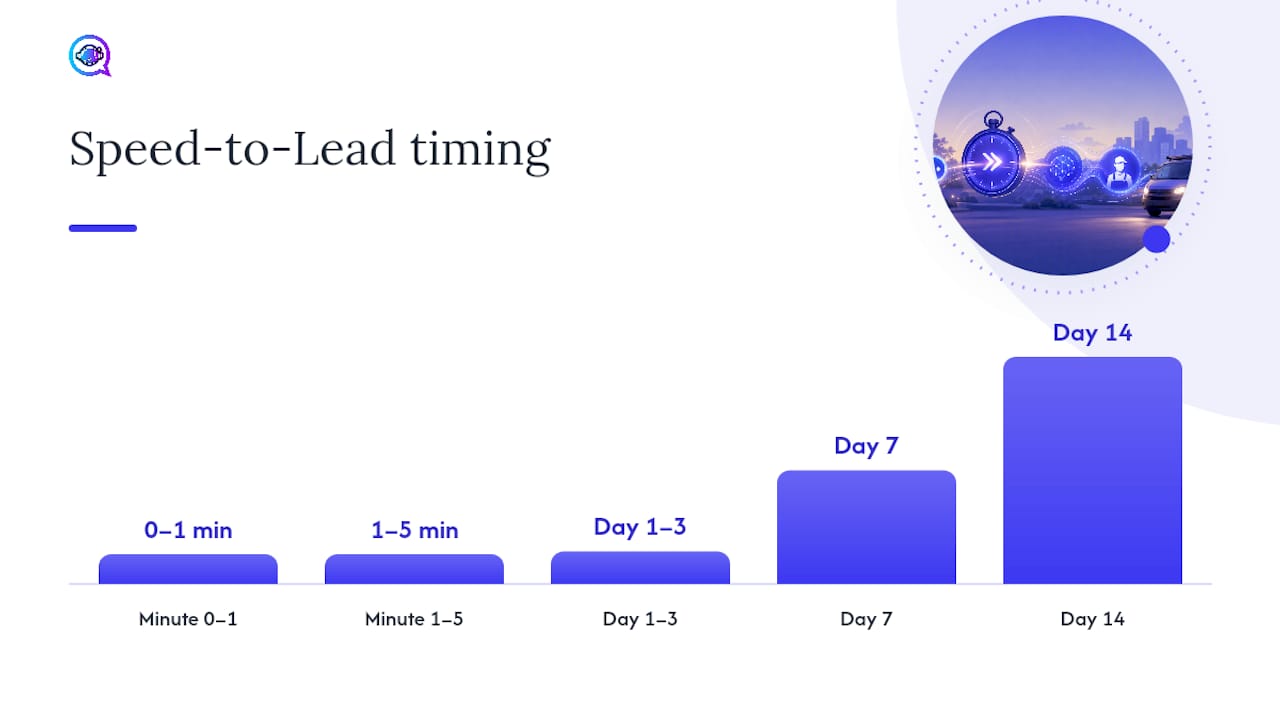
Minute 0 to 1: Send a short, two-sentence SMS in a human tone with a single ask. Something like: “Hi {{firstName}}, this is [Business Name]. What day works best for a quick call this week?” No hard sell, no paragraph of information.
Minute 1 to 5: Follow with an email that includes a calendar link, a brief overview of your services, and any relevant attachments (intake forms, pricing sheets, service area maps).
Day 1 to 3: Send an SMS follow-up if there’s no response, then a short value-focused email on day 3, maybe a testimonial, a case study, or an answer to a common question.
Day 7: Send a “breakup” SMS. Something like: “Still interested in getting this scheduled? Just reply and I’ll find a time.” This message alone often revives leads that felt lost.
Day 14: Send a final email, then shift any still-cold lead into a monthly nurture sequence instead of daily contact.
Pro Tip: Set up escalation rules so that specific keywords or affirmative replies (yes, call me, schedule) trigger an instant alert to a human team member. Everything else stays automated until intent shows up.
Route every reply into your CRM as it happens, not at the end of the day. That’s the difference between catching a hot lead and finding it cold three hours later. For copy-ready message examples that map directly onto this sequence, Astreaux’s guide to SMS lead follow-up templates is worth bookmarking.
What Do You Need for TCPA Compliance With Automated SMS?
Automating SMS follow-up means taking compliance seriously from day one, not retrofitting it after your first complaint. The basics aren’t complicated, but skipping them is expensive.
Know the difference between inbound and cold outreach. A lead who just filled out your form is a different legal situation than someone you’re texting cold, and TCPA guidance treats them differently.
Add a short consent line to every form. One sentence disclosing that submitting the form means agreeing to receive texts covers the basics.
Always honor Reply STOP. Test your platform regularly to confirm opt-outs actually process, not just display a confirmation message.
Log everything in your CRM. Consent timestamps, message copies, and opt-out requests all need a paper trail if anyone ever questions your process.
Get extra careful in regulated fields. Healthcare, finance, and legal services carry additional rules on top of TCPA basics, so loop in counsel before scaling automated texting in those spaces.
For a deeper walkthrough of consent language and recordkeeping specifics, Astreaux’s TCPA compliance guide for SMS covers the practical side in more detail. Readers wanting a broader view of how automation and personalization intersect with regulation more generally may also find value in this overview of AI in marketing.
What Does the Technical Setup Actually Require?
Getting SMS-first automation running takes four pieces working together, not a complicated tech stack.
A trigger: a missed call, a completed form, or a booking request that kicks off the sequence automatically.
An SMS gateway and an email sender that fire in near-simultaneous succession once triggered.
A CRM or system of record that captures the reply, logs intent, and writes back source data so you know which lead came from where.
Delivery receipts and opt-out automation built in, not bolted on after a compliance scare.
Owner alerts limited to high-intent replies only, so you’re not pinged for every automated “thanks” and burning out on notifications within a week.
Track four numbers to know if it’s working: response time, booked appointments, conversion rate, and no-show rate. If response time doesn’t drop into single-digit minutes, something in the trigger chain is broken. For the full technical checklist on connecting these pieces, see Astreaux’s guide on automating lead follow-up.
Why Speed-to-Lead Automation Changes the Math for Service Businesses
Automated first-touch SMS solves a problem that has nothing to do with motivation and everything to do with availability. Nobody staffs a front desk at 11 PM on a Tuesday, but leads don’t wait for business hours. Letting AI handle that first text means the reply goes out whether you’re awake or not, and the human on your team only gets pulled in when a reply actually signals intent.
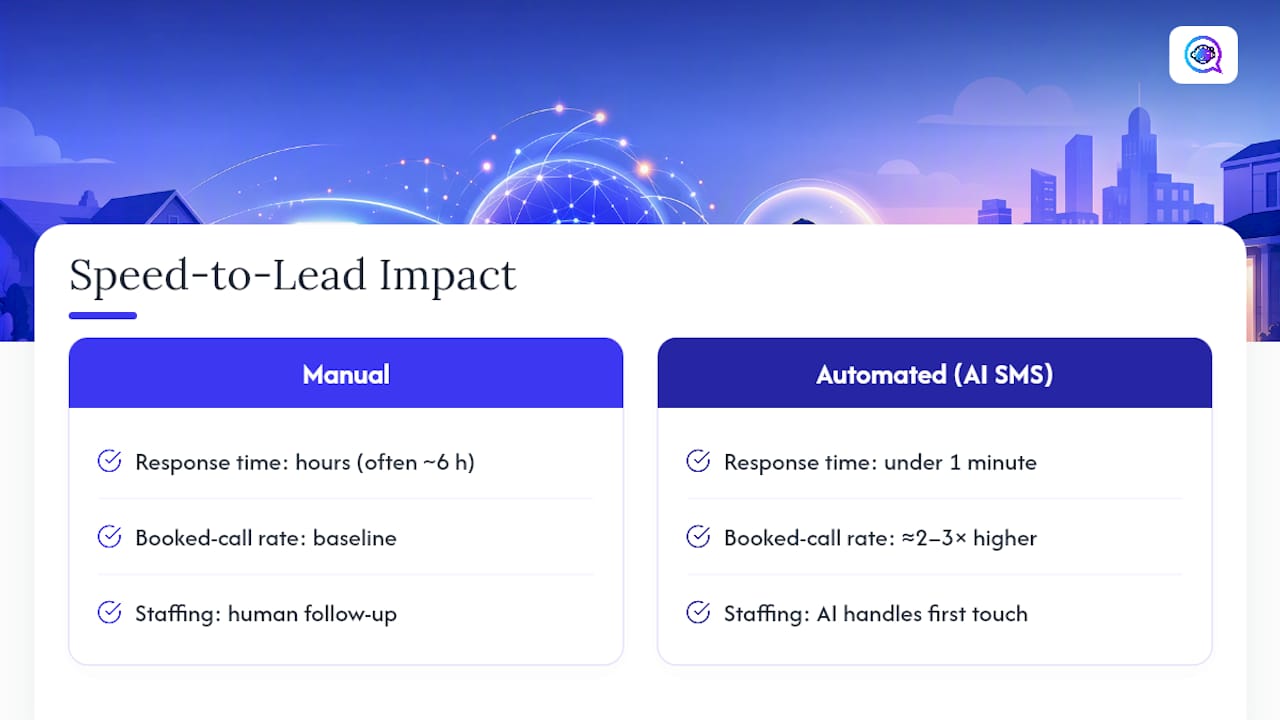
Astreaux is built around that exact gap. It learns a business’s voice well enough to send a first reply that doesn’t read like a robot, then hands off to a person the moment a lead says something worth a real conversation. Businesses that automate this first touch commonly see booked-call rates roughly double or triple versus manual follow-up, with response times dropping from hours to under a minute.
Picture a contractor who used to call leads back after finishing a job site visit, sometimes six hours later. An AI-driven SMS reply within a minute, paired with a calendar link in the follow-up email, closes that gap entirely. The lead schedules before they’ve even considered calling a competitor.
— Jamaal
Try Astreaux for SMS-First Lead Response
Astreaux is the alternative to hiring a full-time front desk just to catch leads fast enough. It sends instant, personalized replies trained on your business’s own voice, then handles scheduling and nurturing automatically so no inbound lead sits untouched for hours.
The platform connects with many apps, so your CRM, calendar, and ad platforms can stay in sync without manual data entry. Service professionals use it to cut response times and reduce no-shows without adding headcount. If you want to see how a three-message pilot looks before committing to a full sequence, Astreaux’s guide to a three-message automated pilot is a good place to start. Ready to see it running on your own leads? Book a demo with Astreaux and watch your first automated reply go out before your next meeting ends.
Sources
How to Automate Lead Follow-Up Without Hiring Anyone | BlueDash Creative
SMS vs Email for Service Business Follow-Up: Which One Gets Responses | Mustardseed Digital
How to Automate Lead Follow-Up and Never Lose a Lead | Thinxster
FAQ
Is SMS or Email Better for Following Up With Leads?
SMS wins for immediate, time-sensitive follow-up because it gets read within minutes and reaches open rates of 95% to 98%, compared to email’s typical 20% to 30%. Email still matters for detailed information, attachments, and anything that needs a written record, so the strongest approach uses both together.
How Fast Should I Respond to a New Lead?
Aim for 60 seconds when possible, and no longer than 5 minutes. Leads contacted within 5 minutes convert at roughly 9 times the rate of those contacted after 30 minutes or more.
Is Automated SMS Follow-Up Legal for Service Businesses?
Yes, when you handle consent correctly. Inbound leads who just submitted a form are treated differently than cold outreach under TCPA guidance, and every message needs a working Reply STOP opt-out plus documented consent.
Can Astreaux Handle Both SMS and Email Follow-Up Automatically?
Yes. Astreaux sends personalized AI-driven replies trained on your business’s own voice, handles scheduling and nurturing automatically, and integrates with more than 7,000 apps to keep your CRM and calendar in sync. Pricing details are available directly on the Astreaux website.
What Should the First SMS to a New Lead Say?
Keep it short, two sentences at most, with a single conversational ask rather than a sales pitch. A message like “Hi {{firstName}}, this is [Business Name]. What day works best for a quick call this week?” tends to outperform longer, more formal texts.