

Therapist Cancellation Policy: Templates for 24, 48, or 72 Hours
A clear therapist cancellation policy combines a defined notice window, a consistent fee rule, documented exceptions, and client consent obtained at intake. The right version for your practice depends on your caseload and modality, but every strong policy shares these four pieces. Below, we walk through templates, HIPAA and CMS considerations, and the steps to put a policy into practice.
TL;DR:
Set a 24 to 72 hour notice window based on how quickly openings can be filled; shorter windows suit telehealth and group sessions.
A sample fee structure charges 50% of the session rate for late cancellations and the full rate when a client misses an appointment without notice.
Document emergency fee waivers, and apply missed appointment charges equally to clients with Medicare and those without it, as CMS requires.
Obtain signed or digital acknowledgment before the first session, then send booking confirmation and another reminder 24 to 48 hours before appointments.
AstreauxKeep Your Therapy Schedule MovingAstreaux uses conversational AI to respond to new leads and streamline scheduling, helping therapists manage inquiries and appointment bookings.Book a call
Why a cancellation policy matters for your practice
A missed session costs you more than one hour. When a client cancels without notice, that slot usually can’t be refilled, which means lost income and a gap in continuity of care for the client who needed it. Over a full caseload, a pattern of late cancellations can quietly erode both your schedule and your revenue.
There’s also an ethical dimension. The American Psychological Association frames consistent, well-communicated expectations around scheduling as part of responsible practice management, tied closely to how clinicians handle interruptions in care and eventual termination. A written policy gives you a framework for maintaining boundaries without each cancellation becoming a one-off negotiation.
A documented policy also simplifies the administrative side of running a practice:
You can apply the same rule to every client, which protects you from claims of unfair treatment.
Billing becomes predictable because staff or software can apply the fee automatically instead of case by case.
New clients know what to expect from day one, which reduces awkward conversations later.
You create a paper trail that supports your decisions if a client disputes a charge.
A policy you’ve written down and explained upfront does the enforcement work for you. Clients who understand the rule before they need it rarely feel blindsided when it applies.
Key elements every therapist cancellation policy must include
A policy only works if it answers the questions clients will actually ask. Build yours around these five components, written in plain language you can drop into an intake packet.
Notice window. State exactly how much advance notice counts as “on time,” such as 24, 48, or 72 hours, and clarify whether that’s measured from the appointment start time or from the start of the business day.
Fee rule. Specify what happens when notice isn’t given: a flat fee, a percentage of the session rate, or the full session fee, and whether it applies to late cancellations, no-shows, or both.
Reschedule rules. Explain how rescheduling differs from canceling, including any cap on free reschedules per month and what happens once a client exceeds it.
Exception handling. Note that emergencies, illness, or safety concerns will be considered individually and describe what documentation, if any, you’ll ask for.
Presentation and consent. Identify where the policy lives (intake form, informed consent document, practice website) and confirm that the client’s signature or digital acknowledgment is required before the first session.
Keeping these five elements visible in one place, rather than scattered across multiple documents, makes it easier for clients to find the answer themselves instead of asking you to repeat it. It also gives you a single source to point to if a billing question comes up months later.
Setting notice periods and fees: common practices and sample approaches
Most practices land on a notice window that allows sufficient time to fill cancellations, commonly ranging from about one to three days. The right choice depends on how far in advance you typically fill cancellations. A shorter window suits practices with a waitlist that can absorb last-minute openings, while a longer window fits specialty services, intensive outpatient programs, or clinicians who rely on advance planning to manage a tight schedule.
Fee structures generally follow one of three patterns:
Flat fee: A set dollar amount regardless of session length or rate, which keeps billing simple to explain.
Percentage of session fee: For example, 50% of your standard rate for a late cancellation and 100% for a no-show.
Full session fee: Charging the entire rate for any missed appointment without 24-hour notice, often used by practices with high demand.
For example, a late-cancellation charge might be half the standard session fee, while a no-show fee might equal the full session rate. Writing out the math in your policy, rather than just stating a percentage, helps clients understand the cost before it happens.
Group therapy and telehealth sessions often warrant shorter notice windows since remote and group formats are easier to fill or adjust. Many practices also allow a small number of free late cancellations each year, common accommodation tied to reasonable exceptions discussed by practice billing guidance, before the fee policy kicks in. Whatever structure you choose, state the exact dollar amount or percentage in writing so clients see the number, not just the rule.
Exceptions, ethics, and clinical judgment
Rigid enforcement without room for judgment can damage the therapeutic relationship you’re trying to protect. The APA’s guidance on terminating therapy stresses planning for interruptions in care and communicating clearly to avoid any perception of abandonment, a principle that extends naturally to how you handle a client’s missed session during a crisis.
Reasonable exceptions typically include:
A documented medical emergency or sudden illness.
A safety concern, such as domestic violence or an unsafe commute during severe weather.
A first-time lapse from a client with an otherwise consistent attendance record.
If you’re billing Medicare beneficiaries, CMS guidance requires that missed-appointment charges apply uniformly across Medicare and non-Medicare clients alike, so an exception process can’t single out one payer group over another.
Pro Tip: Ask for a brief note or log entry whenever you waive a fee, even one line, so you have a consistent, defensible record if the same client requests exceptions repeatedly.
Sample language: “Fees may be waived at the clinician’s discretion for documented emergencies. Waivers will be noted in the client’s file.”
Communicating, documenting, and enforcing the policy (intake forms, reminders, billing)
Your policy only protects you if clients see it before they need it. Place the full text in your intake paperwork and informed consent form, and require a signature or digital acknowledgment before the first session. A verbal mention during the first call isn’t enough on its own.
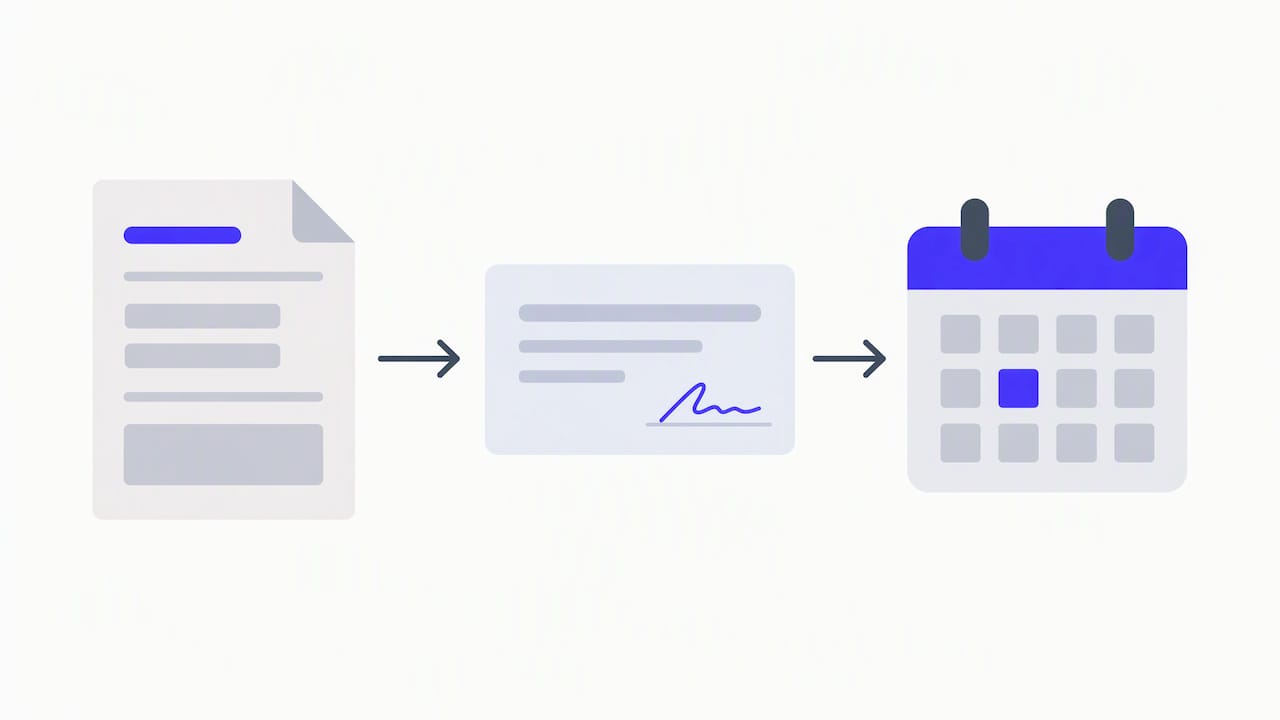
Appointment reminders play a direct role in reducing missed sessions, and HHS guidance confirms that reminders are considered part of treatment, meaning you can send them without additional client authorization under HIPAA. That said, the content and delivery method still need to protect client privacy, a distinction covered in more detail in our breakdown of HIPAA text reminder requirements.
A few practical steps make enforcement smoother:
Send a confirmation at booking and a reminder 24 to 48 hours before the appointment.
Log every cancellation and the reason given, even informally, in the client’s file.
Charge the fee through the same payment method on file to avoid a separate invoice step.
If you accept Medicare, apply the same missed-appointment charge structure to every client, consistent with CMS billing rules, since insurers typically don’t cover no-show fees themselves.
Sample consent line: “I understand that missed appointments without 24-hour notice will be billed at the rate described above, and that this charge is my responsibility, not my insurance provider’s.”
Ready-to-use templates and customizable policy language
You don’t need to draft a cancellation policy from scratch. Below are three starting templates, ranging from firm to flexible, that you can adapt to your fee structure and caseload.
Strict template: “Appointments canceled with less than 24 hours’ notice, or missed without notice, will be charged the full session fee. No exceptions apply without prior written approval from the clinician.”
Balanced template: “We allow up to two late cancellations per calendar year without charge. Beyond that, a 50% fee applies to late cancellations and a full fee applies to no-shows.”
Compassionate template: “We understand that emergencies happen. Documented medical or safety emergencies are exempt from cancellation fees. All other missed appointments without 24-hour notice are billed at the standard rate.”
For telehealth, shorten the notice window since remote sessions are easier to fill on short notice. For group therapy, consider a shared waitlist policy so a canceled slot can go to another group member quickly.
Template | Notice window | Fee approach | Best fit |
|---|---|---|---|
Strict | 24 hours | Full session fee | High-demand practices with waitlists |
Balanced | 24 to 48 hours | Percentage-based, limited free passes | General outpatient practices |
Compassionate | 24 hours | Full fee with documented exceptions | Practices serving high-acuity or crisis-prone clients |
Whichever version you choose, adapt the wording to match your actual fee amount, insert it into your intake form, and confirm the client’s signature is captured before the first session begins.
Implementing the policy: workflow, reminders, and minimizing no-shows
A written policy works best paired with a consistent reminder workflow. Most practices see the biggest drop in missed sessions when reminders go out at two points: a confirmation right after booking and a second reminder 24 to 48 hours before the appointment, sent by text, email, or phone depending on client preference.
Building this into your intake flow from the start sets expectations early rather than retrofitting them later. A few things to prioritize:
Confirm the client’s preferred reminder channel during intake, not after the first missed session.
Track cancellation and no-show reasons over time to spot patterns, such as a recurring day or time slot that generates more cancellations.
Look for practice tools with built-in consent logging, so you’re not manually tracking signed acknowledgments in a separate spreadsheet.
Review your no-show rate quarterly to decide if your notice window or fee structure needs adjusting.
Pro Tip: If you’re evaluating practice management software, prioritize automated reminder scheduling over manual reminders, since consistency matters more than any single reminder’s wording. Our guide to cutting no-show appointments breaks down five specific operational fixes that complement a written policy.
Author perspective: balancing boundaries with compassionate care
We’ve watched clinicians agonize over whether enforcing a cancellation fee makes them seem rigid or uncaring. It doesn’t. A policy applied consistently, with genuine room for documented exceptions, actually protects the relationship better than inconsistent enforcement does, because clients stop wondering if the rule depends on your mood that day.
If you’re worried about pushback, phase in changes gradually: announce the policy before it takes effect, apply it to new clients first, and give existing clients a grace period. Automation can absorb the reminder and documentation workload so the policy enforces itself quietly, letting you spend your energy on the clinical relationship instead of the billing conversation.
— Jamaal
Another option: automating reminders and policy enforcement
Writing the policy is the easier half. Keeping up with reminders, consent logs, and follow-ups for every client on your schedule is where most practices lose time. That’s the gap we built Astreaux AI to close: a conversational AI platform that learns your practice’s voice and handles reminder sequences, intake follow-ups, and rescheduling conversations automatically.

For therapists specifically, that means:
Automated reminders sent on the cadence you set, reducing the manual work of chasing confirmations.
Consent and intake acknowledgments logged automatically, so your cancellation policy has a clear paper trail.
Instant follow-up with clients who need to reschedule, instead of a missed call sitting in voicemail.
If you’d like to see how it fits a therapy practice specifically, visit our AI intake automation page for therapists to check availability for a demo.
FAQ
What is a reasonable cancellation policy?
A reasonable policy typically requires 24 to 48 hours’ notice, charges a flat fee or a percentage of the session rate for late cancellations, and allows documented exceptions for emergencies. The exact numbers vary by practice, but clarity and consistency matter more than the specific window you choose.
How often should a therapist cancel?
There’s no fixed rule for how often a therapist can cancel, but frequent clinician-initiated cancellations can disrupt continuity of care, a concern the APA’s guidance on terminating therapy addresses directly. If cancellations become frequent, documenting the reason and discussing continuity options with the client helps protect the relationship.
What is the 2 year rule in therapy?
This isn’t a standardized clinical or ethical rule with a single defined meaning, and definitions vary depending on the context in which the phrase is used. If a client raises it, it’s worth clarifying what specific guideline or state regulation they’re referencing before responding.
Are 30-day cancellation policies legal?
Cancellation notice periods are generally permissible as long as they’re disclosed clearly and applied consistently, though enforceability can depend on state contract law and licensing board rules. Checking with your state licensing board or an attorney familiar with mental health practice is the safest way to confirm a specific notice period holds up in your jurisdiction.