Real Estate: Copy 3 Drip Campaign Sequences This Week
This guide gives you copy-paste-ready drip emails for buyer, seller, and past-client sequences, plus a 7-step checklist to get them live. Build these three sequences first, since they cover the bulk of a working lead funnel. When you are ready to automate the first reply too, our Astreaux demo link waits for you near the end.
TL;DR:
A buyer sequence can run 6 to 10 emails over 6 to 8 weeks; past clients need monthly updates and an annual anniversary note.
Escalate a lead to phone or text after a reply, two listing link clicks, or repeated opens of the same message within one day.
Tag leads by role, neighborhood, price range, and timeline; pause the sequence after three unopened emails instead of increasing message frequency.
Commercial emails can incur penalties up to $53,088 per message; include an accurate subject, physical address, and working opt out, processed within 10 business days.
Test one variable at a time and compare at least 100 sends per version; track replies and conversions, not just opens and clicks.
Astreauxcalendly.comRespond to Real Estate Leads FasterAstreaux uses conversational AI to personalize lead responses and follow up with qualified prospects, helping agents streamline scheduling and nurturing.Book a call
What a Real Estate Drip Campaign Is and When to Use One
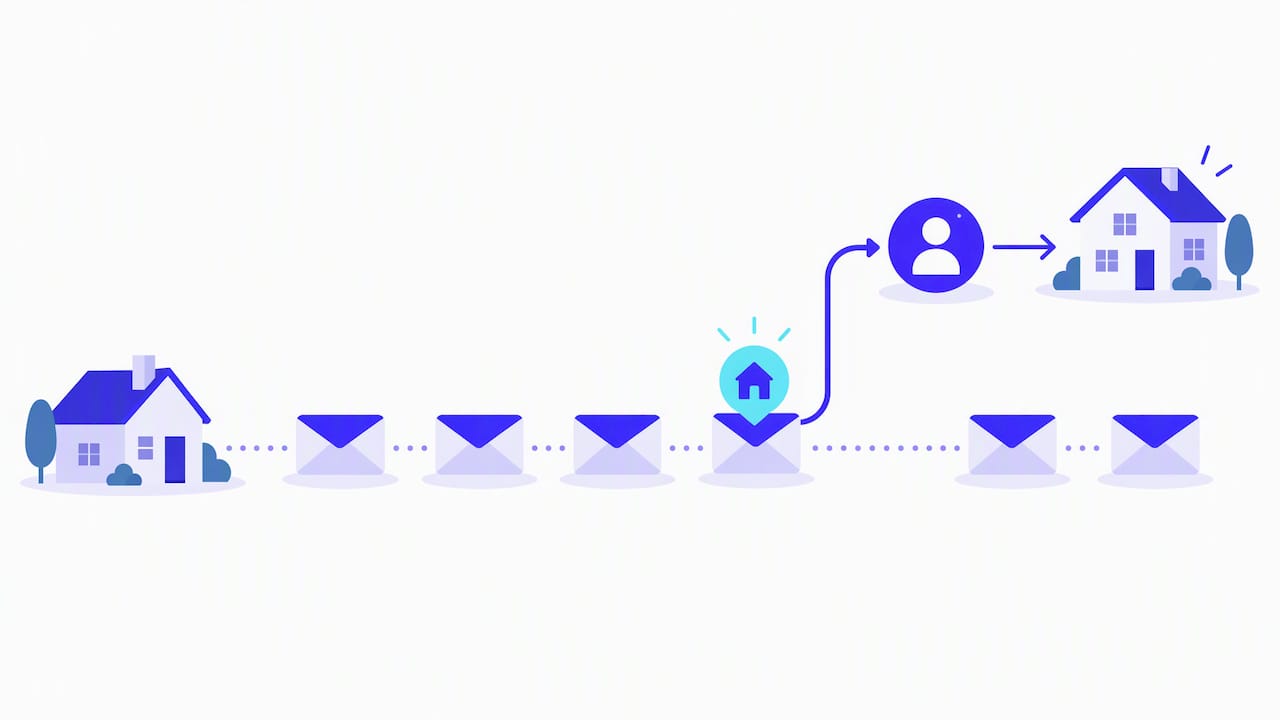
A real estate drip campaign is an automated, triggered series of emails designed to move a lead toward a specific action: booking a showing, requesting a home valuation, or picking up the phone. Each message fires based on a trigger rather than a date on your calendar, which means the sequence works whether a lead signs up at 2 PM on a Tuesday or 11 PM on a Saturday.
Common triggers include:
A website form fill requesting more information on a listing
An open-house sign-in sheet, digital or paper
A saved search alert that matches a new listing
A home valuation request from a seller-focused landing page
An anniversary date tied to a past closing
Automation makes sense whenever a lead needs several touches before they are ready to act, which describes almost every real estate decision. Manual outreach still matters for high-intent moments, like a lead who just replied asking for a showing time. The drip handles the waiting period; you handle the conversation once someone raises their hand.
Why Run Drip Campaigns: The Main Benefits for Agents and Teams
Drip campaigns solve a problem every agent knows well: leads go cold while you are busy with showings, closings, and paperwork. A sequence keeps working in the background, so no lead sits untouched for days.
Only about 30% of agents automate their follow-up, which means a basic three-sequence setup still functions as a competitive edge in most markets. Most of your competition is still relying on memory and sticky notes.
The core benefits break down into a few categories:
Faster speed-to-lead, since an automated welcome email reaches an inbox within minutes of a form fill
Consistent contact across the long decision windows typical of home buying and selling
Higher lifetime value, because past-client sequences keep you top of mind for referrals and repeat transactions
More time for the follow-up that actually requires a human voice, since the routine touches run themselves
Past-client nurturing deserves particular attention here. Industry guidance consistently points to the past-client sequence as the highest-return drip an agent can build, since referral business costs far less to generate than a fresh lead and closes faster once it arrives. A simple monthly market update, paired with an annual anniversary note, keeps your name in front of people who already trust you.
None of this replaces human judgment. A drip campaign is a floor, not a ceiling: it guarantees that every lead gets a baseline level of attention, while leaving room for you to jump in personally the moment someone shows real intent. That combination, consistent automation plus timely human follow-up, is what actually moves a cold lead toward a closed deal.
Common Real Estate Drip Campaign Types and Triggers
Most agents only need three core sequences, plus two smaller add-ons for specific moments.
Buyer drip: Triggered by a property inquiry or saved search signup. Purpose is to educate on the buying process, surface matched listings, and move toward a showing. Typical length runs 6 to 10 emails over 6 to 8 weeks.
Seller drip: Triggered by a home valuation request or “thinking of selling” form. Messaging focuses on pricing confidence, your marketing process, and recent comparable sales. Usually shorter and more frequent early on.
Past-client drip: Triggered by a closing date. Cadence is monthly for market updates, plus an annual anniversary touch. The goal here is referrals and repeat business, not a quick conversion.
Listing-alert drip: Triggered automatically whenever a new listing matches a saved search. Short, visual, and sent as soon as the match occurs.
Open-house follow-up: Triggered by a sign-in sheet. One or two emails within 48 hours, asking about interest level and offering a private showing.
Buyer and seller drips carry most of the strategic weight, since they cover the two moments when a lead is closest to a transaction. Past-client sequences carry the long game.
Real Email Templates and Example Sequences Agents Can Copy
Each sequence below uses a simple placeholder format: {{firstName}}, {{neighborhood}}, {{listingAddress}}, and {{agentName}}. Swap in your merge fields and send.
Buyer welcome sequence (6 emails)
Email 1, immediate (within minutes): Subject: “Welcome, {{firstName}}! Let’s find your next home.” Preview text: “Here’s what happens next.” Body focuses on confirming interest and setting expectations for what they will receive.
Email 2, day 2: Subject: “3 things every buyer in {{neighborhood}} should know.” Delivers first real value, no sales pitch, just useful local context.
Email 3, day 5: Subject: “New matches for you in {{neighborhood}}.” Surfaces 2 to 3 listings matched to their saved search criteria.
Email 4, week 2: Subject: “Your mortgage pre-approval checklist.” Shares a short checklist and offers to connect them with a lender.
Email 5, week 3: Subject: “Got 15 minutes this week, {{firstName}}?” Direct invitation to a call or a showing.
Email 6, week 4: Subject: “Still looking? Let’s simplify the search.” A gentle close that re-confirms interest or offers to pause the sequence.
Seller nurture sequence (4 core emails)
Valuation offer: Subject: “What’s your {{neighborhood}} home worth today?” Direct offer for a free, no-obligation estimate.
Recent comps: Subject: “3 homes near you just sold. Here’s for how much.” Builds pricing credibility with real local data points.
How you market homes: Subject: “Here’s exactly how I sell homes in {{neighborhood}}.” Walks through your listing process, photography, and promotion approach.
Seller case study: Subject: “How one {{neighborhood}} seller got full asking price.” A short, specific story that builds trust without overpromising.
Past-client sequence (4 touches)
Anniversary note: Subject: “Happy home-anniversary, {{firstName}}!” Sent on the closing-date anniversary, warm and personal.
Market update: Subject: “What’s happening in {{neighborhood}} right now.” Sent monthly, brief and factual.
Home-maintenance tip: Subject: “One easy fall maintenance task for your home.” Seasonal, useful, low-pressure.
Referral request: Subject: “Know anyone looking to buy or sell?” Direct but friendly ask, ideally placed after a few value-first emails.
Listing-alert template
Keep this one short and image-heavy: a single photo, the address, price, and a clear “Schedule a tour” button. Subject line example: “Just listed: {{listingAddress}}.” No long paragraphs here; the listing itself does the convincing.
Pro Tip: Keep subject lines under 50 characters and front-load the benefit, since most opens happen on mobile where longer lines get cut off.
How to Build and Launch a Drip Campaign: A 7-Step Checklist
Turning these templates into a live sequence takes a predictable path through any common CRM or email platform.
Define the goal and conversion event. Decide whether success means a booked showing, a requested valuation, or a scheduled call, since that choice shapes every email in the sequence.
Create tags and data fields before onboarding leads. Set up fields for buyer, seller, price band, neighborhood, and timeline before a single lead enters the system.
Map triggers and email flow. Sketch a simple flowchart: trigger, email 1, wait period, email 2, branch point. This catches gaps before you build anything live.
Write short emails and load your templates. Use the examples above as a starting point, then adjust tone to match how you actually talk to clients.
Configure send cadence and escalation rules. Set timing between emails, and define when a lead should escalate to a text message or phone call instead of another email.
Test with 50 to 100 contacts. Check deliverability, confirm merge fields populate correctly, and verify every email includes the opt-out link and physical address CAN-SPAM requires.
Review metrics monthly and iterate. Pull open rates, click rates, and conversion numbers once a month and adjust subject lines or timing based on what the data shows.
Pro Tip: *Run your test batch through a spam-checker tool before the full send.
Cadence, Timing, and Sequencing: Recommended Timelines by Lead Type
Timing separates a drip that converts from one that gets ignored. Hot leads need a reply within minutes, not hours.
Hot leads get an immediate welcome, ideally within minutes, paired with a text if your platform supports it.
Buyer sequences follow a day 0, day 2, day 5, week 2 rhythm, then settle into weekly touches.
Seller sequences start faster: week 0, week 1, then biweekly until the home is listed.
Past-client sequences slow down considerably: a monthly market note plus one annual anniversary message.
Escalate to phone or text whenever a lead clicks a listing link twice, replies to any email, or opens the same message more than once in a day.
Lead type | First touch | Mid-sequence cadence | Escalation trigger |
|---|---|---|---|
Hot buyer | Within minutes | Day 2, day 5, week 2, then weekly | Reply or repeat click |
Seller | Within hours | Week 1, then biweekly | Valuation page revisit |
Past client | Within a week of closing | Monthly, plus annual anniversary | Any inbound reply |
Personalization and Segmentation Best Practices
Tags are the backbone of relevant automation. Without them, every lead gets the same generic blast, which is exactly what drives unsubscribes.
Tag by role first: buyer, seller, or past client.
Layer in price band and neighborhood tags so listing alerts actually match interest.
Add a timeline tag, like “ready now” versus “exploring,” to control urgency in your messaging.
Use merge fields that matter most: first name, neighborhood, price range, and a recent comparable sale.
Let behavior move leads automatically: a click on a listing link or a new saved search should shift someone into a more specific sequence.
Tag-based segmentation keeps sequences relevant and measurably reduces unsubscribe rates compared with blasting one list with the same message. The goal is relevance, not frequency: sending fewer, better-targeted emails consistently outperforms sending more generic ones.
Pro Tip: If a lead hasn’t opened your last three emails, pause the sequence rather than escalating frequency. A quiet inbox usually means the content stopped matching their situation.
Compliance and Deliverability Essentials Agents Must Not Skip
Every commercial email you send, including listing announcements, falls under the CAN-SPAM Act, and violations can carry penalties of up to $53,088 per message, adjusted for inflation by the FTC.
Six requirements apply to nearly every drip email you send:
Accurate “From,” “To,” and routing header information
A subject line that honestly reflects the email’s content
Clear identification of the message as an advertisement when applicable
Your valid physical business address
A visible, working opt-out mechanism
Opt-out requests processed within 10 business days
One wrinkle worth knowing: when a message mixes transactional content (like a scheduled showing confirmation) with promotional content (like a listing pitch), the FTC looks at the email’s primary purpose to decide which rules apply. Structuring transactional details prominently keeps a message squarely in that lighter-touch category when that is your intent.
Deliverability runs on a separate but related checklist: clean your list of bounced addresses regularly, authenticate your sending domain with SPF and DKIM, and warm up a new domain gradually rather than blasting a full list on day one. Run through opt-out links, header accuracy, and domain authentication before any large send, every time.
Metrics, Testing, and Optimization
A drip campaign is only as good as what you measure. Four numbers matter most: open rate, click-through rate, reply rate, and conversion to a showing or valuation request.
Track each sequence as its own cohort rather than averaging everything together, since a buyer drip and a past-client drip have completely different benchmarks.
Test one variable at a time: subject line, send time, or call-to-action wording, never all three at once.
Compare results over at least 100 sends per variant before drawing a conclusion, since smaller samples swing too much.
Watch reply rate closely, since a reply almost always signals stronger intent than an open or a click.
Run a simple 30/60/90-day routine: at 30 days, check for any email with an unusually low open rate and fix the subject line. At 60 days, review click-through patterns and cut any email that nobody engages with. At 90 days, look at full-sequence conversion and decide whether to add, remove, or reorder messages.
How AI-Driven Lead Automation Complements Drip Campaigns
A drip sequence handles the long game, but the first few minutes after a lead comes in decide whether that sequence ever gets the chance to work. Instant AI-driven replies help most at the capture stage: acknowledging a new lead, asking a qualifying question or two, and applying the right tags before the drip even starts.
A simple workflow looks like this: a lead fills out a form, an AI reply responds within moments, the response tags the lead as buyer or seller based on their answer using AI-driven reputation and agent matching, and that tag automatically triggers the matching drip sequence while also flagging a showing to schedule.
Instant replies capture attention while it is highest, right after the initial inquiry
Automatic tagging means no lead sits in a generic, untagged bucket waiting for manual sorting
A fast first response and a well-timed drip work together rather than competing for the same job
The right way to use this kind of automation is for speed and qualification, never as a replacement for your own follow-up once a lead shows real interest. Pair instant replies with auto-reply workflows built for booking showings and you get a system where nothing goes cold in the first hour, which is often the hour that decides everything.
Jamaal’s Practical Priorities This Week
Most agents reading this already have more sequence ideas than time to build them, so the real work is picking one and shipping it. Choose the sequence tied to your biggest current gap, likely the buyer welcome series if you have never built one.
Start with three templates, not ten. A tight sequence you actually finish beats a sprawling one that sits half-built in your CRM for months. Load the welcome, the matched-listing, and one follow-up email, then turn it on.
After two weeks, pull reply rates and count booked showings. That single number tells you more than any open-rate dashboard. Iterate from there: fix the weakest email, keep the strongest, and add the next sequence once the first one is running cleanly.
— Jamaal
Try Astreaux: Instant Replies That Feed Your Drip Sequences
We built Astreaux to handle the moment right before your drip campaign even starts: the first reply to a brand-new lead. Our AI responds within minutes, trained on your own voice, so the initial contact feels like you wrote it even when you are in a showing or asleep.

From there, we tag the lead by role and intent, route them into the matching buyer, seller, or past-client sequence, and flag a showing for you to confirm. One example workflow: a lead fills out a listing inquiry at 9 PM, our system replies within minutes, tags them as a motivated buyer, and your buyer drip picks up the next morning right on schedule.
The platform connects with thousands of apps, so it fits into many common CRM systems
It helps real estate agents, contractors, and other service professionals reduce response time on fresh leads
Scheduling and nurturing run together, which can improve appointment bookings and reduce no-shows
Visit our real estate agents page to see how instant response fits your current setup, or book a demo to watch the handoff into your own drip sequences.
FAQ
What is a drip campaign in real estate?
A real estate drip campaign is an automated series of emails sent to a lead based on triggers like a form fill or a saved search match, rather than a fixed calendar date. The goal is to move that lead toward a concrete action, such as booking a showing or requesting a home valuation, without requiring manual outreach for every touch.
What is an example of a drip campaign?
A buyer welcome sequence is a common example: an immediate welcome email, followed by a value-focused email two days later, matched listings on day five, a mortgage checklist in week two, and a direct invitation to connect by week three or four. A past-client sequence with a monthly market update and an annual anniversary note is another common example built for long-term referrals.
How to make $100,000 your first year in real estate?
There is no single guaranteed path, but consistent lead follow-up through structured drip sequences is one practical lever, since only about 30% of agents currently automate their follow-up, leaving plenty of room for a well-run system to outperform competitors on response speed alone. Combining fast first responses with a disciplined buyer, seller, and past-client sequence tends to convert more of the leads an agent already generates.
What is a drip system in real estate?
A drip system refers to the combination of your email platform, CRM tags, and trigger rules that together deliver a drip campaign automatically. It typically includes tagging logic for buyer or seller status, timing rules for when each email sends, and escalation rules that move a lead to a phone call or text once they show stronger interest.