Lead Response Time Benchmark: What Fast Actually Means
The benchmark to hit for high-intent leads is under five minutes, and best-in-class teams now respond in under one minute. That five-minute number isn’t a rounded-up guess. It traces back to research from Oldroyd and his co-authors, who found firms contacting leads within five minutes were roughly 100 times more likely to make contact than those waiting 30 minutes, and 21 times more likely to qualify that lead.
The gap between that research and current practice is wide. Optifai’s benchmark of 939 companies found only 23% respond within five minutes, and close rates drop significantly from the best response times to very slow responses beyond a day. Astreaux and similar automation tools exist precisely to close that gap without adding headcount.
Your first move isn’t picking software. It’s measurement:
Pull your median first contact time from CRM timestamps for the last 30 days
Set a formal SLA target by lead tier (more on that ladder below)
Run a 30-day pilot measuring contact rate before and after any process change
The data point that should worry you: Companies with no documented response SLA hit 15-minute standards roughly half as often as those with a formal SLA in place. The tool matters less than whether you’ve written the target down.
Key Takeaways
Speed to lead is a measurable process metric, and closing it from hours to minutes reliably lifts contact and close rates across every lead source.
Point | Details |
|---|---|
Hit the five-minute window | High-intent leads need contact under 5 minutes; best-in-class teams reach under 1 minute. |
Measure median, not average | Median response time resists outlier distortion and reflects the typical lead’s real experience. |
Tier your SLA by intent | Hot MQLs, warm leads, and cold leads each need different targets and escalation triggers. |
Fix routing before hiring | Manual routing and assignment lag cause more delay than understaffing does. |
Automate the instant reply | Astreaux’s conversational AI engages leads immediately and books appointments without added headcount. |
What Lead Response Time Actually Measures
Lead response time is the gap between when a lead is created in your system and when a real, substantive human contact happens. Not a form confirmation email. Not a “we got your message” auto-text. The formula is simple: first substantive contact timestamp minus lead creation timestamp, expressed in minutes or hours.
Two decisions determine whether your number is honest or flattering:
What counts as “first contact.” An automated acknowledgment doesn’t qualify. A human call, a personalized text, or a scheduled booking confirmation does. Blend the two and you’ll hide your real bottleneck.
Median versus average. Median is the better operational metric because a handful of leads that sat for three days won’t distort your whole picture, and it reflects the experience your typical lead actually has, not a statistical artifact.
Timestamp source consistency. Use your CRM’s lead-created field, not the ad platform’s click timestamp or the form tool’s submission log. Mixing sources introduces timezone drift and phantom gaps of 20 to 40 minutes that have nothing to do with your team’s speed.
Pro Tip: Don’t let lead scoring or data enrichment sit in front of first contact. If your workflow waits for a third-party enrichment API before a human or bot ever reaches out, you’re adding delay that has nothing to do with sales effort and everything to do with a vendor’s response time.
Lead Response Time Benchmarks By Intent And Channel
Benchmarks vary sharply by how much intent a lead has already shown you. Treating a demo request the same way you treat a newsletter signup is the single most common measurement mistake sales teams make.
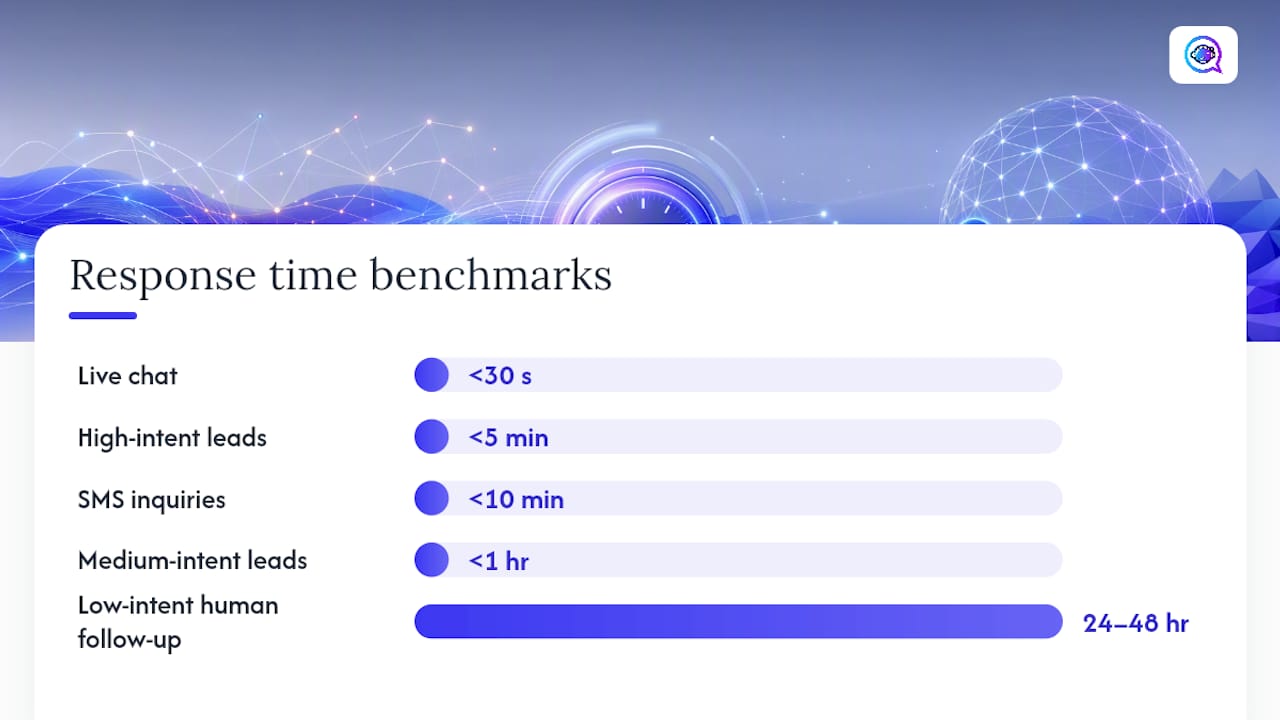
High-intent leads (demo requests, pricing page inquiries, “contact sales” forms) carry the tightest window. Target under five minutes; best-in-class teams push under one minute, especially when a booking link is involved and the lead can self-schedule before losing interest.
Medium-intent leads (whitepaper downloads, webinar registrations, calculator tool usage) have more slack. Target under one hour, with four hours as the outer edge of acceptable. Past four hours, the lead has usually moved on to a competitor or simply lost the thread of why they filled out your form.
Low-intent leads (newsletter subscribers, generic content downloads) don’t need urgent human attention, but they do need an immediate automated acknowledgment, followed by human follow-up within 24 to 48 hours. Skipping the automated touch entirely is worse than a slow human reply, because silence reads as indifference.
Channel matters as much as intent:
Live chat: under 30 seconds, or the visitor closes the tab
Phone inquiries: under 5 minutes, since callers who reach voicemail rarely call back
Paid ad leads: under 5 minutes, because ad-driven leads have the shortest attention span of any source, having just clicked out of active browsing
Web form submissions: under 5 minutes for high-intent forms, under 1 hour for informational ones
SMS inquiries: under 10 minutes; text-based leads expect a conversational pace, not an email-style delay
Industry directionals shift these numbers somewhat. Real estate and home services leads decay faster because buyers are often comparing three or four providers simultaneously within the same hour. Financial services and insurance leads tolerate slightly longer windows, but the 63.5% of B2B companies that never respond at all to a demo request shows the bigger problem isn’t speed calibration. It’s that a majority of firms aren’t responding at all.
Why Response Speed Drives Revenue, Not Just Satisfaction
The connection between speed and revenue isn’t a soft “customer experience” argument. It’s a measurable decay curve. HBR’s analysis of large lead datasets found that responding within one hour made firms roughly 7 times more likely to qualify a lead than waiting just one additional hour. Every hour of delay compounds against you, and the curve isn’t linear. It’s steep and front-loaded.
“Lead interest decays almost immediately after the inquiry moment, which means the buyer’s attention window, not your team’s capacity, sets the real deadline.” This pattern shows up consistently in research on attention and decision windows: the longer a decision sits unattended, the more competing options fill that mental space.
Optifai’s more recent data confirms the pattern holds today: close rates run 32% for sub 5 minute responses versus 12% for anything past 24 hours, a gap wide enough to reshape a sales team’s entire quarter. Meanwhile, non-response itself has grown as a failure mode, with average response times among companies that do reply now exceeding a full day in some audits. The lesson isn’t “hire faster reps.” It’s that routing and assignment governance, not individual effort, is where most revenue leaks out.
How To Track Lead Response Time Without Fooling Yourself
A response time report only tells you the truth if you build it correctly. Sloppy dashboards routinely undercount delay by counting an automated text as “first contact,” which flatters your numbers while your actual close rate stays flat.
Track these five metrics at minimum:
Median response time across all leads, segmented by source and tier
Percentage under 5 minutes, your primary speed-to-lead KPI
Percentage under 1 hour, your secondary threshold for medium-intent leads
Contact rate, the share of leads that receive any human touch within 24 hours
Time-to-assignment, the gap between lead creation and rep or bot assignment, which is frequently the hidden bottleneck teams miss entirely
Build these using CRM timestamp fields for lead creation, assignment, and first outbound activity, segmented by lead source and tier so a slow paid-ads channel doesn’t get masked by a fast organic-referral channel. Report weekly for operational teams and monthly for leadership, with sample sizes of at least 50 leads per segment before drawing conclusions.
Metric | Target Threshold | Alert If |
|---|---|---|
Median response time | Under 5 minutes (high-intent) | Exceeds 15 minutes |
% responded under 5 min | 40% or higher | Falls below 23% |
Time-to-assignment | Under 2 minutes | Exceeds 10 minutes |
Contact rate (24 hr) | over 90% | Falls below 63.5% |
Set alert thresholds that trigger a manager notification, not just a dashboard color change. A red number nobody looks at fixes nothing.
The Real Reasons Leads Sit Unanswered
Most slow response times trace back to four fixable operational patterns, not lazy reps or insufficient staff.
Manual routing. A human deciding who gets which lead adds delay by default, especially outside business hours. Replace it with intent- and capacity-based automated assignment.
After-hours gaps. Roughly two-thirds of inbound leads for many service businesses arrive outside standard hours. Auto-acknowledgment with a self-serve scheduling link keeps the lead warm until a human can follow up.
Assignment lag. A lead sitting unclaimed in a queue for twenty minutes is functionally the same as no response system at all. Build failover rules that escalate to a manager if a lead goes unclaimed past a set threshold.
Data gating. Waiting on lead scoring or third-party enrichment before making first contact adds delay that has nothing to do with sales capacity, as platform audits consistently find.
Pro Tip: *Audit your last 20 unclaimed leads and time-stamp exactly where each one stalled.
An SLA Ladder You Can Paste Into Your CRM Today
A response time benchmark only becomes useful once it’s tiered by lead intent and turned into rules your team, or your automation, actually follows.
Hot MQL (demo request, pricing inquiry): target under 1 minute automated acknowledgment, human contact under 5 minutes. Escalate to manager if unclaimed after 10 minutes.
Warm, high fit (content download matching ideal customer profile): target under 1 hour. Escalate after 2 hours.
Warm, low fit (generic content download, webinar signup): target under 4 hours. Escalate after 24 hours.
Cold (newsletter signup, low-engagement form): automated immediate reply, human follow-up within 24 to 48 hours.
After-hours (any tier arriving outside business hours): automated acknowledgment with scheduling link within 1 minute, human contact by the next business morning within the tier’s normal window.
Tier | Auto-Ack Target | Human Contact Target | Escalation Trigger |
|---|---|---|---|
Hot MQL | Under 1 minute | Under 5 minutes | Unclaimed after 10 minutes |
Warm, high fit | Under 5 minutes | Under 1 hour | Unclaimed after 2 hours |
Warm, low fit | Under 15 minutes | Under 4 hours | Unclaimed after 24 hours |
Cold | Under 15 minutes | 24 to 48 hours | No follow-up after 48 hours |
Turn each tier into an automation rule tied to lead source and form fields, then track manager KPIs against the escalation triggers, not just the response targets. A manager whose team consistently escalates hot MQLs has a capacity problem, not a motivation problem.
What To Fix First, Next, and Eventually
Not every fix requires the same investment, and sequencing them wrong wastes months.
Start here, this week:
Turn on auto-acknowledgment with a self-serve scheduling link for every lead source
Add SMS nudges for leads that haven’t booked within 15 minutes of the auto-ack
Route chat-widget leads to a scheduling bot instead of a “someone will contact you” message
Build this over the next quarter:
Replace manual lead routing with intent-based and capacity-aware automated assignment
Enforce your SLA ladder with alerts that escalate to managers, not just dashboards
Segment queues by rep availability so a lead never sits behind someone at capacity
Invest here for the long term:
Deploy conversational AI that qualifies and books appointments instantly, learning each business’s voice for personalized replies rather than generic scripts
Integrate that AI directly with your CRM so qualification data flows into your pipeline without manual entry
Run controlled experiments, one lead source at a time, comparing contact rate and close rate before and after each change
Pro Tip: Pick one lead source, run the immediate wins for 30 days, and measure contact rate lift before rolling changes out everywhere. A source-by-source pilot proves the ROI case faster than a company-wide rollout ever will.
How Automated Engagement Actually Shortens The Clock
Astreaux was built around one specific gap: the time between a lead landing and a human getting to it. Its conversational AI engages instantly, in a voice trained on the specific business it represents, so the reply doesn’t read as a generic bot script.
Contractors using instant estimate-booking workflows cut the wait between an inbound request and a scheduled site visit
Real estate agents route showing requests straight into a booking flow instead of a manual callback queue
Therapists handle intake inquiries with automated scheduling that respects the sensitivity of the request while still moving fast
The gap between “we have the technology” and “we actually respond in under five minutes” is almost always a configuration problem, not a capability problem.
Speed To Lead Is An Ops Problem, Not A Talent Problem
Sales teams love to talk about hustle. The data says otherwise. Every benchmark in this piece, from Oldroyd’s original multipliers to Optifai’s close-rate gradient, points to the same conclusion: response speed is a process variable, and process variables get fixed with routing rules, SLAs, and automation, not with pep talks. The teams winning on speed to lead aren’t necessarily working harder. They’ve just removed the friction between a lead arriving and a human, or a well-trained bot, reaching them.

If you take one thing from this article, make it the 30-day pilot. Pick a single lead source, apply the SLA ladder above, measure your median before and after, and let the contact-rate numbers make the case for whatever comes next.
See How Astreaux Fits Your SLA Ladder
Astreaux is built for the exact gap this article measures: the minutes between a lead landing and a human reaching them. Instead of hiring a night-shift rep or hoping your team checks their phone fast enough, Astreaux’s conversational AI answers instantly, in your business’s own voice, and books the appointment before the lead’s attention moves elsewhere.

It plugs into your existing routing and calendar tools through integrations with over 7,000 apps, so the hot-MQL tier of your SLA ladder, the under-5-minute target, becomes something your system enforces automatically rather than something your team has to remember. Contractors use it for instant estimate booking. Real estate agents use it for showing requests. Mortgage brokers use it for consultation scheduling that starts the moment a rate inquiry comes in.
If your median response time is longer than you’d like to admit, start a trial with Astreaux and see how much of that gap closes in the first week.
Sources
FAQ
How quickly should you respond to a lead?
Respond to high-intent leads, like demo requests or pricing inquiries, in under five minutes. Best-in-class teams push that under one minute using automated instant engagement.
What are the statistics for lead response time?
Oldroyd’s foundational research found five-minute responses were 21 times more likely to qualify a lead than 30-minute responses, while Optifai’s recent benchmark found only 23% of companies actually hit the five-minute mark.
What is lead response time?
Lead response time is the gap between when a lead enters your CRM and when a real, substantive human contact happens, measured in minutes or hours rather than by an automated acknowledgment alone.
What is a good average response time?
A good median response time is under five minutes for high-intent leads and under one hour for medium-intent leads; Optifai’s data shows the broader B2B average sits closer to 47 hours, far outside any competitive target.
Can automation actually close the response time gap?
Yes. Tools like Astreaux use conversational AI trained on a business’s own voice to reply and book appointments instantly, closing the gap that manual routing and after-hours delays typically create.