
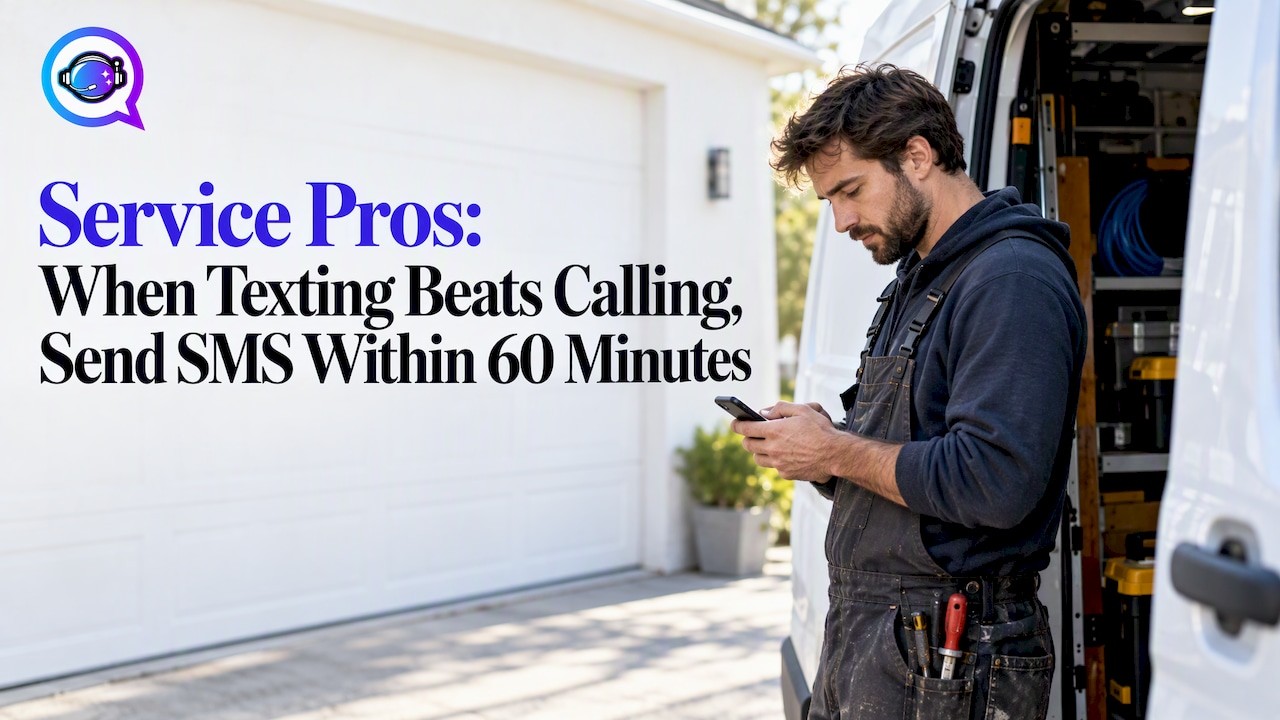

Service Pros: When Texting Beats Calling, Send SMS Within 60 Minutes
Texting wins the speed race for most inbound leads, since a short SMS gets opened and answered faster than most people pick up an unknown call. Calling still wins when a lead is warm, the conversation is complex, or you are closing a deal. The exception that matters most: before you dial a cold number, check your consent and Do Not Call status first, because that guardrail decides whether you can call at all.
TL;DR:
Sending a follow-up text within 15 to 30 minutes after a missed call increases the chances of engaging the lead, especially on cold outreach lists.
Calls should only be made within legal timeframes and after confirming explicit consent, with established business relationship windows applying prior to outreach.
Inbound leads or high-stakes conversations benefit from calling directly, while cold or unqualified contacts should only be texted to avoid legal risks.
Tracking response speed, reply rates, live-answer rates, booking, and conversion metrics helps determine the most effective communication strategy.
Starting automation with manual testing ensures compliance, personalization, and proven effectiveness before scaling up the sequence.
AstreauxRespond Faster to New LeadsAstreaux uses conversational AI to automate personalized lead engagement, scheduling, and follow-ups for service professionals.Book a call
What research and regulatory guidance say about speed
Response speed shapes whether a lead converts or goes cold, and timing windows matter more than most service professionals assume. A missed call followed by a quick text tends to recover more conversations than silence or a string of unanswered calls.
Texting within a tight window after a missed call tends to prompt more replies than waiting.
Short, personalized first messages outperform long ones for getting a reply.
Calling outbound numbers is governed by federal rules that limit when and whom you can contact.
The FTC’s Do Not Call Q&A sets Established Business Relationship windows: three months for an inquiry and 18 months for a purchase. Those windows decide whether you’re legally clear to call a number on the Registry, and they apply before you ever touch a timing strategy.
When to text first and when to call first
The right channel depends on where the lead came from and what the conversation needs to accomplish.
Inbound web or ad leads: Text first with a short qualifying question. A fresh inbound lead expects a quick, low-pressure touch, and a text respects that they just filled out a form, not signed up for a sales call.
Warm or referral leads: Call first. Someone referred by a past client or already mid-conversation with you expects a voice, and a text here can feel like a downgrade.
Complex or high-stakes conversations: Call. Mortgage pre-approvals, therapy intake questions, or a contractor estimate with multiple variables need back-and-forth that a text thread handles poorly.
Cold outreach lists: Text first, and only to confirm permission before calling. A cold call to an unqualified number carries legal risk and a low answer rate.
Real estate showings: Text to confirm the appointment, call if the buyer has questions about financing or contingencies.
Contractor estimates: Text to schedule the site visit, call to walk through pricing once you’ve seen the job.
Timing and sequencing that actually convert
The sequence you run matters as much as the channel you pick. Send an SMS within 60 minutes of a missed call for the best shot at recovering that lead. If you’re texting first instead, give it a short window, often 15 to 30 minutes, before you call, so the text has time to land and get a reply.
Touch 1: Instant text on missed call or inbound form submission.
Touch 2: Call within the hour if no reply to the text.
Touch 3: Second text 24 hours later if the call goes unanswered.
Stop contacting after three attempts without a response unless the lead replies or re-engages.
Pro Tip: Texting before a call often works like a hand-raise. It signals the call is expected, not a cold interruption, which tends to improve live-answer rates.
Our missed-call text playbook breaks down the exact mechanics of this sequence for service teams booking jobs on the spot.
Scripts and call openers you can paste today
Keep first-touch messages short, specific, and easy to answer in one tap.
Inbound qualification SMS: “Hi {{firstName}}, this is {{yourName}} with {{businessName}}. Got your request, what’s the best time this week for a quick call?”
Missed-call recovery SMS: “Hi {{firstName}}, sorry I missed your call. Reply here or call back, happy to help with {{topic}}.”
Call opener: “Hi {{firstName}}, this is {{yourName}} following up on the text I sent, got a couple minutes?”
Swap placeholders for your industry’s language, a roof inspection versus a therapy consult reads differently, but keep the structure: identify yourself, reference the prior touch, offer one clear next step. More examples live in our SMS lead follow-up templates.
Compliance basics: Do Not Call, EBR, and SMS consent
Before any sequencing decision, confirm you’re allowed to contact the lead at all.
An inquiry creates an EBR for three months; a purchase extends it to 18 months, per the FTC’s TSR guidance.
Receiving a lead’s contact info from a lead-generation source generally does not create an EBR on its own, according to an FTC staff advisory opinion, so disclosure at the point of lead capture matters.
TCPA rules require written consent for most marketing texts and prerecorded calls, separate from Do Not Call coverage.
Log consent at the moment of capture, not after the fact, to keep a defensible record.
Our TCPA compliance guide walks through opt-in language and opt-out handling in more detail. For teams collecting permission at events or storefronts, a partner resource on QR-based lead capture covers quick, documented opt-ins that pair well with a text-first sequence.
How to measure which channel wins for your team
Track a short list of metrics before declaring a winner.
KPI | What it tells you |
|---|---|
Time-to-first-response | How fast your team engages a new lead |
Reply rate | Whether the first touch earned a response |
Live-answer rate | Whether calls connect to a real conversation |
Booking rate | Whether contact turned into a scheduled appointment |
Conversion rate | Whether the booking turned into a paying client |
Run a text-first sequence against a call-first sequence on comparable lead sources for at least a few weeks, not a few days, to avoid reading noise as a trend. Our response time benchmark defines what “fast” looks like across these metrics so you’re comparing against a real baseline, not a guess.
Automating the text and call sequence with Astreaux
Once you know the sequence that works for your leads, the next step is making sure it fires every time, not just when someone remembers to follow up.
A new lead comes in from a form, ad, or call, and the system sends an instant SMS within seconds.
If the lead doesn’t reply, the workflow routes a call attempt to the right team member.
A missed call automatically triggers a short recovery text instead of leaving the lead to notice a voicemail.
Scheduled follow-ups continue on the cadence you set, spacing texts and calls so no lead goes untouched for days.
We built AI solutions around this pattern: instant engagement that responds in a business’s own voice, paste-ready templates for common scenarios, and integrations with a wide range of apps so the sequence connects to various CRMs or calendar tools used by teams.
Pro Tip: Start the automation with one lead source before rolling it out everywhere, so you can confirm the sequence matches what your team already proved works manually.
Before replicating this at scale, confirm your consent logging is in place, your EBR windows are tracked, and your scripts are approved for each lead source.

A practitioner’s take on speed, personalization, and rollout
The temptation is to automate everything on day one. Don’t. Start with a small, manual test: text-first on one lead source, call-first on another, and watch what actually gets replies for your specific audience. Speed matters, but a fast message that ignores consent or sounds like a template to a referral lead can cost you the deal it was meant to save. Automate only after you’ve proven the sequence by hand, and keep your consent records as tight as your response times.
— Jamaal
Try automating your text and call follow-up with Astreaux
Running the sequences above by hand works until lead volume outpaces your team’s attention, and that’s usually where follow-up gaps start costing booked jobs. We built AI to handle the instant text, the missed-call recovery, and the scheduled follow-up automatically, in a voice trained to match your business rather than a generic script.
Service professionals use the same core workflow to keep every lead moving through text and call touches without a team member chasing each one manually. If you want to see how the sequence maps to your own lead sources, start with the Astreaux AI product page, or check the contractor-specific workflow if estimate booking is your main use case.
FAQ
Should I text or call a lead first?
Text first for most inbound leads, since a short message gets a faster reply than an unexpected call. Call first for warm referrals or complex conversations where a lead already expects to talk.
How quickly should I text after a missed call?
Send a recovery text within 60 minutes of the missed call for the best chance of a reply. Waiting longer tends to lower response rates, since the lead’s attention has already moved on.
Is it legal to text or call leads without consent?
Written consent is generally required for marketing texts and prerecorded calls under TCPA rules, and Do Not Call coverage depends on your Established Business Relationship window. The FTC’s Do Not Call guidance sets those windows at three months for an inquiry and 18 months for a purchase.
What if a lead only wants to text, not call?
Respect that preference and keep the relationship moving over SMS rather than pushing for a call they’ve already declined. Many service professionals close the entire booking process over text once the lead has signaled that’s their preferred channel.
Does texting vs calling work differently by industry?
The channel preference shifts with the complexity of the conversation. Simple scheduling, like confirming a showing or a service appointment, tends to work well over text, while financing questions or clinical intake conversations usually need a call.


